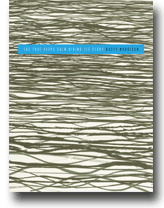
 The True Keeps Calms Biding Its Story is Rusty Morrison’s second book of poetry – also a book length conceit wherein every line ends with either “please,” “stop,” or “please advise.” Each “poem” consists of a trio of three line stanzas justified at the right (rather than the usual left) margins.
Normally, I would say that I am wary of book length conceits and themed books – though one of my favorite books is Charles Simic’s 1990 Pulitzer winning collection of dark prose poems, The World Doesn’t End and my favorite contemporary poet is Anne Carson, whose most famous collections – including Autobiography of Red and her most recent, Nox – are both thematic meditations governed by an overriding literary conceit.
So, my concerns are not borne out by my actual preferences.
Perhaps I am just mistrustful of a writer’s ability to maintain both that kind of abstract formal limitation and consistently high quality. Of course, could not the same question be asked of, say, rhyming poetry? And I do not often question Byron’s Childe Harold!
But to return to The True Keeps Calm Biding Its Story…
I enjoy poetry that consistently challenges the flow of my reading – that pulls me up short. Certainly, it can go too far and prevent me from truly enveloping myself in the reading process (I won’t name names here today – I come here to praise poets, not to bury them). Adrienne Rich’s habit of inserting extended gaps within lines is something I enjoy (and a tool I copied in much of my own poetry – with mixed success – in the early and mid nineties).
I would say that the way Morrison’s formal limitations break up the flow and interfere with the normal process of reading and interpretation lend added strength to the plaintive tone of the collection.
And plaintive is an appropriate tone – for the collection addresses the death of his father. Furthermore, the arrangement of the lines and stanzas self-consciously reflects telegraphs. By referencing obsolete technology, it reflects the passage of time and extinction implied in a father’s death. It also reflects that these are messages sent off into an unhearing void – there is no telegraph machine operating that can pick up the signal.
Perhaps because I was, like many sensitive, awkward adolescents, deeply occupied in my early years by Edgar Allan Poe, I feel a keen affinity toward poetry that reflects on death (though Poe’s own writings were, of course, far more lush, romantic and gothic than either Morrison’s or my own).
Incidentally, The True Calms Keeps Biding Its Story was the 2008 James Laughlin Award winner, handed out yearly to a poet’s second published book. Among the judges that year was the current poet of the hour (at least since Versedcame out), Rae Armantrout.
The True Calm Keeps Biding Its Story was published by Ahsahta Press, the university press of Boise State in Idaho. They are a small press that consistently publishes some of the best and most interesting poetry in America today.
 the coffee philosopher