Christopher Hitchens on Auden.
Though I shuddered to read him call Pound’s writings as ‘the sinister gibberish on the page.’
Christopher Hitchens on Auden.
Though I shuddered to read him call Pound’s writings as ‘the sinister gibberish on the page.’
This another Canto taking place in either the late eighteenth or early nineteenth century. I would hazard to say it is the eighteenth century.
I say this because if there is one thing Pound does well is capturing the style of that period. If you have done any reading of English letters from the seventeenth through the end of the eighteenth century, you’d see a unique style. Things like writings of Samuels Pepys and Johnson or of Lawrence Sterne’s comic masterpiece, The Life and Opinions of Tristram Shandy, Gentleman. The French have a wonderful term for the sort of shapeshifting, genre-less writings of the period: belles letres.
In terms of contemporaries, I think of the scene in Ulysses (the Scylla and Charybdis episode, I believe) when Stephen is drinking with the medical students and entire chapter progresses, stylistically, through the history of English literature, from the Anglo-Saxon through Middle English through Shakespeare through Dickens…
That same commitment to capturing the particular voice of periods in literature is something that Pound clearly shares.
Whereon said Lord Coke, speaking of Empson and Dudley,
the end of these two oppressors
shd/ deter others from committing the like
that they bring not in absolute and partial trials by direction
…by every legal measure, sirs, we recommend you…
At seventeen pages, this is a doozy.
It’s about the American Revolutionary War. Sort of.
This being Pound, it’s also about finance. But less banking than international trade. And international relations. But mainly as they relate to trade.
And mainly trade by sea.
Pound engages in one of his strategies of listmaking, as of lists that might be compiled by ‘characters’ in his Cantos, often written in a sort of short hand.
Benjamin Franklin appears prominently, but I think this has more to do with the prominence of France (Franklin having been ambassador to France on behalf of the Continental Congress) than of a particular focus on Franklin.
While writing about France, he even manages to toss in some ancient history:
Laws of the Visigoths and Justinian still in use in Galicia
(Yes, I know that Galicia is in Spain, but the references to Spain are made, so to speak, by ‘characters’ in France).
Another lengthy Canto.
This one is about the disputes leading up to the American Revolution, namely the Stamp Act.
He spends a lot of time complaining about taxes and regulations (keeping in mind that “strict regulations” in the eighteenth century allowed for things like slavery).
A reminder that though Pound may be most appreciated these days by liberal lovers of literature, he was, by contemporary standards, very conservative. Sort of a Grover Norquist/Tea Party Republican.
One amusing thing, at least for the modern reader, is Pound’s use of the word “bro” in the very first line of the Canto:
To John’s bro, a sheriff, we lay a kind word in passing
He also inserts himself into the action in an amusing fashion:
Upon which he offered me a retaining fee of one guinea
which I accepted
(Re which things was Hutchinson undoubtedly scro-
fulous ego scriptor cantilenae
(Ez. P)
Little did I know that Keats was born on Halloween.
The little used bookstore on Capitol Hill with the cranky owner sold me a marvelous little leather bound collection of his complete poetry, just the right size for a jacket pocket.
New Directions turned 75 years old last Friday!
In case you don’t know who they are, New Directions are they guys who keep modernist greats like Ezra Pound (including my Cantos), William Carlos Williams, and Marianne Moore in print.
 The Sixty-Third Canto, short though it is, confused me greatly.
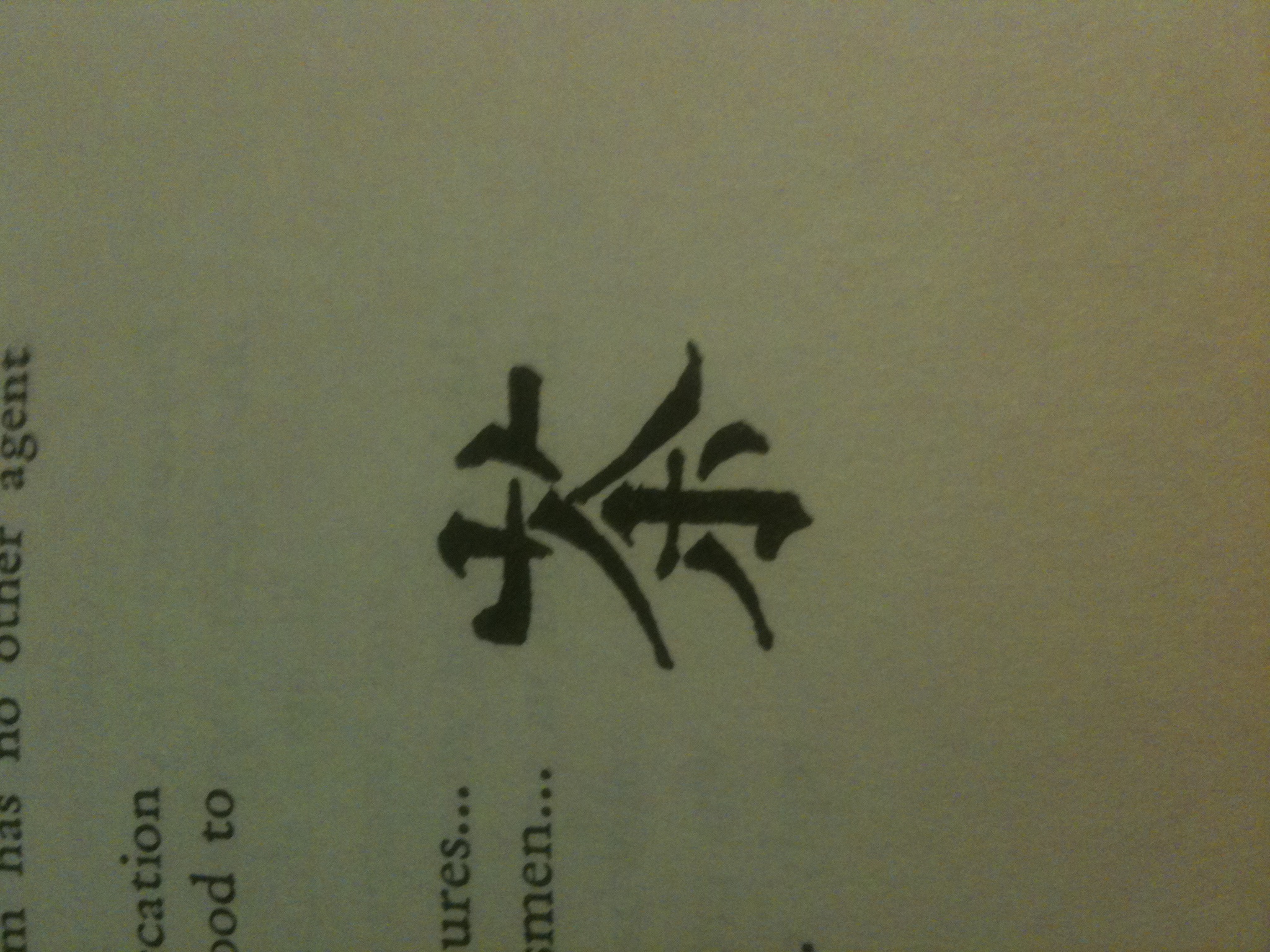
In the first place, we have abandoned China. Well, mostly. There is the Chinese character (pictured) which Pound inserts something less than 2/3 of the way into the Canto.
So far as I can tell, it is the diary or correspondence of a lawyer (that much is mentioned: …So that I/believe no lawyer ever did so much business/for so little profit as I did during the 17 years that I practiced) commenting on the various things he has read recently – from history to current news to literature.
Byron and Shakespeare are mentioned (Timon of Athens, specifically, in the latter case). Jefferson, Adams (pere et fils), Franklin.
I want to thank British poet Andrew Motion for making this point, that the dichotomy between literary quality and readability is almost entirely a false one.
War and Peace is not a good book because it’s beautifully written but well-night unreadable. No, it’s a damn fine read.
Even so-called difficult books, if well written, are also readable and enjoyable. In different ways than other books, perhaps, but then again, the best selling and very readable Guns, Germs and Steel is readable and enjoyable in a different than The Hobbit.
I’m not reading The Cantos because they’re boring and unreadable. Yes, they are often difficult, but it is not painful to have one’s view expanded and one’s mind challenged. Or rather, if it is, then you are a sad, sad person.
Great literature is great literature for many reasons, none of them are ‘unreadable’ nor ‘providing no pleasure in the reading of it.’
Here’s another bit of (not misplaced) grousing about the direction of the Man Booker Prize.
This Canto returns to the western world. Specifically, Revolutionary America.
It begins as if by a (presumably) pro-British governor, but the ‘narrator’ seems to change. This can only be determined by subject matter as the voice does not change much (though it does get colloquial in its spelling in parts).
 The subject matters moves to discussions of attempting to secure funding and support for the Revolution from various European powers, including the French and also Dutch banking houses. Surprisingly, he shows little venom towards those Amsterdam banks.
There is an odd lines: in consideration of endocrine human emotions
Correct me if I’m wrong, but I don’t think an 18th century speaker would even know of the endocrine system, much less of the affect of hormones and glands on human emotion.
An accident or a deliberate anachronism by Pound?
He also includes a Chinese character (see picture) near the beginning of this (fairly long) Canto. What does it mean? And what did Pound intend by including it, despite having left China, so to speak.
This Canto contains a lot of talk about taxation, something the finance obsessed Pound often harps on.
But a little more interesting to me is something briefly touched on in the last couple of Cantos – what one might call the ‘Christian problem’ (though Pound consistently spells it ‘Xtian’ in this Chinese themed sections).
‘You Christers wanna have foot on two boats
and when them boats pull apart
you will d/n well git a wettin’ ‘ said a court mandarin
tellin’ ’em.
 the coffee philosopher