Eliot & Coffee


Someone recently commented on an older post of mine about T.S. Eliot that they had found the post while searching for information about Eliot’s relationship to coffee.

I didn’t have a good answer for him.

But when I think of Eliot and coffee, I always drift to Love Song of J. Alfred Prufrock and the man who measures his life in ‘coffee spoons.’

Prufrock always seems to me to partake very strongly of Eliot’s Anglophilia. He is writing in a style to seems to aim for a certain English-ness in its language. But while the English do drink plenty of coffee, we can agree, surely, that tea is a much English drink.

The coffee spoons with which Prufrock measures his life with are an indication of his mundanity and his measured fears. But tea spoons or something associated with tea (sugar spoons?) would be much appropriate to this English style (not many American poems write about a being embarrassed by a footman holding one’s coat; that particular class consciousness sounds more like something from across the Atlantic to me). In that sense, in an English sense, might not coffee spoons stand out?

Maybe not. I’m just guessing. But I’m guessing that is a certain (essential?) American-ness showing through in Eliot, an American-ness we don’t really see again until Four Quartets.

I Am Killing The Art Of Writing Letters


Of course, I am writing this from that quintessentially sloppy and temporary platform, the blog, but I agree with this man that the death of longform letter writing is a tragedy.

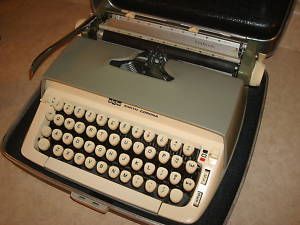
A while back, I was trying to write letters on my old-fashioned, manual typewriter (though that mournful essaying speaks of writing longhand).

But did I stick with it? No, I did not. I have hardly typed in a month. When I do, it is to get a better view of some poems I might be working on. Which is why I’m not using this post to pretend I will take an instrument that is mightier than the sword and swat the armies of ignorance. I will keep as I am and mourn uselessly for what has been lost.

Weekend Reading – School’s Out


Hopeful lines out of character for these downbeat poets.

What Albert Barnes actually wrote about modern art.

A new argument for hating Thomas Kinkade.

Midweek Staff Meeting – The Space Ether Will Give You The Power Of Flight


The (contested) evolution of English.

DC has the fifth best park system in America!

Science catching up with science fiction?

Tuesday Morning Staff Meeting – Writing For The Dead


The poetic chronicler of Montana’s graves.

Actually, if you think there’s a conspiracy, you’re deluded…

Why? Cheap rents and a weak currency, that’s why!

Critique Of The Collins Way


I am not a fan of Billy Collins. I have not been reticent about that. So that’s why I want to highlight this blog post by Elisa at The French Exit which provides a lovely critique of Collin’s poetic ideology.

I’ll let Elisa speak for herself.

I went to a reading and talk by Thomas Lux yesterday, and I was disappointed to hear him espousing Collinsian rhetoric (he actually name-checked Billy Collins) to the effect that poetry should be “accessible,” the poem should be “hospitable,” and even that difficult poetry is “rude.”

I don’t understand this mindset. It’s one thing to prefer a simple, straightforward, user-friendly, and personable poetics. It’s quite another to turn your tastes into an ideology, to frame accessibility as some kind of moral imperative. How exactly are we supposed to manage the arts so that everything is equally “accessible”? And isn’t “accessibility” almost entirely subjective, depending on one’s education, class, race, sex, culture, and so on, not intelligence per se? Accessibility, as far as I’m concerned, is racist (and sexist), because it’s defined so often by white men who assume that what is accessible to them is accessible to everyone. (Sorry to be picking on white men this week; fight racism with racism I guess.)

If you like “accessible” poetry (whatever that means to you), then write and read accessible poetry. But leave me my Stevens (not accessible at all), my Anne Carson, my Lyn Hejinian, my Kirsten Kaschock. You can have your Billy Collins.

Weekend Reading – The Reason For Poetry Is Hope


Ariana Reines reviewed.

Of what stuff books are made of.

Less than you might think.

An analysis of lyric poetry reveals hope.

Gary Snyder


The final reading of the Folger Shakespeare Library‘s 2011-2012 poetry series was Gary Snyder, the great, west coast poet of deep ecology. It took place last night.

He was an engaging reader and speaker when by himself on stage. Not powerfully so, but still significantly so. He has obviously led an interesting life (studying Zen Buddhism in Japan, serving on tramp steamers, reaching the summit of Mount Saint Helen the day that the atomic bomb was dropped on Hiroshima, and his relationship with various poets of the San Francisco Renaissance and the Beat writers).

In the past, I have described him as a Beat, though he was never part of the original group in New York, but only met them when they came out to San Francisco. Now, I would be more likely to relate his poetry with the man who introduced him to the Beats, Kenneth Rexroth, than with the Beats themselves. Like Rexroth, his poetry is more influenced by the restrained aspects of spiritualism, rather than the ecstatic ones.

As befits a poet associated with the deep ecology movement, his writing is very much grounded in the physical and the concrete. The realities of the natural world and the realities of living in the world.

One thing he said struck me. While living in Japan and studying meditation and Buddhism, he often used to visit an English language bookstore and buy books on ecology to read. Then, he pointed out, ecology was about the relationship of things to the natural world – which mainly meant how things ate each other. Only later, did it acquire the quasi-political/spiritual/activist meanings now associated with it. When one speaks of ecology now, one is generally making a statement about politics and society. Then, it was simply a branch of science.

During the Q&A, Snyder was very short with a young man who stood up and asked him to speak about Jack Kerouac’s novel, The Dharma Bums. The main character is generally considered to be based on Snyder and some of the events in the book based on some trips taken together by Snyder and Kerouac.

Snyder dismissed the whole line of thought, basically saying that Kerouac wrote fiction and Dharma Bums is novel. Not even one of Kerouac’s best novels (and Snyder’s tone implied he thought it not a very good novel). Then he said that someone always asks him about this and he’s tired of answering so that’s all he’s going to say. And that was how the Q&A ended.

The novel was clearly a touchstone for the young man – a way to keep a connection to the wilderness and the west coast while living her in DC – and I felt bad for him and for what was almost a public shaming by Snyder.

And let me say that I’m just glad that young men still read Kerouac. Whatever I may think of him as a writer, I think it will be sad day when young people stop indulging in old rebellions and stop reading Salinger, Kerouac, Ginsberg, Burroughs, and others when they are in their teens and twenties.

Whoever that young man was, kudos to him for finding meaning and solace in the turning to books.
Monday Morning Staff Meeting – The Golden Age


Is poetry really in another golden age?

The man, the myth, the critic!

Was she America’s first female public intellectual?

Sunday Book Review – Here Come The Italians!


A review of a collection of 20th century Italian poetry.

All the science fiction and fantasy book reviews you could desire.

Ex nihilo nihil fit.