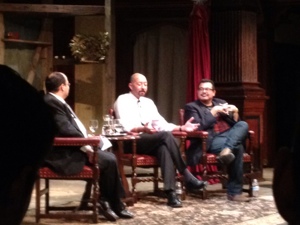
Poets Francisco Aragon, Carl Phillips & Eduardo Corral At The Folger Shakespeare Library


20120919-141913.jpg

Folger Poetry Series Kicks Off


Carl Phillips and Eduardo C. Corral kicked off the 2012-2013 O.B. Hardison Poetry Series at the Folger Shakespeare Library on Monday night. Phillips was the judge for the last Yale Series of Younger Poets and Corral was his chosen winner.

Corral was introduced, both by Phillips and by the program with some beautiful, haunting, and challenging lines from a poem in his debut collection. And it was all down hill from there. His poetry never hit those heights again, which is why I purchased a book by Phillips (I limit myself to buying just one book at these things, no matter how much I want to splurge; discipline, discipline).

Can I admit to being a bit hierachical? I found Corral to insufficiently respectful beside Phillips. Or maybe I found his efforts to portray himself as Phillips’ equal too forced and overdone. Corral may become a great poet. But he just published his first book and the man beside you has been there and done that, as it were.

During the question and answer portion, the last question came from a local poet, Sandra Beasley (well, sort of local; I suspect she doesn’t live in SE). She asked about how first books and publishing had changed.

I rather felt her question was more about the contest culture of getting first publication and perhaps the greater difficulties of the process now (but what the hell do I know? I’m inserting myself into the mind of a stranger; but she spoke like she’d memorized the question and seemed to orate as much as interrogate, which leads me to believe that there was some point in there that I don’t think was addressed). The answer given was actually about ‘project books,’ as both men called them – things like books about just one thing (fleas were mentioned – though Virgil wrote a poem of that title and Phillips did say he liked Virgil; also collections of just sonnets).

Many of Phillips’ poems spoke lovingly and elegically of sexual love and desire, frequently tinged with memories of when sex and love between men was more verboten than it is now. His known for the influence of Greek and Roman literature on his work (though he dismissed that being overemphasized; he also said that, excepting The Iliad, he didn’t much like classical poetry, but preferred to read the great orators, like Cicero and Quintulian) and of the two books available (the other being Double Shadow), I made my selection because Speak Low featured more poems the explicitly referenced the classics.

When I asked Phillips to sign my book, he was extremely personable and reached out to me (I tend to be a pretty basic, ‘here’s my book’ kind of guy when it comes to getting autographs) and spoke for a bit. Certainly, I can see him as very generous teacher in many respects (he does teach university).
Book Reviews


The nature of book reviews has become rather controversial lately. Especially as high profile book reviews, in magazines and newspapers, have become more precious as newspapers and magazines reduce or eliminate the amount of space given to books. One question is: should one be critical? Not critical in the sense of critical thinking, rather, in the sense of writing negative things about a book. This is an especially poignant questions when it comes to poetry. With so little space left (and please, let’s not count blogs like this one – they are no substitute for the Sunday book reviews that your local newspaper hopefully still includes), is writing about a book we don’t like worthwhile? Or should we focus on book reviewing as promoting quality books? But even when writing online, if we truly care about book culture and poetry culture, does writing harsh reviews hurt it, but making it seem less worthwhile, or support it by building an honest dialogue and culture of critical thought? It’s easy to take the high road and say, the latter, of course. But it is true that literary culture is suffering from a debilitating sickness, I think. And if it is, does the latter actually speed its sickness towards a nasty end?

Below are some articles and arguments on this subject:

Against Enthusiam

Some Notes Against Enthusiasm

In Celebration of Enthusiasm

Has Twitter Made Book Reviewers Too Nice?

Arthur Krystal: The Excuses of a Mean Book Critic

A Critic’s Case for Critics Who Are Actually Critical

Is This Book Bad, Or Is It Just Me? The Anatomy of Book Reviews

How Is the Critic Free?

Nice Book Reviews

How to Be a Critic

A Failure in Four Parts

Poetry Currents


Is Free Verse Killing Poetry? (I don’t think so)

Has Poetry Changed? (I certainly hope so – change is part of life)

What Are Poets For? (I don’t know… poetry, maybe?)

Ted Joans Lives! (The Movie)


Possession


I know that there is a movie out there by the same name, but I’m actually talking about the A.S. Byatt novel.

Despite it’s good reviews, I resisted the novel on account of having been young (sixteen or seventeen) when it came out and it also seeming like too much of a ‘chick novel’ (I was more into The Three Musketeers and manly womanizers like Albert Camus).

I can’t even remember where I finally picked up Possession. It was somewhere ’round here and it was used. I think maybe I grabbed it from a box of free books on the sidewalk outside someone’s house. I started it, put it down, and was inspired by an NPR story to pick it back up again, though enough time had passed that I had to start over again.

The ending was necessarily anti-climatic (and the little grave digging bit seemed like a irritating action sequence that was mostly there to sloppily tie up some loose threads) after the breathless archival discoveries and literary sleuthing of the first half, but it was still marvelously put together. The distance from which the characters is interesting, with only Roland Mitchell (who is a sort of hapless hero) getting much interior description of his thoughts.

The dynamic between the characters – specifically the modern day (romantic?) leads and the Victorian (definitely) romantic leads – is interesting. The romance between the Victorian poets is certainly more fiery and more passionate than the tentative one between the contemporary literary scholars, but in each case, the female is the dominant figure in the relationship. In the Victorian case, it is because she is a simply a more powerful figure (the male poet, modeled, I gather, on Robert Browning, writes narrative poetry that deliberately sublimates his own personality into characters and historical figures). In the modern world, it is because the woman is more financially secure and, more importantly, a more prominent and (it is bluntly implied) all around better scholar. I even got the impression that she (I should give her name – the modern scholar is Maud Bailey) likes that he (Roland Mitchell) is passive and her professional inferior.

Good book. Worth reading. Worth reading again. And skip the movie. It’s okay, but only okay. And Roland Mitchell is transformed from hapless (and English) academic hack into a blonde, muscular American who manages to find at least one excuse to take his shirt off (no disrespect intended to Aaron Eckhart, an actor I have liked since the nastily mean-spirited Your Friends and Neighbors).

Black Poets Anthology Turns A Prisoner Into A Poet


That title, by the way, is entirely too facile.

Nonetheless.

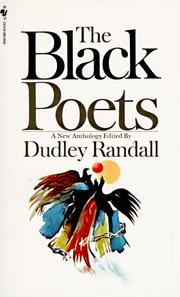
In this interview, the poet Reginald Dwayne Betts speaks about being in prison and screaming for someone to toss him a book and another inmate slipped him a copy of the Dudley Randall edited anthology, Black  Poets. Which is the same book that I found at Biblion in Lewes, Delaware and that introduced me to the excellent poet, Frank Horne.

Of course, I encountered this book during a time in a my life I had a decent job and was walking around a wealthy, beach front enclave and was in the company of loved ones. So any comparison breaks down pretty quickly, ’cause I’ve had it pretty good, all in all.

But I’m pleased to see that book having such effects on people.

Thursday Morning Staff Meeting – Do People Still Do That?


Review poetry, that is.

Day one.

Angkarn Kalayanapong has left the building.

Midweek Staff Meeting – Is The Economist Any Good?


Ralph Fiennes reads a poem by Vladimir Nabokov. That’s just awesome.

I’m still not sure if it’s actually worth reading The Economist.

Nantes is the new New York.

Tuesday Morning Staff Meeting – Oh The Places You’ll Go


Vogue now reviews poetry?

Flea markets – now serving poetry.

You would be lucky to be a failed poet.