Pound Is Dead


I can’t believe I forgot. This day in 1972, Ezra Pound died. God rest his soul.

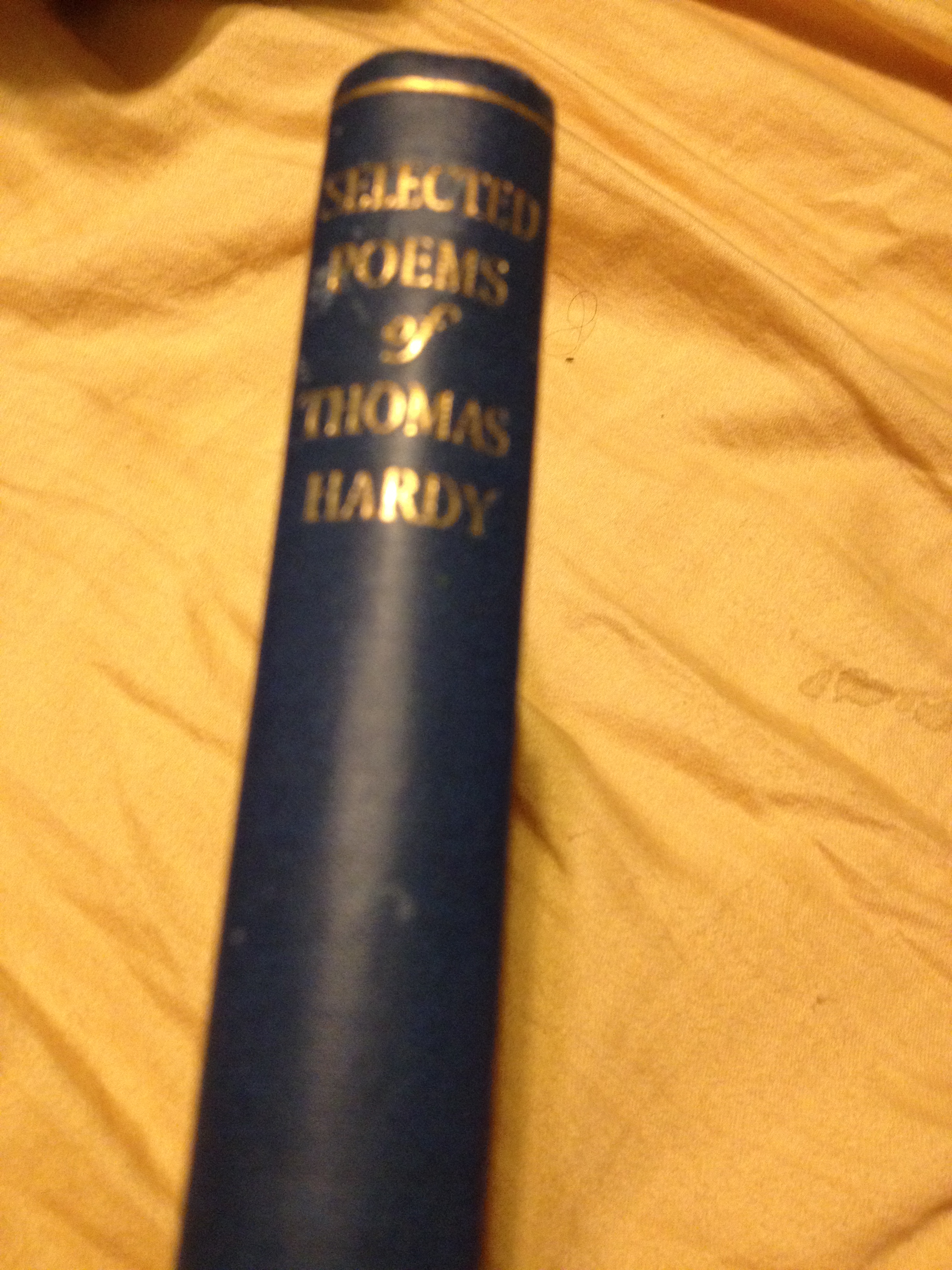
Selected Poems Of Thomas Hardy


For some reason, they made us read several books by Thomas Hardy when I was in high school. Jude the Obscure, The Mayor of Casterbridge, and Tess of the d’Urbervilles. The first was unrelentingly depressing. The second I can’t even remember (some dude some sells his wife and kid to some sailor who turns out to be a good guy; some dude feels bad, stops drinking, becomes upstanding citizen and titular mayor; wife and kids move to Casterbridge and hilarity ensues; did I say ‘hilarity?’ I’m sorry, I mean hundreds of pages of unrelentingly depressing prose). The third had one really good scene: when the whiny b—h Tess got herself hanged at the end. I liked that part, but the rest had a lot of depressing pages where you were in the presence of the supremely irritating Tess.

So, is it a wonder that I did not go out of my way to read anything that came out of the suicidally bleak and muddy mind of Hardy?

Hell no. It’s a miracle that I’m still willing to read the English language after the kind of torture put together by whatever moron came up that high school English curriculum (I mean, folks, what about including some swashbucklers or romances instead, like the novels of Dumas or Austen? something that won’t encourage teenagers to put down books… forever).

But, I kept running into references to Hardy’s poetry.

So I finally bought some.

Like his prose, it’s muddy, mournful, and parochial, but the compact nature of a poem compared to a muddy doorstop of a book makes a huge difference. Formally, he is very old fashioned compared to what others poets were doing in the late nineteenth and early twentieth century, but even that reinforces his depictions of these rural communities, which are necessarily behind the times.

His focus (obsession) was the dirty, rural lower classes who failed to live up to supposed Victorian ideals. By which I mean a lot of unwed pregnancies and more than a few abortions (generally by use of folkloric abortifacients and rarely very successful). It’s all very slow and mournful. Elegiac, even. He is writing about a lost, or at least dying, culture. He doesn’t pretend it’s a great culture, only that, like anything that is passing, deserves remembrances. In later poems, you can feel Hardy, who still comes across as more of a nineteenth century writer, feel left behind by the approach of modernity and the very different ravages of the Great War.

Midweek Staff Meeting – A Poet’s History


The great broken menhir of Locmariaker, with Cæsar’s table

Gary Snyder through the years.

Canadian poets have not died out (yet).

A travel book about Brooklyn lit (not really, but kind of).

Cool megalithic stuff. I’m serious.

Happy Birthday, Virgil


The poet who brought us The Flea and Georgics would have been 2082 today.

Your Monthly Dose Of Seth Abramson’s Quiveringly Praiseful & Profoundly, Verbosely, & Gushingly Erudited Reviews Of Recent Books Of Poetry Published By Various Doughty Vanguards Of Our Stupendous Poetical Culture


Yes, he’s irritating. But not many reviews of poetry are being published these days in, you know, places people can see them.

So here you are – http://www.huffingtonpost.com/seth-abramson/september-2012-contempora_b_1923827.html

For something a little more fun to read (though still a bit overdone), check out these reviews (also in the HuffPo) of books by San Francisco poets.

American Hybrid (Belatedly) Reviewed (But Not By Me)


This is somewhat belated (I think the book came out in 2010) review of American Hybrid, a poetry anthology of ‘hybrid’ poetry widely viewed as being both a good start towards chronicling the dominant form of American poetry right, and also as being not really successful.

Peter Riley, the reviewer, takes some umbrage at how contemporary British poetry is (in his eyes) ignored and belittled (which is too bad, because I am now convinced that greatest experimental poet since Ashberry in the 50s and 60s is Cambridge’s J.H. Prynne).

I mostly just want to give Riley credit for this line:

There is an imbalance because it is assumed that there is an avant-garde, which there isn’t, and that there is an enemy conservative poetry of equal weight, which there isn’t either.

The review is interesting and isn’t really about American Hybrid and ranges over subjects like the much discussed proliferation of MFA programs and the now insidious/dominant MFA style (apparently, they just don’t have that many MFA programs for poets over there, so this strange, cloistered poetic-industrial-academic complex doesn’t really exist over there) and how experimental poets in America, even when they meet counterparts on the British Isles, have little interest in what their UK cousins are doing, and how American Hybrid compares poorly to the canonical New American Poetry: 1945-1960.

The Integral


Just wanted to draw some attention to this very cool article about Lous Zukofsky’s use of the integral in his poetry.

A few weeks ago, I started his very long poem/book length sequence “A” and it’s great reading.

Sean Connery Reads C.P. Cavafy


Intellectuals & Artists In Politics


The role of artists and intellectuals in political resistance is a well documented and generally well respected modern and contemporary feature, but their role in actual governance has been littered with failure and ignorance.

Up until fairly recently, art and intellectuals were primary supported by (or actually part of, by way of birth) the governing class, which placed them in a different role vis a vis politics.

But at least since the Romantic period, certainly artists and also, to a great extent, I think, intellectuals have been put into a role as outsiders.

This is all about Ezra Pound and what to do with him. Because that question never goes away, does it?

I was reading this article about Pound’s relationship with Mussolini and the impression is that Pound was roundly duped by Il Duce.

Listen to this comment by Mussolini’s aide:

This is an eccentric proposal thought by a foggy mind lacking any inkling of reality. Keeping in mind the affection Pound has for Italy and the enthusiasm that motivates him, it is sufficient to let him know that his interesting proposal is being studied…

Pound as a stupid little man, tossed meaningless sops to keep him happy with being effectively ignored so he could be blithely trotted out as a meagre tool of propaganda when time permitted.

The great genius… reduced to so little.