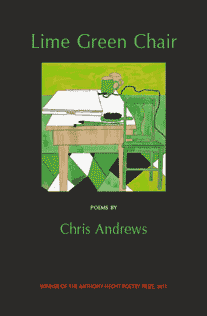
Lime Green Chair


The second line of the first poem (The Mist Lifts) indulges in the words ‘higgeldy-piggeldy.’

That’s an expression of whimsy, but a special kind of whimsy.

A sing-song mood of dark, Dickensian whimsy (think of the lingering descriptions of the yellow fog from the opening passages of Bleak House).

Even though the poems make frequent use of surrealistic association games, their influence is kept low key and does not interfere with the anachronistic avalanche of faint and constant archaicisms (see what I did there? that’s called ‘alliteration’).

The book is divided into three parts and part I and II are by far the best, because they make use of a sonnet-like form. While not rhymed (at least, not in any traditional sense), they have a musicality and the use of a thirteen line and then and eight line stanza clearly references the sonnet.

The middle section consists of longer poems, each longer than a page and most running on for three pages or more. They are broken up into stanzas, but the music is diminished by the lack of order the sonnet-esque form imposed.

But the stuff that works… really works. I saw last year’s winner, too, and was singularly unimpressed. Not so this year. Andrews is someone whose second collection I would buy, no question, just to see what he does next.

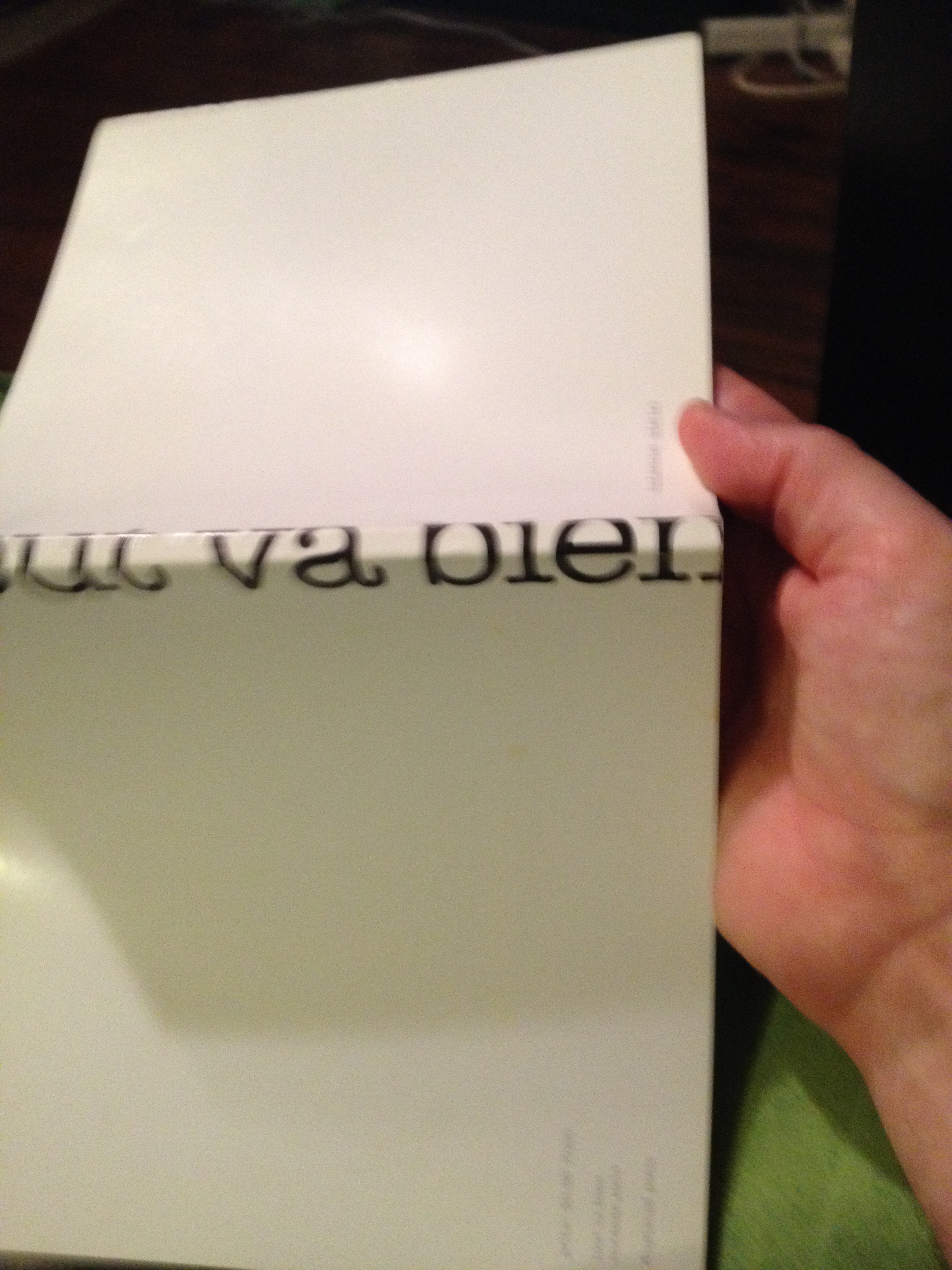
TOUT VA BIEN by Suzanne Stein – TOUT VA BIEN


The third section of TOUT VA BIEN is also called TOUT VA BIEN.

To be quite frank, it’s less interesting than the first two sections. It opens with some prose (I wouldn’t call them prose poems, just prose) and then movies onto some conceptual poetry about conceptual poetry. Which I don’t object to in general, but everything rather reads like a lesser version of Vanessa Place’s much talked about little blue book, Notes on Conceptualisms.

The writing is good, but if I’m honest, reading this section didn’t make me want to read more Stein, it made me want to go back and re-read Notes on Conceptualisms.

Weekend Reading – Political Geography


‘War is God’s way of teaching Americans geography.’ – Ambrose Bierce

Notes on Solon

Poetry calls to us, like wild geese

Did a collector of Symbolist paintings orchestrate this museum heist?

Not very, I hope.

TOUT VA BIEN by Suzanne Stein – FUGITIVE STATE


The second part of TOUT VA BIEN is entitled FUGITIVE STATE and is a more traditional poetic form.

Actually, the first page and a half consists of three line stanzas, with relatively lengthy lines, focusing on forms and framework and things that limit. It’s all very good and I wish she’d kept it up. Not that the rest of FUGITIVE STATE isn’t good, it just isn’t as good. The changing formal nature (shorter lines, longer and shorter stanzas, prose poem paragraphs) doesn’t add anything for me. Partly, this is because I was so wrapped up in that initial bit that the shift was disappointing for me. It’s like reading a novel and discovering that the guy you really liked at the beginning is not actually the main character. Sure, maybe you’ll like the rest of the book and this new, real protagonist, but you were really into that first guy.

The focus also shifts to identity. Now, that’s a complete break, because, after all, isn’t identity a limiting agent? And Stein definitely explores that, but also gets into the meaningless of identity (the repetition of a line about an ‘anti-terrorist’ who is financed by terrorists), but that subject is a little worn over for me. She does take it over to the subject of political alienation (as you can guess by the ‘anti-terrorist’ bit).

I should note that she does go back into (mostly) using the long lined, three line stanza structure, but even then, it’s broken up with other forms and the spell (a repetitive spell that brings attention to form) is broken (though breaking the spell also brings attention to the form), or leastways it was for me.

Stein also has tendency to let cool sounding phrases take the place of lines and stanzas that actual move the poetic project forward.

I was an American correspondent in America, who could no longer correspond to anything…

I don’t know. Too me, that’s cool thing said in a coffee house to a friend after too much coffee and collegiate philosophizing (or after too much time in the bar after too much alcohol and barfly philosophizing). Not so sure it belongs in a work of poetic creation.

But credit where credit is due. The ending, the final page of FUGITIVE STATE is magnificent and could stand as a fine poem in its own right:

so How long until How make long the lost bucolic?
there’s a descriptive act and a de-descriptive act
surface-oriented slippage I wanted to Ask
internal Organ failure internally
accurate and externally Sordid
as gestures that aren’t That didn’t
make
I wanted to Make
it was building it was irreparable
taken    apart    Under    Accidentally    Right    on    Target
with the script flipped I once               there was
Absolution, once        Have you taken stock of your Conduct?
The crowds inside, or the Trap as, we were well before
the fact
Desire’s a Tool to put to use I wanted to

That’s a great bit, and also crystallized for me the implicity touches from Gilles Deleuze and Felix Guatari’s book, Anti-Oedipus, with its ‘bodies without organs’ and ‘desiring machines.’

Speaking of which, did you know that Anti-Oedipus is now being published by the Penguin Classics imprint? Seriously. I feel old.
Midweek Staff Meeting – Take That ‘Don’t Be Evil’ Thing More Seriously, Will You?


Someone’s gotta stand up to bullies.

Places. Public. Private.

A history of poets in schools.

TOUT VA BIEN By Suzanne Stein – HOLE IN SPACE


I’m going to try to do a close reading of Suzanne Stein’s . I can’t remember where I got this – I think it came with something I ordered (TOUT VA BIEN has only been given away, rather than sold).

It’s divided into several sections, the first of which is HOLE IN SPACE.

HOLE IN SPACE is the transcript of Suzanne Stein speaking extemporaneously at St Mark’s Poetry Project in 2008. ‘Hole’ is apt, because a significant portion of the text are ellipses and ‘um’ or ‘uhhh’ – each of those being a ‘hole’ in speech. On the other side of things, it’s hard to see much else. I just read it and I can barely remember what it was about (which is primarily a discussion of space and place – how the internet has changed the sense of place, what site-specific work would/should look like in the current environment; which presents a contrast to the title, which translated means, ‘it’s going well;’ while that’s just a colloquial phrase for ‘things are okay,’ looking closely, it does use ‘va’ or ‘goes;’ motion in the title, but the first section is about not about ‘going’ or motion, but about mindfulness of place).

The effect is very similar to some of the works of Kenneth Goldsmith. Like his complete transcription of single issue of the New York Times or his transcription of a year’s worth of traffic reports or his transcription of a year’s worth of weather reports, HOLE IN SPACE encourages a center mindfulness, if one is willing to enter an empty, meditative state. However, that effect is not to make one aware of ostensible meaning. Reading Goldsmith’s transcription does not give one greater understanding of the meaning of that day’s New York Times, but rather of words and repetitions without meaning. Free from connection to literal meaning, it takes lectio divina another level. Which is why I struggled to remember the meaning of the talk she was giving, but remember very clearly the holes in the transcribed language. Looking for meaning between the words and sentences of language rather than within the words and sentences in language.

Tuesday Morning Staff Meeting – Whistle While You Work


Are readers & publishers whistling past their graveyard?

The women of Poetry.

Buffalo honors Di Prima.

Weekend Reading – Presidential Poets


It’s like pairing wine and cheese, only it’s presidents and poets.

This happened. That’s right, a ‘poetry boulder’ was dropped by helicopter near Stratford-upon-Avon (Shakespeare’s home, in case you didn’t already know).

Last, major, independent Canadian book publisher goes into bankruptcy.

But nobody panic.

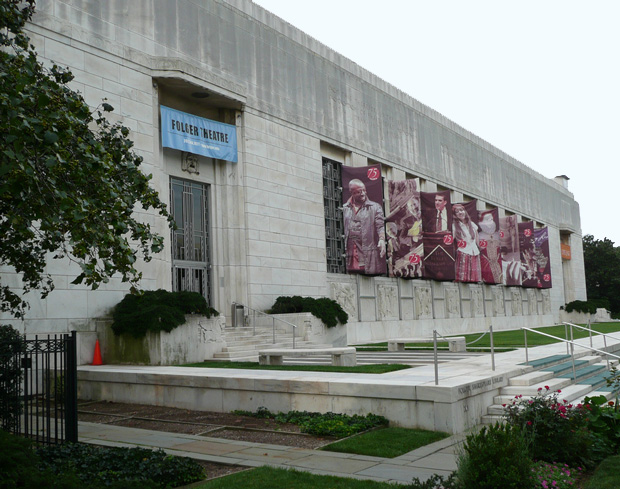
Chris Andrews & Mark Strand At The Folger


The most recent winner of the Anthony Hecht Poetry Prize (given to a manuscript of what would be a poet’s first or second collection) is an Australian poet named Chris Andrews.

Andrews and the judge who picked him, Mark Strand, read their work at the Folger Shakespeare Library on Monday night (November 19th).

Mark Strand is not a poet I’ve read much. I don’t own any of his collections and have only read a handful of his poems in some lit mags (mainly Poetry).

Andrews, naturally, was not a poet I had read at all previous to that night.

Usually, I like to get in a little early, go to the gift shop, where they stock the available books by the featured authors, and take a look at what’s available and see which one I want. That way, I avoid the ugly line at the table they set up after the reading and don’t have to wait in line for thirty minutes to get my book signed.

For various reasons (involving a bottle of twelve year old bourbon of which I drank not a drop), I arrived at the Folger Shakespeare Library pretty close to the wire. What with there being a line to pick up my will call ticket, I was feeling a little time sensitive when I ran into the shop.

I decided to pick up Chris Andrews’ Hecht Prize-winning first book, Lime Green Chair. Mainly because I didn’t have strong feeling towards Strand (actually, I briefly confused him with Mark Doty, who have some mistrust towards because I found the Best American Poetry of [Whichever Freaking Year It Was] that he edited to be less than inspiring) and figured it was better to put my money in the hands of a new(er) poet.

Both men were good readers, though in different ways.

Andrews spent less time in chit chat than any other poet so far this year. He very nearly dove straight in and read with a quiet, but compelling voice and diction that caught a musicality in his work that I had missed when glancing through it in my seat. I seemed to catch flutterings of slant rhymes within the lines (more than half the collection consisted of unrhymed, sonnet-like pieces with a first stanza of thirteen lines and an eight line second stanza).

Strand sometimes stumbled over the words, but projected an experienced (and gently dirty-minded) humor as he mostly read from a collection of prose poems.

Probably the best combination of quality poems and quality reading since Theo Dorgan and Paula Meehan read there more than a year ago.

Anyway, I’m nearly done reading Lime Green Chair and I’ll write about it after I’ve had a chance to digest it a bit more.

A Poet’s Guide To Public Transportation


Ten rules for riding public transportation from a poet.

I can enthusiastically support the first four, at least. Some of the latter ones are a mixture of illegal (at least in DC) and too England-centric.