 Vocabulary is the secret to success.
The Sunday Paper – Roman A Clef
The Chief Glory Of Every People Arises From Its Authors
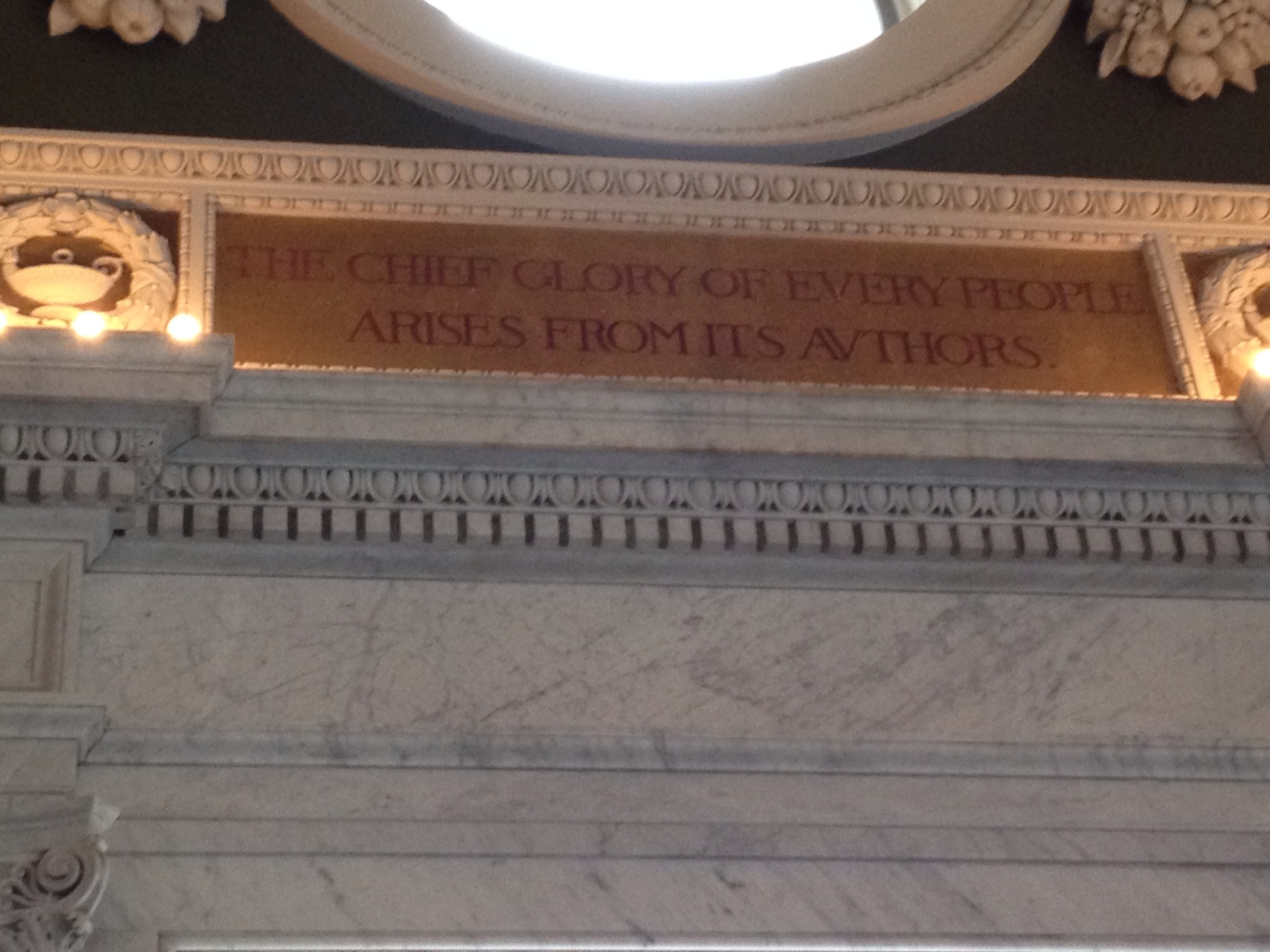 What a marvelous sentiment!
‘The chief glory of every people arises from its authors.’
I took this picture while visiting the Jefferson building of the Library of Congress with my better half’s father.
Is it true?
In a thousand years, will people remember George W. Bush? Steve Jobs?
Or will they remember Mark Twain?
The glory of Greece and Rome is as much in Homer, Cicero, Plato, and the idea of a Republic and Democracy as it in roads, aqueducts, and temples, however glorious.
It Could Have Been Different
Maybe if San Francisco had named their team after an American literary icon instead of an era of rampant greed and pillaging of the land, things might have gone differently.
The San Francisco Beats, perhaps?
A Writer’s Life
I have been lucky. I have been able to make my love words part of how I make my living. My ability to use programs like InDesign and to remove paper jams from deep in the printer have probably been equally important, but let’s not harsh my vibe.
One of my nieces wants to be writer. She’s interning at a magazine right now. While I could write a lot about the problem with internships (not only are most internships in flagrant violation of U.S. labor laws [if the internship is unpaid and the intern is doing actual work, that’s wage theft and it’s illegal], as well as creating a economic caste system that disproportionately benefits young people whose parents can afford to underwrite almost all their child’s living expenses during the term of the internship), I actually started thinking about here when I read this quote from Eileen Myles, who is an amazing poet, as well as a cultural commentator:
Look beneath the surface, and it’s not an optimistic take. Beneath the faith that society will learn to value its writers, it’s not a long dig below the permafrost to find the fear that society will not.
How many ways will remain for my niece and which things she carries will she have to sacrifice to achieve even Myles’ hard life?
Poet’s Corner
 Reading this little bit about the demise of Edmund Spenser pulled me up short when I came across the phrase ‘Poet’s Corner.’
Of course, this is a corner where poets are buried, rather than where they are honored when they are alive. But what a beautiful idea. Why doesn’t our nation’s capital have a poet’s corner where poet’s can speak truth and beauty.
Charles Wright, Upon Learning He Had Won The Bollingen Prize
‘I always fantasized about winning the Bollingen Prize because it’s the only prize Pound ever won.’
Don’t Be A Hater
I probably should have said, “don’t be an a–.”
My own, local Washington Post published itself an asinine and irritating little piece on poetry. I was seething. Luckily, someone else responded more productively than I could manage:
From coldfrontmag.com/news/open-letter-to-alexandra-petri
I hope you’ll click on it and read the whole thing.
Ashberry’s Rimbaud (New Year’s Resolution, Book Four)
 I’m always pleased to see a book of poetry penetrate public consciousness, even if it’s only the latest saccharine desert from Billy Collins or (worse – much, much worse) a collection by Jewel (I’m not universally condemning celebrity collections, mainly because I am curious about James Franco’s new chapbook).
John Ashberry’s translations of Arthur Rimbaud’s Illuminations seemed to make that leap (translations seem to do better; I recall Pinsky’s translation of The Inferno and Heaney’s Beowulf similarly succeeding).
You can clearly see how Rimbaud’s final work would appeal to Ashberry. The poetic connections Rimbaud makes are a nice, fairly direct line to Ashberry’s wild, imaginative urban musings. And, more generally, isn’t Rimbaud also the quintessential beautiful young poet? You don’t have to be a gay man to have a crush on a figure like that (heaven knows, when we were all playing at being subversive poets in high school, we had crushes on him – crushes that in no way interfered with a straight teenage boy’s indefatigable skirt chasing).
Rimbaud, of course, wrote prose poems and Ashberry loves enjambment and sometimes I feel like Ashberry struggles with knowing how he should think about that. Or am I projecting something? I know little about Ashberry beyond a few favorite books and could easily be mistaken in this, which is only a feeling anyway, because, if I tried to explain it further, how would I put into words that struggle? After all, the line ends where the line ends, right? Not much room for translator innovation unless one were to decide to just throw away part of what’s on the page.
While Illuminations is not Fleurs de Mal and Rimbaud no Baudelaire, I sometimes get a tickle at the back of my brain, a voice asking if Rimbaud has been neutered somewhat? Gentled slightly? Of course, this is where the sad level of my French is frustrating that I can’t be sure of anything.
And there is a ‘but.’
But, Ashberry is certainly capturing the oft ignored delicacy that is also part of Rimbaud’s poetry. It is easy to get caught up in the idea of Rimbaud, l’enfant terible. But that idea almost always comes at the expense of Rimbaud, the actual poet (in fact, I suspect it has more to do with the Thewlis/DiCaprio movie, Total Eclipse, than it ever had with people reading his poetry). Here is where you can see the particular genius of Ashberry’s choice to translate Illuminations.
Another thing that Ashberry does very well is getting across that wonderful cocktail of the urban and rural environments that suffuses Illuminations. Ashberry is so deeply connected to the biggest urban environment in America, New York City, that it was surprising to see his deft touch here.
He does an amazing job of bringing out the simplicity of Illuminations, somehow finding simply constructed words and phrasings, avoiding falling into the trap of baroque language. Which isn’t to say that Ashberry can’t get a little cute, but it’s not a major quibble, though I do wonder why he translated ‘vagabonds‘ as ‘drifters.’ It seems an unnecessary insertion of the translator into the translation.
I hadn’t read Rimbaud in years. Maybe a decade. I don’t necessarily keep perfect track of these things.
As I noted earlier, it’s easy to confuse the idea of Rimbaud with the poet himself. Illuminations is not Baudelaire. And understanding that also let me see a truer line between the two iconic/iconoclastic French fathers of modernism. Baudelaire, formally, was not very daring. Rimbaud is (though he didn’t invent the prose poem), but lacks the great boiling anger of his predecessor.

 the coffee philosopher