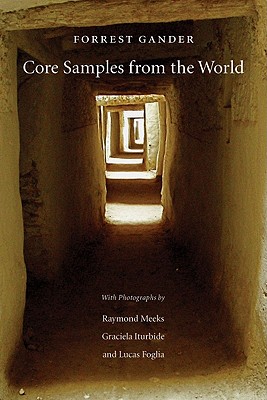
 Core Samples from the World is a beautiful and disquieting book, though not always disquieting in a good way.
As part of the Folger’s poetry series, Forrest Gander read at the Philips Collection, against the backdrop of an exhibition of works by Jean Dubuffet, Alfonso Ossorio, and Jackson Pollock.
The exhibition itself was very good, though most of the Dubuffet’s and Pollock’s I had seen elsewhere. Ossorio was new to me, so kept my attention much more strongly and moved me much more deeply. His merging of a unsettling passions, representation, anti-representation, and a deeply conflicted faith is wonderful to behold.
Forrest Gander is a poet I had been meaning to read and I’m glad for the excuse. He read not just against intellectual backdrop of the exhibition, but also against the very real backdrop of projections of various works from the exhibit. For each slide, he read a poem he felt was in correspondence with the work.
Unfortunately, Gander’s poetry and the work of the three artists demand close attention and my ability to appreciate both the poems and the art were diminished by split attention. Frankly, I was barely listening to the poems by the end. Which is too bad, because he’s an excellent poet.
Local poet, Sandra Beasley, moderated the discussion. I like some of her work and she’s clearly knowledgeable, but she talked too much. By which I mean to say, when the questions you are asking, in a public discussion like this, are longer than the answers you’re getting, it’s time to think up better ways of the asking the questions. She also brought up that Gander is a relationship with another man. The context was a question about living with another artist, but the fact of his sexual orientation was somewhat awkwardly inserted and the way he dodged around the question suggested to me that he wasn’t very glad that part of his life was brought up.
But on to Core Samples from the World!
The poems are interspersed and, to some extent, done in correspondence with photographs by Raymond Meeks, Graciela Iturbide, and Lucas Foglia. Of the three, only Iturbide was familiar to me.
The good stuff. Gander’s a good poet. Some gorgeous turns of phrase: stopless winds or A butcher draws his blade against the plush throat of a goat
Read that last one again. The interior rhyme (it’s from a prose poem section) of ‘throat’ and ‘goat’ and strange, beautiful insertion of ‘plush.’ Great stuff, eh?
And in the third section, there’s a long series of prose poems about a trip to Bosnia-Herzegovina. It’s hard to explain, but it’s magical. I rather thing that he does so well here because it’s about a more purely western culture (though eastern Europe).
Finally, it ends with one of the best descriptions of the feeling of being drunk you’re likely to find outside of a Kingsley Amis novel.
But…
A lot of ‘buts.’
Gander is a very, very good poet. This is not a very good book.
It feels unsettlingly paternalistic. The poems a somewhat narrative, world-wearingly detailing his trips to writers’ conferences in places like China and Mexico (it can read like a melancholy, non-hyper Tom Friedman who has actually learned to write – not just poetry, but anything). He interrupts ‘his’ poetry with sing-song three lines stanzas that read like mediocre translations from Tu Fu, but which are clearly intended to be the voice of these strange, foreigners he meets. And in combination with some photos that resemble a bit of poverty porn (though not all – and in the middle is strange photograph of young, blonde dressed like an extra from a Raquel Welch movie about dinosaurs, only one of her tastefully nipple covering furs is actually a fox stole; go figure).
I almost feel like ripping out the photographs and forcing myself to read each section of the longer poems out of context, away from each other, just to enjoy the language and skill. But I can’t, can I? I can’t separate it, can I?


 the coffee philosopher