‘Apollinaire: Selected Poems’


Let’s just put one thing out there: I’ve always loved surrealist poetry. Eluard, Char, Desnos. Awesome. All of them.

Apollinaire, though maybe not a surrealist, or perhaps proto-surrealist, shares one thing with all those poets I mentioned: he is very readable.

Surrealist poetry gets a bad reputation (Real surrealist poetry. The classics. Couldn’t tell you why. It’s classified as something difficult and weird, but while it contains some interesting leaps, it’s almost invariably a far less taxing read than Eliot or Frost [who has undeserved reputation for being easy to read; he’s only easy if you don’t bother to understand him, for example, Road Not Taken is about the lies you tell people to explain your past decisions; there, I’ve said; it has nothing to do with being different or taking a less traveled road because you’re awesome and unique – and do you know why? BECAUSE BOTH ROADS LOOKED EXACTLY THE SAME! THERE WAS NO ‘ROAD LESS TRAVELED’ SO STOP READING THAT POEM AS SOME SORT OF PAEAN TO BEING INDIVIDUALISTIC BECAUSE IT’S ACTUALLY A PAEAN TO LYING TO YOUR GRANDKIDS ABOUT WHY YOU DIDN’T TAKE THAT JOB IN BILL GATES’ GARAGE IN NINETEEN SEVENTY-NINE AND INSTEAD KEPT YOUR GOOD JOB AT THE FACTORY THAT MANUFACTURED WALKMAN PORTABLE TAPE PLAYERS]).

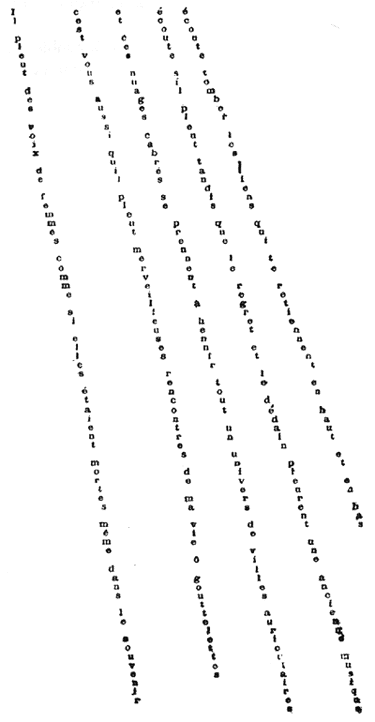
His visual poems or typographic poems, where the words on the page and the image they create (as in resembling rain falling from the sky in Pleut) can be difficult far the impossibly far from fluent French reader (like myself) to fully appreciate on the page. The strategy of simply writing the translation on the opposite page, exempt from the visual structure, was probably the best solution, but not really satisfactory. You know what I’d love to see? A big art work, like painting, of those poems. Go full out VisPo.

apollinaire-rain


Weekend Reading – Patriotic Edition


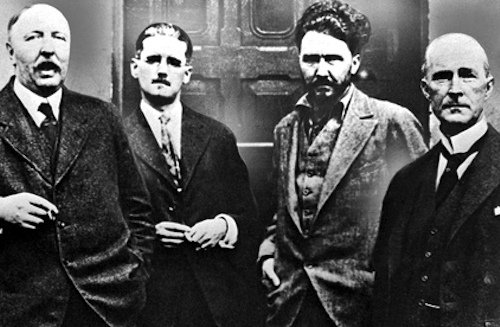
500x327xFrom-left-Ford-Madox-Ford-009_jpg_pagespeed_ic_LzJe_rwvBb
Doesn’t Ezra Pound (third from the left) look badass in this picture?

You’re darn right, it’s vital!

Take back the word.

It forgot to add that David Brooks is a monumental douche.

Lost classics of literary criticism.

‘Careless Rambles’ By John Clare


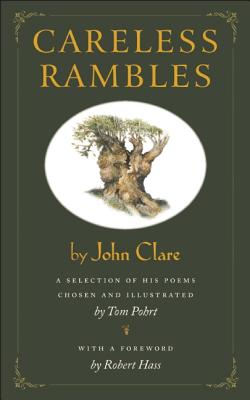
9781582437859The title comes from one of the poems in the collection, but it should be noted that Clare’s rambles are far from careless. They are animated by a reverent, careful naturalist’s eye, even if only an amateur one.

A gifted, if unadventurous poet, it is easy to see why he holds a patriotic place of pride in the English canon. He is the supreme, naïve chronicler of the rural England that Tolkien mourned for.

There are three longer poems in the collection: A Morning Walk, The Eternity of Nature, and The Holiday Walk. The first one drags, the second indulges in a Wordsworthian philosophical fantast that Clare is ill-equipped to pull off, but the last one is a fine encapsulation of Clare’s view (though it is not the finest poem in the collection). In The Holiday Walk, schoolchildren go on a supervised expedition into nature. A kindly schoolmaster provides some small education gobbets and also chides them against injuring insects via admonitions to love all nature, from beetles to beech-trees. The attention to insects is especially telling as an example of Clare’s deep love of the natural world and a commitment to observe, without interfering (a nineteenth century ‘Prime Directive’).

Clare shines best in the smaller poems, which, at their best, focus on small aspect of the countryside. A particular tree, an insect, a small animal’s nest, a small bird. He then chronicles the small, mundane beauty within it. And it is beauty he seeks. Not metaphor nor meaning, but the unforced beauty of small things viewed simply and honestly.

The book is illustrated by watercolors by Tom Pohrt which are good but, meh. I could take ’em or leave ’em. The introduction, though, by Rober Hass (an excellent poet himself), is worth reading, though.

Monday Morning Staff Meeting – Local Boy Done Good


gal1-243x366If you read through the whole article (fascinating, in and of itself), you’ll see a contribution made by the Folger Shakespeare Library!

A great little way that the Indiana Poet Laureate is promoting a bit o’ poetry literacy.

Deep reading Dickinson.

I gotta recommend Diego’s. Have the Greek fellow do it, if he’s available.

I worry that the quality of public intellectuals has gone down in correspondence with the decline in the quality of the public’s intelligence.

But they’re doing something right over there – in this case, protecting brick and mortar bookstores from predatory pricing practices.

Rhyming Poetry


I’ve been reading a lot more rhyming poetry lately, which has never been my thing, but I’m on a real kick lately. Algernon Swinburne, John Clare, and William Combe (the first two in selected poems type editions and Combe’s Tours of Doctor Syntax – a trilogy of comic epics that I heartily recommend; they’re funny and well written, or, at least, what I’ve read so far [I’m only a little way through Doctor Syntax Tours in Search of the Picturesque]).

I would never advise anyone to leap, unprepared, into Swimburne. He’s sort of a kinky Browning (though never quite so indecipherable as Browning’s densest works). Imagine Christina Rossetti’s Goblin Market written from the point of view of a sexually voracious, leering male onlooker, but never actually so undisguised as the scarcely disguised ‘goblin rape in the forest,’ so simultaneously more and less and kinky.

I’d probably also never suggest Combe unless that were your thing. If you’d read Candide and thought to yourself, ‘this would be ever more awesome if it rhymed!’

But Clare is a great place for simple, enjoyable rhyming poetry. I’m not very far into a collection entitled Careless Rambles but I already feel pretty safe saying that I love it. Not only that, but it’s threatening to make me want to move to the country. Not deep in the country. Maybe Vermont. Somewhere with easy access to independent bookstores, folk concerts, and art museums. But back to Clare. Think Wordsworth, but with end rhymes and without the melancholy ruminations of human mortality and indifference and without the mixed feelings about politics and revolutions. Or, really, any feelings about revolution. I should also not the Clare is not one for extended metaphors. Things are what they are. Which all makes him sound boringly simple and he should be, by all rights, but all I can tell you is that he is not. He’s got a nice, amateur naturalist approach the nature, though when he gets philosophical, he also gets a little less interesting to read.

Last year, my year of cramming in as many books as I could, was not conducive to reading rhyming poets because a good, rhyme schemed poem takes time to read. It’s an incredibly time consuming process and I find that I have to consciously read it to myself, not necessarily out loud, but as if reading it out loud. There is a scene in the movie, The English Patient (I can’t remember if it was in the book, too; I like Michael Ondaatje, but I’m going to commit some heresy here and say, in this case, the movie is better than the book), where the titular patient tells a character to read Kipling at the rate of Kipling’s pen moving across the paper. It’s not bad advice and it’s a good way to think about reading Clare or Swinburne or even Frost. Read as if laboriously writing the poem yourself by hand.

It’s hard for me because I’ve always been a fast reader, but suddenly I am forced to slow down drastically, more even than reading supposedly more difficult poets like Pound or Eliot (though not as slow as Gerard Manley Hopkins, who’s ridiculously complex schematics require a skeleton, infinite patience, and a glacial pace, all just to unearth the unsurprising revelation that a deep love of God and Christ is not actually sufficient to cure homosexuality).

But perhaps this is my entre into the so-called ‘slow reading movement.’ It feels odd to be taking so long to read fairly short books (and I don’t expect I’ll read all of the Swinburne right now, nor that I’ll finish Doctor Syntax anytime soon, though I intend to finish Clare, who has been on my ‘to do list’ for a long while), but maybe good training and a good way to slow down in general.
Weekend Reading – Utilitarianism


dc_guerrilla_poetry_insurgency_t_shirt-r25d98f20201d429295cd22d5cef3e520_804gs_512I need it.

The internet age and its reading discontents.

Approaching fatherhood philosophically.

The economist as novelist. The economist as literary critic/theorist.

The canon will never die. Or, rather, the debate about the canon will never die. Nor the canon, really. It will just get bigger. But if it gets too big, does it also get meaningless. It’s a legitimate question, though my own opinion is ‘no.’

Teach poetry.

Review: ‘French Decadent Tales’


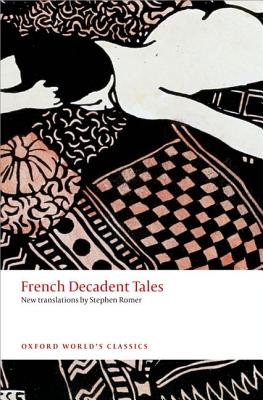
9780199569274I just finished reading semi-recent collection/translation of short stories from the French Decadent movement. The title is helpfully entitled: French Decadent Tales. No confusion there.

And no confusion within, either.

I read it over some time – three months, in fact – because otherwise, the stories can quickly run into each other. It’s a great beach read, but bring something else to read in between each of the stories. Reading it over some months also means that the stories are not so clear in my mind anymore.

The first half of the collection is strongest in the memory and is undoubtedly where most of the gems can be found. These stories are ripe, gothic, (in the sense that the Cure and Bauhaus are gothic, not a gothic church, nor even necessarily a gothic novel; they are far too gem-like for the wordiness of a Radcliffe) and indulgent. Don Juan’s Crowning Love-Affair is sad, stately paced, erotic, and disturbing. Presentiment reads like a lost tale of Poe, rediscovered, with the odor of an unfallen but still suicidally melancholy House of Usher and The Dandy of the Unpredictable is amusingly perverse.

The best ones are of a piece with the German writer, E.T.A. Hoffmann and his tales (which my father gifted me with when I was in junior high). Don Juan is a recurring theme and figure here and it is hard not to recall the ghostly companion in the opera box in Hoffmann’s tale.

But the collection, on the whole, is uneven and it did not win me over from the side of French poetry to the side of French prose. The obsession with death is sickly sweet in large does and the proto-Freudian conflation of sex and death/Eros and Thanatos can feel overwhelmingly in such compact forms, pressed close against each other.

Oh. And happy Friday the 13th.

Going Home


From the ending of Yevtushenko’s long poem, ‘Zima Junction.’

Don’t worry if you have no answer ready
To the last question.
Hold out, meditate, listen.
Explore. Explore. Travel the world over.
Count happiness connatural to the mind
More than truth is, and yet
No happiness to exist without it.
Walk with a cold pride
Utterly ahead
Wild attentive eyes
Head flicked by the rain-wet
Green needles of the pine,
Eyelashes that shine
With tears and thunders.
Love people.
Love entertains its own discrimination. 
Have me in mind,
I shall be watching.
You can return to me.
Now go.

Yevtushenko was only twenty-three when he wrote that about coming back home to the rural, frozen community where he grew up. There is something of the young man in there – more than a little, in fact – but it’s mind boggling how mature he was, seeing with poet’s eyes.

‘Love people.’

When I wrote about ‘Zime Junction’ before (see here), I got the maturity of the style, but not the content. I loved the long, Wordsworthian excursions (pun intended) – though with a different kind of melancholy than that which suffuses the Lake Country sage (was Wordsworth ever young?) – but really missed out on the closing of the poem the first time. I wonder now how often he did return after that first time back?

Weekend Reading – In Praise Of All The Saints


St. Mark’s is saved!

Another one (Amazon user) bites the dust.

They had a sort of reunion of these folks a couple years ago at the Folger Shakespeare Library and it was a great night and a great reading. I’m certainly jealous of their experiences.

This is part of a short series about poetry and poets, viewed through the lens of the western Zodiac. This last one contains my sign – Libra. How does this analysis relate to me, to my poetry? Does it? In truth, I always like to think that maybe it does, even if only a little…

A marvelous summer reading list from a great bookstore.

He did and so should you.