Majestic Nights (New Year’s Resolution, Book Nine)


I bought Majestic Nights: Love Poems of Bengali Women at the Rubin Museum in New York City.

The Rubin has a wonderful collection of Himalayan art. At least, that’s how they describe themselves, but really, it’s a Tibetan art. The whole thing is an unsubtle argument against China’s argument that Tibet is historically part of greater China. The Rubin implicitly argues that parts of China and India and pretty much all of Nepal and Bhutan are historical parts of greater Tibet. My own opinion is, well, free Tibet, but let’s be careful about how history is used, particularly when historical boundaries (much more fluid) are used to pick the borders of modern nation-states.

It is a relaxing museum with moderately priced admission. I will say that notes on the objets d’art were entirely too large and imposing, as if trying to compensate that the pieces themselves, mainly paintings and small statues, were by and large not physically imposing. Let the art speak for itself a bit more. A medieval triptych by Fra Angelico is not going to blow you away based on its size, but on its delicate artwork and driving faith the inspired it. I would have liked to have seen the Rubin’s collection in a setting that would give me a better opportunity to understand these religious works in the same way.

Also, after my experience at the Cloisters, I had to re-think my opinion about a large collection of religious artifacts accumulated and displayed in a secular institution. This is different, I feel, just because of the great need to protect uniquely Tibetan works from being misused or destroyed by the Chinese government, but it’s good that we stop to think about these issues more carefully.

But on to this book.

I’ve got to say, I’m wondering if Kenneth Rexroth hasn’t had a pernicious effect on translation, because it seems that any translation of eastern love poetry always seems to carry some memory of his translations of Chinese and Japanese love poetry.

So far as I can tell (and, I’m sorry, the fact that I don’t for certain is a failure by the editor and publisher to be clear), these are all poems by more or less contemporary women poets from Bangladesh (though at least one lives in relative exile in France).

There is an ebb and flow to the order of things. Rather than arrange things chronologically, it is arranged more in order of the early stages, maturity, and ending of a romantic relationship. Except that the editor didn’t include many poems in the middle section, so it goes too quickly from a lot of hot, sexy poems about skin and lips and desire to a lot of poems about women being left distraught and alone by men. It’s whiplash.

I love erotic poems, so I loved the first 40% of the book, but those poems also had a certain sameness to them. In truth, a lot of the poems had a certain sameness… a certain Rexroth-ishness.

Honestly, I can’t properly say how I feel about this book. I’ll never sit down and re-read it through again, but I might occasionally re-read a poem or two from it at random; something to keep near the bed or the desk for a quick, mental health poetry break. But, I guess, I’m disappointed. I had low expectations, but then I started liking the poems and then I started getting bored by the similarities.

Lest I end this on too mediocre a note, the next to last poem, Rice Sheaves This Alluvial Night by Khaleda Edib Chowdhury, is the collection’s only prose poem and what a prose poem it is. Six paragraphs desperately piling sex, desire, and despair:

But still this night must be understood once more. A man must know the object of his longing.


394627_489683391079480_701764605_n

The Strand Book Store


I can’t rightly call it one of the my favorite bookstores, but only because favorite bookstores are developed through a history of repeated visits and memories of discoveries and encounters over time.

When we visited New York, I literally took a day specifically to visit the Strand Book Store (and also neighboring Forbidden Planet, a well known comic shop).

But it is a wonderful, wonderful place. It didn’t have everything I wanted (Mary McCarthy’s The Company She Keeps, for example), but a truly amazing selection. I bought:

Alexander Pope, Essay on Man and other Poems
William Carlos Williams, Spring and All (with a lovely rubbery, leathery powder blue cover that’s wonderful the the touch)
Ron Silliman, The Alphabet (which, so long as I am reading a book a week, will probably not be read this year, since it’s a 1000+ page difficult poem/poetic series)
Karl Marx, The Capital (it’s was a used, inexpensive, hardcover edition, the sort of thing one wants in one’s permanent library)
Nicholson Baker, The Anthologist

My World Begins


There are some holes in my world, the one I created for the Dungeons & Dragons game I am DM’ing. I admit it. So shoot me. Or don’t and keep reading.

Finian (a deft halfling thief), Teague (an incautious and potty mouthed singer and poet), and Regdar (a lifelong military man) start out as low level officers on a semi-important island within a distinctly unimportant empire.

Having created a world on my own and having done so in a somewhat haphazard fashion (I had a draft in my head, but not much more than that), it put the players at the awkward disadvantage of not really knowing as much about the world they were in as they really should have. I’ve tried to fix that over time, but that’s also been haphazard.

Below is the intro to the small part of the world where I dropped them:

The Sunward Empire is a series of twenty-seven islands, ruled by gnomish sorcerer, the Sunward Emperor. His wife (by tradition) is the Windward Priestess, a human. Together, they are not just the ruling secular authority, but also the head of the national religion, which worships the sun (Kaji) and the wind (Raag). In matters of secular governance, the Sunward Emperor leads, and the Windward Priestess in matters of religion. However, the Emperor is also a religious figure and the Windward Priestess a figure with real secular authority. They are not, typically, referred to by their names, however, their names (Verkef and Alriat, respectively) are widely known. The Sunward Emperor and Windward Priestess are chosen a college of gnomish arcanists and a college of human clerics, respectively. The gnomish and human cultures dominate the Sunward Empire.

No one island is more than a day from its nearest neighbor and the Empire can crossed by boat (in good weather) is ten days, east to west, and five days, north to south. The islands are in the middle of (usually) calm ocean, between the western continent of Loe and the eastern continent of Goa. The Empire, as a whole, is self sufficient, but regular trade does come from the peoples of the two continents, but little is known about the civilizations of either (technologically, most of the traders seem to come from cultures that resemble the Mediterranean and Mesopotamian civilizations of the late bronze and early iron ages).

The empire is peaceful and mulitcultural. The dominant groups are gnomes and humans, but there are large populations of dwarves and elves and halflings.

Each island is jointly governed in local matters by an appointed governor and council whose makeup is determined by local traditions (some are reasonably democratic, but most are de facto group of the heads of leading families).

The characters are based on the westernmost island, call the Throughward Isle. The island council is made up of a group of leading citizens. When someone dies, the remaining figures pick his replacement (this council has no females and is fairly chauvinistic), almost always from amongst the oldest families or leading merchants. The council has two factions: one is led by an elf named Aelat and the other by a halfling named Anderaz. The governor is a human named Maloud and is also the commander of the imperial garrison, consisting of about forty soldiers. The garrison is larger than most (except for the capital island of Hazakis) in order to be able to send half or more on expeditions to act as marines.

In addition to being a significant trading location, Throughward Isle also has the largest iron mine in the Empire.

The characters are officers in the garrison. They may either be native to the island or have recently been transferred. The commanding officer (Maloud) and most of the garrison are human.

Weekend Reading – What Worth A Book?


Calculating the value of brick and mortar.

I want to be a bibliotherapist.

It wasn’t all Thanksgiving turkeys and apple pie; there was also being flayed alive.

Midweek Staff Meeting – No More Books For You!


Amazon trying to kill the free Kindle e-book? (not that I object – too many free e-books sets a bad precedent for how we view and treasure art, literature, and literacy)

Actually, it would be nice to have someone in charge who actually cared about preserving the brick and mortar business.

Barnes and Noble giving up on the Nook? (I hope not; I own one and enjoy it, though it would be nice to see them focus on their core retail business)

If a poet dies in the forest, does anyone notice?

The Continuing Saga Of Dungeon Master Coffee Philosopher


We’re still doing it. DM’ing an original Dungeons & Dragons campaign. We’ve even added a new player, a friend of mine of several years who looks likely to hang around for a while (I think he was reassured that everyone in our little cabal is over thirty-five and has a professional career).

I worked up a plot of sorts and have a broad idea of where that plot will lead. But I was never great at plotting, so it’s nice that the party has taken off and done their own thing. Abetting that, I’ve tried to insert a certain randomness into the mix – mainly through the cheap trick of die rolls that select a random encounter from list, which list sometimes also includes key plot points, thereby encouraging folks to go off on tangents that I hadn’t ‘planned’ to happen yet.

As you can see, I’m still somewhat obsessed with limiting the ‘directedness’ of the game – not directing the players don’t the paths I want.

Have I ever explained what’s going on?

No?

Maybe tomorrow.

The Anthologist (New Year’s Resolution, Book Eight)


The Anthologist is a novel about poetry.

I hadn’t planned to be reading it now. I bought the book during an epic binge at the Strand in New York (I was also victimized by poetry collections by William Carlos Williams and Ron Silliman and a nice, hefty tome of Marx). No question, I intended to get to it. After a fashion, it’s a book that I’ve been meaning to get to since it came out several years ago. I don’t read very much contemporary fiction, barring genre fiction, but I used to and hoped to use this to get myself back in the habit.

But, my plan was to make some more headway into The Wheel of Time or perhaps finish the final volume in Brin’s Uplift Trilogy.

For some reason, I read a bit of The Anthologist when I should have been finishing up Pope, but there was such a strange connection between the two that I knew it had to come next.

The narrator is a mediocre to minor poet who write free verse but loves to read rhyming poetry and is flailing in an effort to complete a paying gig: the writing of a lengthy (forty page) introduction to an anthology of rhymed poetry.

The narrators lengthy discursive internal monologues on poetry just brought to mind what I had learned and felt diving into Pope.

So that’s why I read this book next and not something else. I’m reading something else now, so I guess it all evens out.

The Anthologist is driven by chronology, rather than plot. You see, the story, at least until the very end, where something like a climax and resolution occurs, is the internal narration of the narrator, a semi-successful poet name Paul Chowder. The internal narration is driven by chronology because Chowder, the character, is driven by procrastination. The book is a chronicle of the narrator distracting himself to avoid working on this introduction to an anthology (hence the title) that is supposed to be working on. The pleasure comes from both the head shaking chuckles inspired by how he weasels around buckling down and getting to work, as well as his erratic, discursive monologues about poetry and the history of poetry. Interspersed are some ‘interactions’ with dead poets (seeing some great poet in the supermarket, for example). You know they’re not actually there and Chowder isn’t trying to convince the reader of their reality. While interesting, I don’t actually see the point nor necessarily feel that they fit terribly neatly into the whole.

That resolution I mentioned is, invariably, unsatisfying. The voices in one’s head (not talking auditory hallucinations here, just the running commentary we all have with ourselves and which makes up the bulk of this novel) do not end, they do not resolve themselves. As a result, any ‘ending’ was pretty much always going to feel rushed and inadequate. And so it was, but that’s okay. He kept that part very short, so that parts that will still linger a month from now will be the lovely stuff that came before.


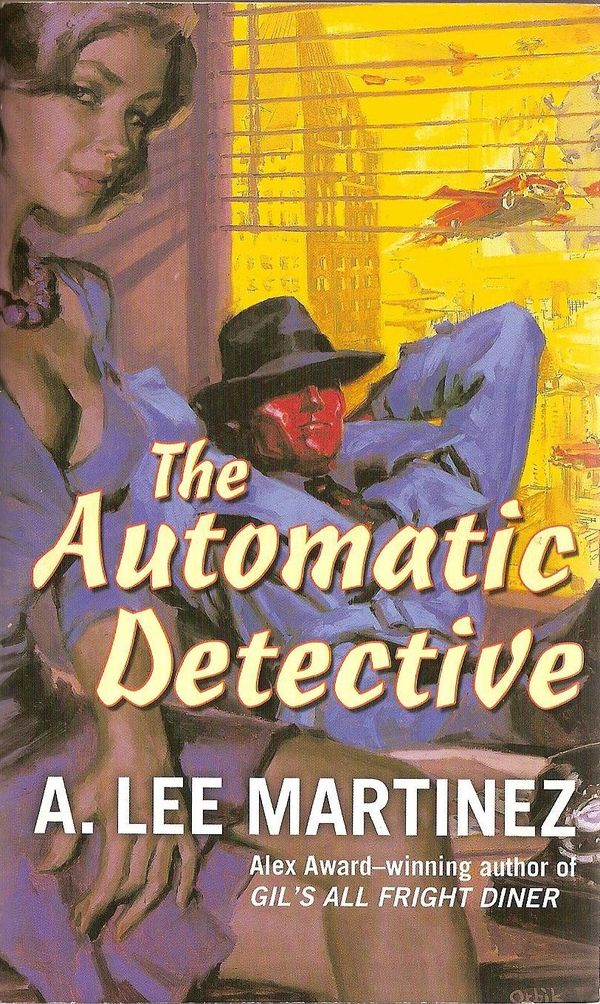
The Automatic Detective

Do Poetry Slams Do Nothing For The Cause Of Poetry?


This essay, Poetry slams do nothing to help the art form survive, struck a chord with me.

I have always had mixed feelings about slams. And I have always felt that the quality of poetry heard in poetry slams is lacking and certainly it works against innovative and experimental poetry (try reading Gerard Manley Hopkins or John Ashberry in front of a mirror and in a slam style and then ask yourself how well they’d hold up).

The only division in poetry is between those people willing to take the time to read it and those who will not.

Nathan Thompson, the essayist wrote that line in refutation of the idea that slam poetry is a democratization of poetry. He writes, not without merit, that ‘Most slam poems are not strong enough to be published in even minor poetry journals.’

Slam poetry is not a substitute for… poetry. In some ways, it’s like the girl in school who can hit the high notes and who sounds great, but then you hear Billie Holiday sing Strange Fruit and how she can do it with subtlety, tone, and emotion and without even raising her voice.

Perhaps. I don’t know. I just with slam and performance poetry were used to also direct audience members and participants towards the great mass of poetry culture, from Homer to Natasha Trethewey.