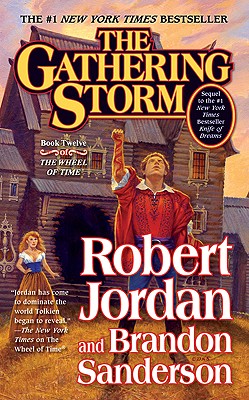
The Gathering Storm (New Year’s Resolution, Book Twenty-Two)


9780765341532While perhaps as smooth as it could have been, the transition from Robert Jordan to Brandon Sanderson that occurs in The Gathering Storm is nothing less than jarring. It feels like a new series. Sanderson reintroduces the characters and it feels almost like he doesn’t know them. On the plus side, Rand Al’Thor is already less irritating.

But purely as a piece of genre fiction… well, it’s better. It flows better. I cruised through it faster than some shorter books earlier in the series because it felt like less of a slog. Not were loose ends wrapped up, about one third of the way through, Sanderson began to show the reader he was going to start advancing things significantly. Much more propulsive of a read. And, dare I say it? Yes, I must. Sex is handled better. Women are handled better. He can’t undo some of the irritating lovestruckness of Jordan’s depictions (he wrote badly about love from each side’s point of view), but he can make the women a bit less focused on being all swoony-like and make the men less juvenile when they’re thinking about their love interests (always heterosexual love interests; don’t remember any gay relationships in the series). A somewhat long awaited pairing took place and when it finally happened, it struck me that almost no one in this series has premarital sex (except the main hero, Rand, who actually has a little harem of three lovers). This pairing was between two mature individuals: one a sort of sorceress (Aes Sedai they’re called) who’s possibly a couple of centuries old and the other a grizzled warrior probably in his late fifties or possibly early sixties. They decide to put off marriage until, you know, the apocalypse is resolved in favor of the good guys. And they don’t have sex. Okay, I’m catholic so I sort of respect that but, with the world on the edge of extinction, I think a little premarital hanky panky between two mature adults is not a major sin. Frankly, the additional capacity for sanity that generally accompanies getting laid once in a while can only help things if two people are critical players in the battle to defeat ultimate evil. While there is a touch of grit, this is more romantic, high fantasy than the modern style of Game of Thrones.

There is a sort of denouement at the end, as one would hope for the end of a book. But it’s anti-climatic. The real climax was only sort of decently described battle (if it had been better described, it would have been: a fight between witches, also involving flying dragons – they’re not called dragons, but that’s what they are). The ending however, was Rand laughing and learning to chill out a bit. And, like the cleansing of saidin, it was rushed and didn’t seem like enough had been built up to this moment to make it feel sufficiently cathartic.

Maybe, you think, hey, maybe now he won’t be such a raging a–hole all the time! But we’ve been down this road before, haven’t we? He cleansed the poison from male half of the One Power (magic) two books back (0r maybe three; I lose track, because, seriously, this is book twelve – Churchill’s history of the English speaking peoples didn’t require this many pages) and we all thought that maybe now he’d stop being such a little b—h. But now. He not only didn’t stop being a little b—h, he didn’t even stop vomiting when he used magic.

What I’m saying is, I’ll believe it when I see it. Maybe Sanderson realized how irritating Rand had become and is trying to get this fixed to so it will be more fun to read, but I’m withholding judgement.

I would also like to report that my aunt is now reading my posts about fantasy and sci fi. This is important because ninety percent of my readers are my aunt and my mother.

Midweek Staff Meeting – Dinosaurs Of Tibet


The Dalai Llama as a man of the right.

Just… so sad.

A portrait of Descartes.

Poetry doesn’t need to be nice and maybe it oughtn’t be.

I won’t lie. Being Texas, I’m surprised that any group of white people clung to bilingualism for this long.

Queen of Sorcery (New Year’s Resolution, Book Twenty-One)


My Aunt Anna told me that she won’t read this. She sort of skips over whatever I write about science fiction or fantasy. In one sense, I can understand. I mean, it’s a somewhat hermetic world, as genre writing tends to be. But, I still like to think I’ve got something worthwhile to say, even if the subject leaves something to desired (some would say).

Queen of Sorcery is very similar to its predecessor. A little longer, at just a touch over three hundred pages, but, overall, as economical as Pawn. Yes. Economical is the word. Most of the traits of the characters are described as being ethnic or cultural traits. Skip over most of the deeper psychology; he’s sneaky because he’s a Drasnian. Again, economy. There were several battles, but only described in semi-graphic detail, and that was done to create a bit of emotional catharsis for the young hero, Garion. Economy of writing.

There is a one mystery, though I think I’ve figured it out, but Eddings isn’t trying to leave something nagging at the back of the reader’s mind after he or she has put the book down, besides, obviously, a desire to make the reader want to read the next book. He is trying, though, to offer some solid craftsmanship.

Economy of prose. I’ll have to think about that. Something to be learned from the late (great?) David Eddings for a budding fantasy writer. An antidote to Robert Jordan and George R.R. Martin (there’s no antidote to J.R.R. Tolkien; he’s on another level, I think we can agree).

A bit of geekdom, especially for fans of Brandon Sanderson. Eddings has created a reasonably unique system of magic for his world. Sanderson, of course, is famous for finishing off Jordan’s Wheel of Time sequence, but also because he specializes in developing original and interesting systems of magic (one reason why he must have seemed like an obvious pick to finish off what the late Jordan wasn’t quite able to complete). Eddings, back when magic in novels was more like magic from Dungeons & Dragons, tried to do something a little more precise (though closely related to magic in the writings of Ursula K. LeGuin, who is not a genre writer, truly, but sui generis).

A Poet Asks, ‘Am I Poet Enough?’


Joseph O. Legaspi’s musings.

Jack Vance Died


I feel bad. Jack Vance was an important (if not always very good) science fiction and fantasy writer, but, honestly, I thought he’d died years ago.

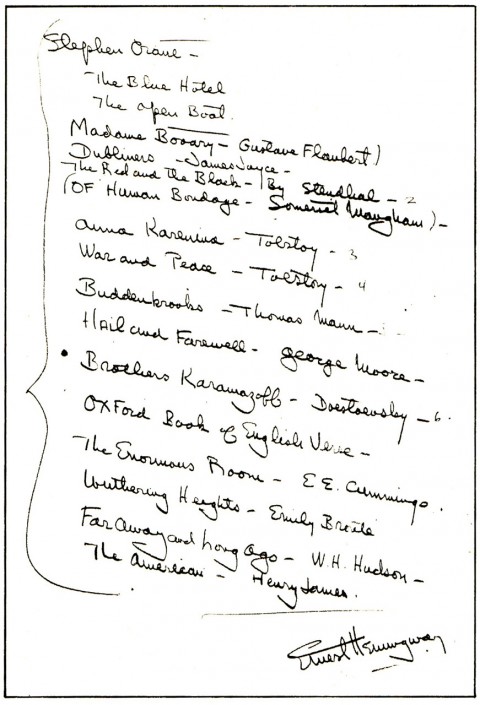
Hemingway’s Recommended Reading List To A Young Man


Hemingway-Reading-List-e1369330871727

The Trouble With Poetry (New Year’s Resolution, Book Twenty)


I am not, normally, a fan of Billy Collins. But he read at the Folger Shakespeare Library and I just don’t miss those.

Actually, he read at the church across the street (Lutheran Church of the Reformation – for the bigger draws, they set up next door and we listen prayerfully from the pews). This will be important later.

So, he read. And he’s better than his reputation. He has built this aww shucks reputation, the poet for people who don’t like poetry because it is too stuffy. He was unashamed about writing a good deal of comic poetry, but, perhaps emboldened by the academic and literate nature of the hosts, spoke deeply about a great many poets, including non-stuffy, difficult poets.

When I got up the front of the line to have my book signed, he took a moment with me. He looked at me and asked whether it bothered me, holding the poetry reading in the church. I said no. But I wished I’d added, did it bother you? Perhaps he looked at me and felt he recognized a (slightly) aging, anti-religious anarchist. But I can’t but think that he was, beneath his Garrison Keilor-esque poetic image, a bit of an anarchist himself. That he was bothered by it and that he thought I would understand. Missed opportunity, I reckon.

The Trouble with Poetry was better than I expected (though it’s unlikely to go on my ‘best loved books’ shelf). It was also darker than I expected.

A mood of quiet alienation, of feeling uncomfortably separated from one’s fellow man, abounded. Death came up not infrequently (three poems struck me in particular: ‘Bereft,’ which said I liked listening to you today at lunch/as you talked about the dead,/the luck dead you called them,/citing their freedom from rent and furniture – which poem went to outline a sort of dislocation with the objects of this world; ‘Flock’ which opened with an epigram noting that it is said that each Gutenberg bible required the skins of 300 sheep to produce, which is to say, that 300 living animals had to die to make it; and finally ‘Building with Its Face Blown Off’ about a war zone).

There is some of Collins’ (signature?) comedy, but not much, and tinged with sadness and failure.

Also, as you might expect from the title, too much poetry about writing poetry. I can’t think of another art form so obsessed with creating art about the particulars of the creation of that particular art form. I might suggest that this, more than stuffiness, is holding back contemporary poetry. It’s frankly too much and poets, in general, need to cut it out. Yes, a poem about poetry every once in a while is fine, but I counted half a dozen in this volume and a quick perusal of poetry mags will easily find you more.

Unacknowledged Legislators


20130526-173454.jpg

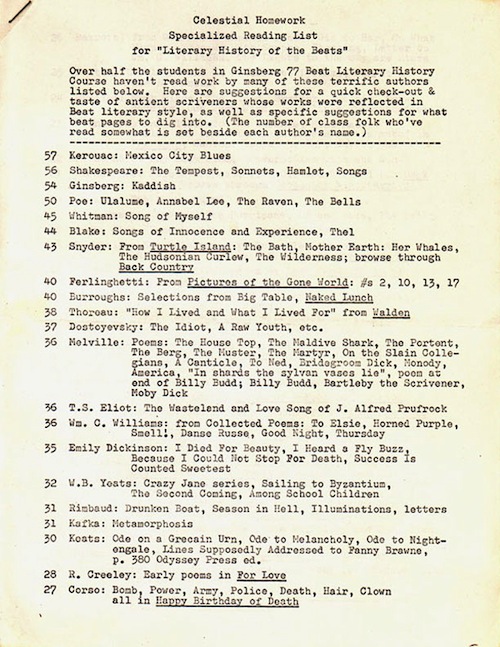
Suggested Syllabus From A Class That Allen Ginsberg Taught In 1977


5-22-13_Ginsberg

Pawn Of Prophecy (New Year’s Resolution, Book Nineteen)


9780345335517How far behind am I on my resolution? I’m sure that I should be in the twenties by now, not one short of twenty.

So anyway… Pawn of Prophecy. It’s a bit of foundational document for the modern, multi-volume fantasy cycle, but no one really talks about it. Doesn’t have the cult following of some others. But certainly, there would be no Wheel of Time without it.

It has the usual trappings, an ordinary seeming boy who is far more than that. A guardian who is secretly an ancient sorceress. An old man who visits frequently, tells stories, and is actually a great wizard and shameless appropriation of poor old Gandalf. What David Eddings added is ordinary language. It’s deliberately down to earth. None of Tolkien’s rumbling influences of old Anglo-Saxon epics. Nor any of Michael Moorcock’s New Wave decadence. Nope. This is plain writing, and not it in a bad way. Yeah. I’ll say it, it’s better written than Jordan’s Wheel of Time.

It’s also a lot shorter. This first volume is just over 25o pages. It’s not breathlessly propulsive, but has a (cliche warning) brisk pace. I most admire the beginning. Seventy odd pages of the boy who will be something great (his name’s Garion, by the way) growing up on a farm. And it goes by quickly and pleasantly, not feeling like it’s slowing down the story nor wasting the reader’s time. And that’s an accomplishment not to be sniffed at.

So yeah, I’ll be reading book two.

I wanted to read this, in spite of desperately wanting not to get sucked into another multi-volume sci-fi/fantasy series because, if  you haunted the science fiction and fantasy shelves of Waldenbooks in Countryside in the eighties and nineties or browsed those sections in countless used bookstores, you saw these all the time. Their cover art is emblazoned on memory. Why didn’t I read them earlier? I don’t know. I picked up other books instead. I read book reviews from RPG magazines and exchanged suggestions with my chum, Matt. Somehow, Eddings, who was fairly prolific (he only died in 2009, though Pawn of Prophecy was published in 1982), never made it onto the list. So maybe I’m rectifying a youthful error.