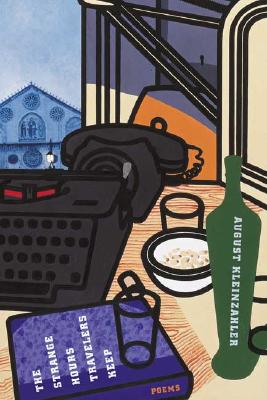
 A surprisingly engaging and enjoyable poet to listen to and the usual moderate of these conversations – the Washington Post‘s Ron Charles – stayed out of the way more often the usual, perhaps because the sanguine Kleinzahler was more willing than the melancholy Hirsch and the phlegmatic Szymbist to take control of the conversation (did you see what I did there with the four humours of medieval medicine?).
In his introduction, Charles noted that the poet, despite being famous for chronicling bars and diners and working class communities, was not a Bukowski. But the impression he gave was of a Robert Pinsky writing a Charles Bukowski. Does that make sense? Probably not. Well, I’m not going to explain.
The poet signed for me The Strange Hours Travelers Keep – which both delightfully named and has a wonderful cover. He aspires to Whitman’s continent spanning enthusiasm, but there is something narrower about him. The title comes from a line of William Carlos Williams and there is something of Spring & All in Kleinzahler (who is also a New Jersey poet). He wears his learning more broadly than Bukowski (again, like Williams), but has something of Bukowski’s resentment. Williams felt resentment, too, mainly for feeling left out of the conversation in favor of folks like Eliot and Pound, but this is a different kind of resentment. Something closer, indeed, the Bukowski. But more sober and plastered over with a fine appreciation of Milton.
There is a touch of misogyny to some of these poems – a ‘character’ in a poem calling Alma Mahler a ‘slut’ or a poem about a female poet who turned cruel eviscerations of her parents and the symbolic emasculation of a husband or lover into poetical success (defined, in this case, as grants, prizes, and choice campus appointments). I couldn’t call this trend pervasive or a trend, but just frequent enough to make me uncomfortable.
Kleinzahler has these wonderful exceptions to his high culture Whitman-ism. A lot of them have this delicious French influence, particularly the Surrealists (mainly Breton), though with too much conscious logic to is zig sagging motions to be truly Surrealist (and we are talking the actual movement; not ‘surrealist’ as short hand for ‘weird’), and also bits of Antonin Artaud’s structured madness. A lengthy prose poem, not suited to excerptation, I’m afraid, but that I highly recommend and which is well worth the price of the book: The History of Western Music: Chapter 4
The best poem that is also great distillation of his more usual style is the sad and melancholy portrait of faux-genteel poverty and terrifying loneliness, The Single Gentleman’s Chow Mein.
That his poems don’t take well to being shown in excerpts is a testament to how well they cohere, even when they appear random (that touch of Surrealism) or stream of consciousness.




 the coffee philosopher