IMG_8320.JPG


IMG_8742-0.JPG

‘WISE WHY’S Y’s: The Griot’s Song/Djeli Ya” By Amiri Baraka


9780883780473I bought this not long after Amiri Baraka passed away, read the first few poems, but when I put it down, neglected to pick it back up again. Well, I did pick it back up again and I am better for it.

Let’s just get this out of the way. Amiri Baraka/LeRoi Jones is a difficult, problematic, and prickly figure. LeRoi Jones was deeply involved in the poetic circles in and around New York City, apparently had lovers of both sexes. As Amiri Baraka, he was angry and militant and, I’m afraid, made more than a few anti-gay remarks. But he was also still LeRoi Jones, in that he was deeply influenced by the major currents of the twentieth century, especially the New York School, the Black Arts Movement, and (like another revolutionary poet, Aime Cesaire) Surrealism. Baraka was also much more political and a major figure in building black political power in Newark, New Jersey.

WISE WHY’S Y’s is deeply political, unyielding, and is weighed on heavily by the history (and, therefore, the legacy) of slavery.

We are bullets into
              tomorrow
    We are Changerers

these limpid blue
that packed sky
(the lost key of
              which
        like my own
        dry frenzy

is part of the hatred
     that’s good
          for us.

That’s from a poem entitled #20 Borders (Incest) Obsession and is intended to be read with musical accompaniment. He actually lists a bunch of tunes to go with the poems (John Coltrane comes up a lot). Because bop and post-bop jazz is the rhythm to these poems, they are often jagged. There is often rhyme, but without a rhyme scene, reflecting the work of jazz musicians like Ornette Coleman and Dizzy Gillespie.

In another poem is this stanza:

                                    (Not Sociology & Social Democratic
                                                     political
                                                    Bohemianism)

I know that he’s mocking the shallow, meaningless political talk of white, coffeeshop revolutionaries… but good lord, don’t you want to be a ‘political Bohemian?’ I hate myself for thinking that, because Baraka is also right to criticize the wordy, windy impotence of ‘slacktivism’ and other such skin deep dissent.


IMG_8319.JPG


IMG_8738.JPG

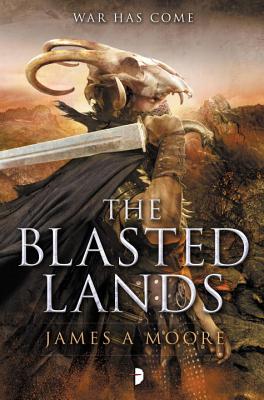
‘The Blasted Lands’ By James A. Moore


9780857663924I had enjoyed its predecessor, The Seven Forges, greatly. Like that one, this was enjoyable beyond the quality of its writing. Moore has a flair for tension in his plots and still has little in the way of vivid descriptions. This one has a few more, though. Apparently, Moore is primarily known as a horror writer and there is a touch of body horror in this book, so maybe that’s why his descriptive powers seem a bit (just a bit) stronger.

But honestly, I needed more. The previous book very much read as a cliffhanger, so even if this is a trilogy (or more), the second book needed to add some more. I understand the need to leave the audience wanting more, but there needed to be a bit less foreshadowing and bit more ‘stuff happening’ here. Some more things resembling some kind of resolution, while still leaving plenty o’ tension and suspense for the third book.

Which, by the way, I will read. Moore seems pretty prolific, so I don’t expect to have to wait long.

Heather McHugh & Geoffrey Brock Read At The Folger Shakespeare Library


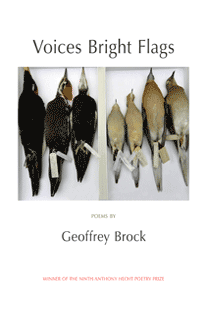
brockcoverThis was a sadly sparse reading. Not empty, but perhaps just 80% full and with upper balcony totally empty. Which is too bad, but Brock gave a great reading.

McHugh was the judge of the latest Anthony Hecht Poetry Prize and she chose a manuscript by Brock as the winner (thereby getting it published by Waywiser Press).

Some years back, I spent too much money on an oversize paperback by Richard Howard entitled, Inner Voices: Selected Poems, 1963-2003. For the life of me, I don’t know why I bought it. I hated it. A lot of the poems are written in the voices of historical figures. I mention this, because that is much of what Brock does, only I like his poetry.

McHugh was a little confusing. She spoke a lot about personal challenges and about her support for a particular cause: people who are long term caregivers for severely disabled relatives (usually their children). At one point, I thought she was reading a poem and then she looked up and started speaking about the cause and I could never tell whether these were asides during the reading of a poem or if none of it had been a poem.

I bought and Brock read from Voices Bright Flags. Very enjoyable. He’s got a nice, light touch and recognizable style, without being repetitive. A lot of serious poems, with passages about John Brown and the Civil War and slavery, but also some light humor about being a father with an insistent toddler. I actually remembered reading the first poem in the collection, Bryant Park at Dusk, in Poetry (the magazine).

I’ll excerpt from a poem about Ulysses S. Grant. Mostly because it’s a good poem, but also because Brock drolly noted that no one writes poems about President Grant.

My heart then like a puffed-up private boasting
he’s cut the enemy’s leg off
– Not his head?
– Sir, someone else had cut that off already.

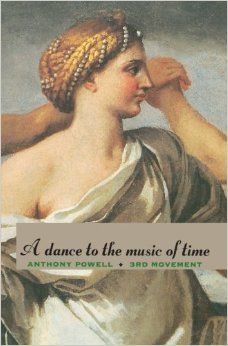
‘The Soldier’s Art: A Dance to the Music of Time Book Eight’ By Anthony Powell


63f5491de9bb3f204d274501fccbe53dSo… the revenge of Widmerpool. Maybe? Does he intend revenge? Or merely to remove anything which might cause embarrassment on his way to the top?

Stringham, one of the wealthier and more popular schoolmates of Widmerpool, had, after years of riotous living, dried himself and achieved a kind of peace. When he reappears, it is as private in the army, whose job it is to be a waiter in the mess hall. Jenkins (the narrator) suggests to Widmerpool that maybe Stringham could be helped.

The piggy (I can’t help but think of him that; in fact, I think of Widmerpool as being a malicious version of Piggy from Lord of the Flies) fellow agrees and transfers Stringham to a mobile laundry unit, knowing that it will shortly be deployed to the Far East and that he is sending Stringham from a comparatively safe position to one of far greater danger.

Is he trying to kill the man? Is this revenge for having been more charming, for being wealthier? Is he enjoying the appearance of meritocracy recognizing his own (evil) genius? Or is just afraid that his connection might be embarrassing so sends him as far away as possible?

I think that it is a kind of assassination. Which is supported because death, suddenly, becomes very real. On a single night, during air raid, bombs hit a night club and a house, each of which contained more than a few people of Jenkins’ long acquaintance. Death by way becomes clear after the first book taking place during WWII (The Valley of Bones) played almost like a melancholy. This one is melancholy, but not a farce. It could even be said to veer into Catch-22 territory, though Powell is a far more traditional writer than Heller and his novels are never so outlandishly absurd as that.

As a narrator, Jenkins is too phlegmatic for me here. It would be out of character, I suppose, for him to become openly emotional, but I wanted a bit more from him.

At this point, it must be nearly twenty years since the first novel and, despite that niggling criticism above, the scale of Powell’s achievement is becoming clear. A certain segment of English history (through the eyes of a very particular segment of the population) is being wonderfully chronicled in a subtle fashion. Things like Dunkirk are mentioned, but the focus is on the small scale. Just like the Great Depression was never mentioned, but its effects on the characters depicted.

R.A. Montgomery, Author And Publisher Of Choose Your Own Adventure Books, Dead At 78


Wow. Of course, I am of an age such that I read a ton of those books as a child. Though, if I’m honest, I read more of the Endless Quest books, which were put out by TSR, the parent company of Dungeons & Dragons (fantasy), Gamma World (post-apocalyptic), and Star Frontiers (science fiction). I actually bought one of those at the Royal Oak Bookshop in Front Royal, Virginia (my father and I took a trip there to celebrate his birthday).

But, this man started all that was either directly or indirectly responsible for dozens of such books that the elementary school version of myself relentlessly plowed through.

Alas, poor Yorick!


IMG_0560.JPG