‘Mary Stuart’


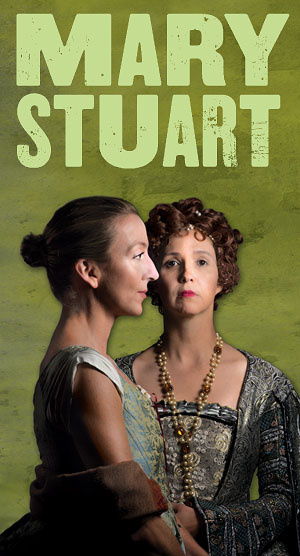
Mary StuartI saw Mary Stuart at the Folger the other day. It was a Peter Oswald translation of a Friedrich Schiller play that nicely combined the language Shakespearean style classicism and (also Shakespearean style) timelessness. He kept iambic pentameter rhythms and that certainly helped. Not the humanity spanning scale of Shakespeare, but good, nonetheless.

The set piece, as it were, was a meeting between Elizabeth and Mary, arranged so as to appear a chance meeting – with Elizabeth hunting near the castle where Mary was under lock and key and Mary, unusually, allowed some small taste of well guarded freedom in the outdoors.

In a way, the set piece was a let down. I was led to expect some showdown between the two that Mary’s wit, charm and inner nobility would win. Elizabeth, during part of Mary’s big speech, was looking up and to her right – directly towards where I was sitting. Her expression wonderfully captured a sense of contempt for Mary’s posturing.

Leicester was a wonderfully deceitful, semi-villain and Mary was great, but I was more impressed by Elizabeth – and not just that one moment. Her vanity and her fickle choice of favorites were well captured, but without sacrificing her realpolitik. It was all well and good to be high and mighty about royal prerogatives, but Elizabeth actually ruled, which came with as many compromises as powers.

Voltaire


I picked up a selected writings of Voltaire at the Dunedin Library book sale. The book is sort of a hodgepodge of stuff “not Candide.”

I cannot say I’ve enjoyed it so much. What is the value in Voltaire these days? Is his value as much for his image – the rebellious, bohemian, intellectual laying some kind of groundwork for liberty or revolution? – as for his actual output. I am excluding Candide here and that slim book alone might be enough to justify all sorts of deserved literary fame.

The first bit contains some letters written to friends in England and you read them, thinking, these are like a lot of other letters from the period. Better written and more interesting than a modern email, yes, but is it really that special? And where is Voltaire’s famed, biting wit? Later came some bite, which felt more like disrespect and some cultural criticism too timely to mean much anymore.

I have been left with an image of Voltaire as more of a p—k than anything else. I need to pick up some Kant or Rousseau or Montesqueiu or someone else like that to rekindle my affection for the enlightenment.

Professor W.H. Auden’s Syllabus For His College English Course


Professor Auden's college syllabusThis is for just one semester. Makes your college reading list look downright kindergarten-esque, doesn’t it?

And yes, that’s THE Auden, we’re talking about, not just ‘some dude with a similar name’ Auden.


2015/01/img_3837.jpg


2015/01/img_4466.jpg

What Is Best In Life?


IMG_4780

‘Drama & Verse: Simon Armitage & Peter Oswald’


The other night, the Folger’s poetry reading was titled, Drama & Verse: Simon Armitage and Peter Oswald.

It was a wonderful night, except that both men took oddly exceptional steps to distance themselves from poetry and towards drama.

Oswald performed a reading of an verse adaptation/translation of an Italian folktale. It was a wonderful experience, done in a mixture of modern and timeless (not timeless, in a cheesy, ‘this is eternal’ sense, but rather in lacking in major, time-sensitive stylistic signifiers beyond ‘modern, post-Austen English) language and also in iambic pentameter.

The iambic part was cool, because earlier that evening, I had been talking about iambic pentameter with my mother and how much of Moby Dick is written in – or in something close – to iambic pentameter. Another reminder that that meter doesn’t have to stick out like an attention-seeking anachronism.

Oswald also did the adaption of Mary Stuart that I’m seeing on February 11. I bought a copy and had him sign it to my mother. She’s been wanting read about figures from Elizabeth I’s time who aren’t actually Elizabeth I. However, I can’t give it to her until I read it and while I started reading it, I decided that I don’t want to finish it until I see the play. But I like it so far.

I’d read Armitage’s translation of Gawain & the Green Knight earlier and enjoyed it thoroughly. So I splurged and bought his translation of The Death of Arthur. Not to be confused with the Malory one. Apparently, this one is known at the AMA or Alliterative Morte d’Arthur. You learn something new every day.

I just wish either man had been more willing to step forward from their roles as translators and (verse) dramaturgists and say, ‘I am a poet and this is poetry.’ I would have been quite happy with that.

The moderator was somebody named Smith from the British Embassy, serving in some cultural capacity. He had a that longish, semi-leonine mane of white hair that only the English and French seem to ever adopt. He looked rather like someone who could have played Doctor Who (a bit of the Third Doctor, Pertwee, in his look; and Armitage looked a bit like a more dour Second Doctor, Patrick Troughton).

‘Last Of The Mohicans’ By James Fenimore Cooper Was Published On This Day In 1826


To this day, his novels are still read by tens of people every decade. Just kidding. No one reads his novels anymore because they are so bad. Really, just terrible.

If You’re Under Thirty Or Forty Or Whatever, This Is Not James Franco


2015/01/img_3838.jpg

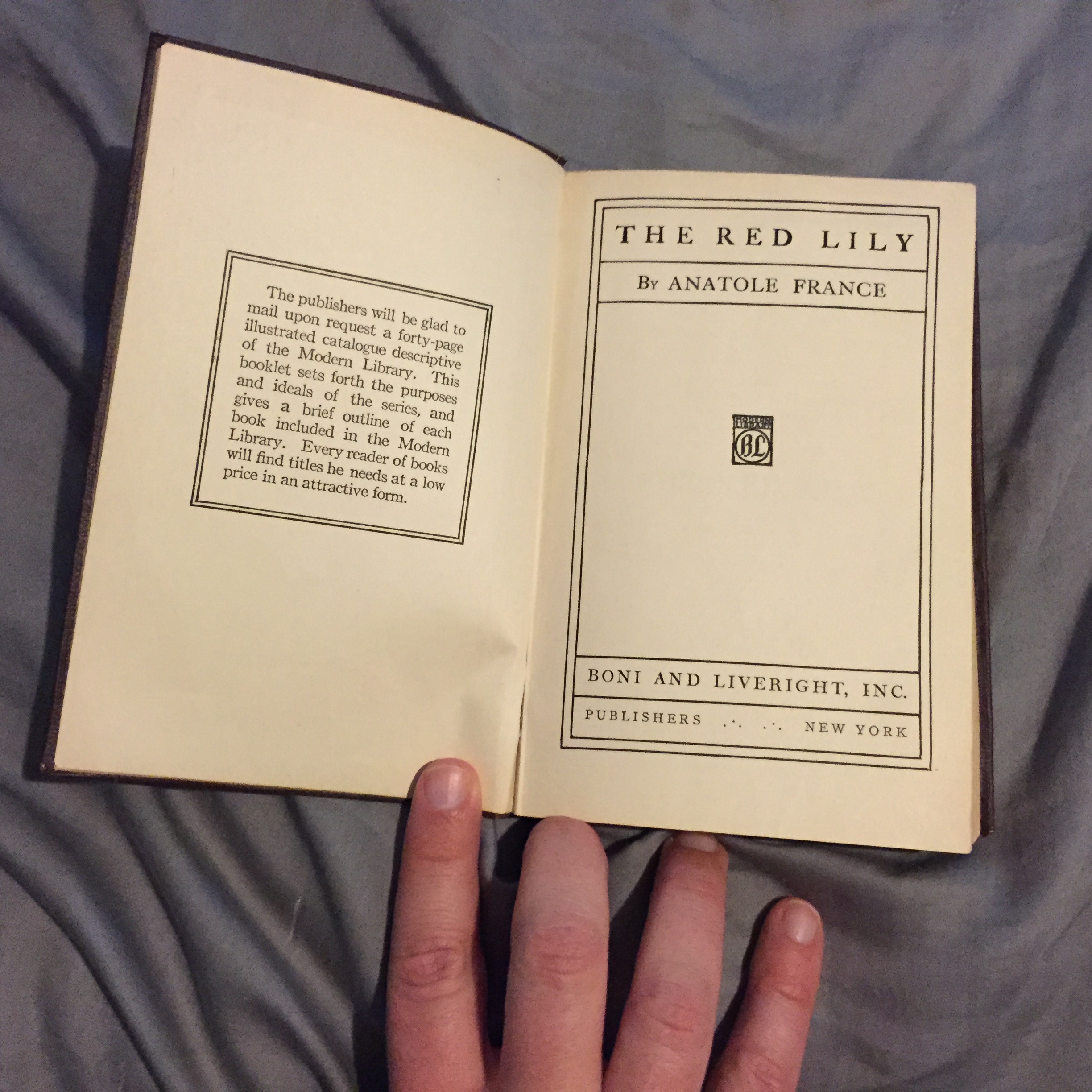
‘The Red Lily’ By Anatole France


IMG_4657It’s been a while since I was hardcore about it, but I used to have a thing for nineteenth century French novels. There was a time in my teens when I was gobbling up doorstops by Dumas, Hugo, Stendahl, and Flaubert. I fell of the wagon a bit, but maybe reading Balzac around Christmas got me back on it.

I found this book at the Strand in NYC. He’s a little later than those other writers and at 250 odd pages, I wouldn’t categorize it as a doorstop. But we’re looking for trends, people, so let’s not pry too deeply.

The story is simple – Thérèse, the Countess Martin gets angry at one lover (Robert) and meets another man (Jacques), a sculptor, while visiting a friend in Italy, and takes him as a lover. She tries to hide the fact that she had this other fellow as a lover until very recently, but the new love can’t handle the jealousy eating at him and ends it and she’s now very lonely.

Though done in the third person, it is third person limited from Thérèse’s point of view.

There is an odd invulnerability about her. Her husband is a fast rising politician (he is appointed Minister of Finance towards the book’s end) and she doesn’t dislike him, but it was a match made for practical reasons. So, for her ego/sense of self worth, as well as for physical pleasure, she takes lovers. Never does she seem very worried about being caught, even as her husband becomes more and more prominent in French politics. Yes, there is a line where she becomes marginally more circumspect when he notes that she is coming home late a lot, but not that circumspect. She also cuts short her vacation in Italy (where most of the novel takes place) in order to dodge some of the rumors and suspicions that may or may not be circulating. Thérèse also never asks where her husband goes for sex in the apparent absence of a sex life with his wife. And what if she got pregnant? Is she using some kind of pre-modern prophylactic? Does she have ‘safety sex’ with her husband so that he wouldn’t get suspicious if she suddenly became pregnant, despite presumed marital celibacy?

These are some of the things I think about (prurient mind!) that never cross her mind.

I wouldn’t call this a feminist novel, but France never presumes to judge his protagonist.

At some point, France suddenly became confident in his writing’s sensualism, its eroticisms. Countess Martin, with her new lover, having just told her former lover that she had met another:

She was flushed with pride in the comeliness of the body she offering upon the altar of love. For she had discarded her clothes save for one thin rose-hued garment, and this had slipped scarfwise from her shoulder, laying bare one breast, whilst the warmer tinted tip of the other glowed through the rosy gossamery that veiled it.

So I’m a little romantic, a little cheesy. Whatever, I like it. I think that stuff is sexy (at least within the confines of the printed word; if a woman said this to me, I might throw up).

The scenes, particularly in Italy, but also in general, are described in a wonderfully sensual way. Not over the top, but he could have done a darn fine travel book, had he been so inclined (and maybe he was; I don’t know – this is the first book I’ve ever read by him).