
‘Alien Hearts’ By Guy De Maupassant


9781590172605Alien Hearts is not a very nice book. The two leads are a vain and uninteresting woman who makes herself moderately famous in society by collecting artists and intellectuals by means of making them fall in forever unrequited loved with her and an even more uninteresting man who is rich and at edge of still being a young man and precipice of middle age and who has no real talent, unless you consider insecurity a talent. Oh, and the woman abandons her artists when she receives and opportunity to join higher, more aristocratic society in fin-de-siecle Paris.

The whole assemblage is appropriately alienating. It similar to, but so much more unsettling (and less enjoyable) than The Red Lily. Unlike that book, there are real casualties in this one.

The ‘hero’ seduces a young waitress and takes her as his servant and later promises to ‘keep’ her in a house in Paris with a maid as his mistress. All the while, he is just waiting/preparing to re-enter the ‘heroine’s’ society and possibly her bed. It’s really, really unsettling to read.

I think of The Great Gatsby:

They were careless people, Tom and Daisy – they smashed up things and creatures and then retreated back into their money or their vast carelessness, or whatever it was that kept them together and let other people clean up the mess they had made.

I keep on coming back to the word ‘alienating.’ Everything about the book is profoundly and deliberately alienating.

At least I learned a new word: Ewig-weibliche

Apparently, it means something like the eternal feminine. Goethe made it famous, I guess.


Whenever I fragrant coffee drink,
I on the generous Frenchman think,
Whose noble perseverance bore,
The tree to Martinico’s shore.

– Charles Lamb


Bibliomat


    So, while we were in Canada, I got to use the famous Bibliomat, the book vending machine at the Monkey’s Paw bookshop, where you get a random book from the vending machine for only two (Canadian) dollars.
I got a collection of WWII comics from Canada, called Herbie.

  William Shatner!!!!


in Toronto, they have stars, just like in Hollywood (and also Palm Springs). Now, if we’re honest, the Hollywood sidewalk stars are much, much cooler… but Shatner, baby!!!!!

Happy National Poetry Month


Check out the poetry calendar for April at the Library of Congress – Calendar

Listen Alfred Lord Tennyson read his famed Charge of the Light Brigade in a recording made by Thomas Edison himself.

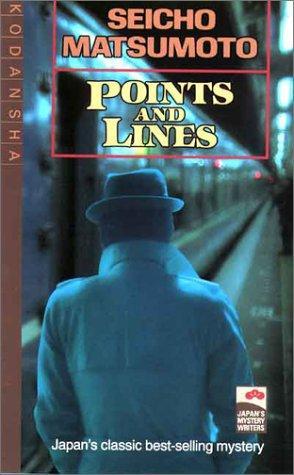
‘Points And Lines’


880842I bought Seicho Matsumoto’s Points and Lines for a present for my mother (at the same time, I bought Flashman for my father; these were both bought at Capitol Hill Books and on the shelf where all the Flashman books are kept has an index card that reads: ‘Flash… Oh Oh…; in case you were not familiar with one of the achievements of western civilization, that is a reference to the movie Flash Gordon and the Queen penned and performed theme song).

I don’t know how I saw this particular book. I was looking in the M’s for something, but I don’t remember what it was that I was looking for.

It’s a very direct and unadorned mystery from the fifties and, in case the author’s name didn’t give it away, it takes place in Japan. The mystery itself centers on train timetables (and also other transportation timetables, but mostly trains). While never stated, I don’t think it’s stretch to say that ‘points’ are train stations and the ‘lines’ are the railroad tracks.

The novel opens with one seeming hero: an aging provincial policeman who can’t help but dig deeper into a seeming lovers’ suicide. But about one third of the way in, a younger policeman takes over. Each moves methodically. Even the dead ends are systematically examined.

The conclusion is disappointing. The author didn’t ‘earn’ the character who wound up playing an important role in the resolution. But it’s overall pretty darn satisfying. My mother is the real mystery buff (which is why I’ll eventually send it to her), but I’m capable of appreciating a fine genre exercise like this.

The book is pretty unemotional, except for the that older policeman who, in two startling moments, opens up. Early on, when getting home late, he eats dinner alone while his wife works on some knitting. When he asks her to have some tea with him after dinner and she declines, he barks at her at the next opportunity. Nothing violent or particularly cruel, but startling. Later, he writes a letter to the younger policeman, encouraging him to finish the case, but also admitting his own failures and disappointments.

I Had This Toy! It Was Awesome!


Tomas Transtromer Died


He never fully resonated with me, but some of  his spare, melancholy poems, full of stark Scandinavia landscapes, I loved very much.

Weekend Reading – Camus Sends His Regrets


Albert CamusThe day Albert Camus was supposed to meet George Orwell for coffee… but then didn’t.

How are you celebrating the 60th anniversary of Howl?

‘Name Of The Wind’


It’s good. But it’s not that good.

I’d heard raves about it and reviews mentioning Arabian Nights style tales within tales. So a third person limited narrative and then a narrative by a chronicler (called ‘the Chronicler’) writing down the story of Kvothe the Kingkiller. It’s not as complicated as it sounds. It is like Heart of Darkness. You can make a lot of the fact that the narrator is actually a guy on the Thames listening to someone else’s story, but there’s really no need. Heart of Darkness is brilliant and you don’t need to make a lot of that minor narrative trick to realize that it’s great. More importantly, that narrative trick has only the tiniest amount to do with its greatness.

So Kvothe is an epic figure with an down to earth nature and it starts out very much the archetypal tale of the hero’s beginning: the tragedy and then growing up an orphan with vengeance, like a hard bead of acid, gnawing at his heart.

But then he goes to the University and… well, let’s just call it Harry Potter-esque. Granted, Kvothe is a more interesting character than Harry Potter, but then so are the flushings that follow a meal of authentic Gujarati cuisine, washed down with prune juice and Guiness and then followed with a dessert of candied tamarind. I can’t say this often enough, so I’ll say it again: if you want to read about a wizard school, you will never do better than to read LeGuin’s A Wizard of Earthsea. What LeGuin does that Rothfuss does not it maintain the same tone and style for the epic bits and the schoolyard bits. Rothfuss seems to switch between classic Tolkien and some kind of mid-century tale of bright young English schoolboys and their antics, only with a little magic.

But let’s not get carried away. This is a good book. If you like fantasy, this is better than 90% of what you’ve been reading. A lot better. But don’t get fooled into thinking it’s in the very top echelon.