Growing Up On Anime


As a teenager, we spoke a lot about anime (which, in those ancient days, we sometimes also called ‘japanimation’) and also (though less) about it’s printed sibling, manga (though we usually just called them graphic novels; at that time, we usually just used the term ‘manga’ to refer to either the anime or graphic novels with nudity). I can’t speak for my friends, but I’m pretty sure that, I, at least, pretended to know and have read and seen more than I actually had. But that’s normal for a teenager, I think.

But certainly, seeing Akira on the big screen at the Tampa Theatre was an awe inspiring couple of hours for me and was probably most responsible for my love (though the foundation had been laid by badly edited and dubbed shows on Saturday morning, cobbled together from various animes, given English language names like Star Blazers and G-Force).

I’m forty now and I still watch this stuff. And I get excited when my favorite ones get name checked (this one here points out some similarities between my favorite anime, Outlaw Star, and the glory that is Firefly).

While my better half was gone for several weeks, I watched a particularly embarrassing series aimed at teenagers (though I still maintain the right to make fun of grown ups who read Twilight and/or watch the movies because there is no good god viable excuse for that if you are over 18). I also read the manga (which came first) on my Nook and now it’s done and there probably won’t be anymore (thought there are whole internet sites devoted to desperately praying that there will be a third series of either the manga or the anime) and I’m unaccountably sad.

When you finish a series that has touched for some reason and you know that there won’t be anymore and, possibly even worse, you can’t go back and read it again for the first time, it’s like having your heartbroken in early adolescence because your pain is almost worse for being insensate, because you lack the age and experience to arrange in your brain into something meaningful and more fully comprehensible. I tried to go back to the beginning and even read the first volume again, but Tom Wolfe was right, wasn’t he, because I couldn’t really do it. My mind was too full of the sadness of the fact of the ending (the ending itself was sad, but not unbearably so; it was more sadness that it had ended at all) to be able begin again.

Pens


This article about judging NYC art galleries based upon their pens seemed like just my kind ‘o thing. I can totally respect the idea of critiquing galleries and of expecting them to have something more than the usual. Pens, too, are a tool for creating art.

Even though my professional writing is almost invariably done on a computer, I am painfully fussy about my pens.

For years, I had single pen; a fountain pen. It had no brand name on it (though it used cartridges made by Waterman), but it had been a gift of Jose and Nico – two friends from Spain – and it was slender and graceful. A perfect writing instrument. It broke after almost ten years during a particularly soul crushing and unhappy Christmas in New York.

I looked for something to replace it and settled on a Cross Century II in chrome. As to pile on the misery, that model has been discontinued, but it has been a sturdy friend so far. The style in fountain pens these days is ostentatious and big and thick. The fountain pen as a tool for Freudian compensation. But I got used to a finer, more elegant style (are you noticing the rhetorical tools that I’m using to dismiss the favored style of fountain pens?) and though I haven’t found anything so slender as the father of my fountain pens, the Century II is comparatively slender, which is why I chose it.

I love this particular kind of notebook – I believe they were originally designed as school composition books – that I used to buy at this shop in LA’s Little Tokyo. They had strange sentences on the front that were clearly more or less literal translations from the Japanese, things like: This notebook is good for writing sentences.

Anyway, a good fountain pen that feels right, fits in the hand and has the correct, tactile feel when you put it to paper, is also ‘good for writing sentences.’


Midweek Staff Meeting – Hobbit Houses


mushroomhouse_one

Poet Mary Ruefle will be at the Hill Center tonight. You should go. I am.

I wish they’d review more poetry, but I guess that I’ll settle for New York Times review of a poet’s memoir (Tracy Smith in this case; I heard her read and she’s very good).

Okay, okay. I get it. This looks fun. #Bookface. Just… read the article I guess. Easier than my trying to explain it.

You missed out on your chance to live in a… above ground hobbit hole? Flintstones cosplay re-enactment set? Move-in ready mushroom?

This New Yorker article struck a chord with me, as someone who enjoys reading nineteenth century literature. I have mentioned a couple of times that I am reading from Richard Burton’s translation of The Arabian Nights and some of the racial language goes well beyond cringe-worthy. Of course, this article was written by someone of Turkish descent and I never even thought of how often ‘turk’ was used as a sort of insult or shorthand for someone or something brutish in nineteenth century literature So… food for thought.

Who cares about the Paris Commune?

This… just because I’m a sucker for this kind of stuff.


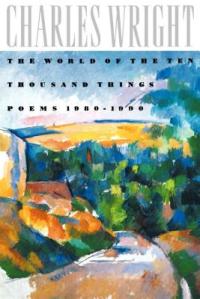
The World of the Ten Thousand Things: Poems 1980-1990


The World of Ten Thousand ThingsThis collection brings together the three poetry collections Charles Wright published during the 1980s: The Southern Cross (1981), The Other Side of the River (1984), and Zone Journals(1988). Also, at the end, there is something short (a chapbook?) called Xionia which reads as part and parcel of Zone Journals, down to titling various poems as ‘journals.’

When I saw him read at the Library of Congress, I mentioned how much the poems from Zone Journals reminded me of the Cantos. Having just finished the book, I can say that every book he published in eighties was pregnant with Pound’s influence.

Besides their shared love of Italy, the style is very Poundian, with the Whitman-esque lines, only dripping with allusion and a sort of distant nostalgia for a place that maybe you never even knew.

But Wright is not Pound and I wish I had not read it so aware of Pound and therefore reading Pound through him because, even though Wright is genius, there are geniuses and there are geniuses. Wright is the former. Pound is the latter.

Wright’s semi-Cantos mix landscapes and memories from his early years in Appalachia, from time living in Montana – a sort of rural, hardscrabble, American mythopoetic time – with time from his years in the military posted in Italy and latter years studying literature in Rome. The balance can sometimes be uneasy (though the balance of everything in the Cantos, to be fair, is also uneasy), though.

The genius in this is not the monumental historical scope of Pound, but a more interior view. But an interior view of the exterior world. The environment filtered through memory. A couple of times, he mentions vaseline, as in vaseline-colored light or seeing things as if through vaseline. Now, he doesn’t strike me as movie obsessed guy, so I don’t think this a reference to a camera trick to make actors look younger, but rather a way to try and explain the haze of temporal distance and memory.

Not Dead Yet – Weekend Reading


A reading of Molière, Jean François de Troy, about 1728

Yes, that was a Monty Python reference, but I’m referring to old fashioned bookstores. Unbelievably, there is a book store in DC that I haven’t yet visited. It’s in Petworth and is called Upshur Street Books.

What? No Shakespeare! Inconceivable! And yes, that’s another movie reference.

This just sounds awesome. How can I get myself invited to one of these ‘Little Salons?’

The ‘mind’ of poetry. But, seriously – you used the Laffer Curve to prove your point? I mean, you do know that the Laffer Curve is almost completely bogus?

This is just kind of cool – a collection of short reviews of both books in Ace’s ‘Doubles’ series. I just read one with The Caves of Mars on one side and The Space Mercenaries on the other. However, there is no review of that book(s) on this site. But that’s okay. You are quite literally visiting a site – right now – that reviews both those books. There’s a search feature. Feel free to use it.

I have heard that the Philly poetry scene is pretty cool and happening. It even got mentioned on Gilmore Girls once.

Nothing short of genius will do. Genius… and no sex. Wait… what?

Typewriters I have known.

Poets Laureate


Thursday, April 30, was the final, formal appearance of current Poet Laureate, Charles Wright, at the Library of Congress. Rather than do a lecture, there was a conversation between Wright and the fifteenth Poet Laureate (Wright is the twentieth), Charles Simic. Don Share, the editor of Poetry, moderated and asked the questions.

I used to be a great fan of Simic and while I don’t read as much anymore, his collection of prose poems, The World Doesn’t End, had an earth shattering effect on my sense of poetry. Wright is someone who I only learned to enjoy after I first heard him read at the Folger Shakespeare Library.

Everyone on stage was charming and intelligent and witty, but there was too much charm and wit on display and not enough talk about poetry. I like Share, but I rather wish his more contemplative editorial predecessor, Christian Wiman, has been on stage.

I brought a copy of The World of the Ten Thousand Things: Poems 1980-1990 for Wright to sign. The later poems in there, taken from Zone Journals, struck me very forcibly as being reminiscent of Pound’s Cantos (everywhere, I am constantly reminded that I haven’t finished my systematic reading of it yet). Partly, it was the Whitman-esque form of the lines and stanzas, but also the deep influence of Italy on both men. But you could tell that Wright had once been in love with Pound and carried the Cantos with him in a backpack. During part of the conversation, Wright did mention the Cantos and Pound and their crazy genius. He clearly loved Pound very much. When I asked him about Pound, he said he wasn’t really thinking about that ‘crazy genius’ when he wrote Zone Journals. He had read the Cantos as a young man, but not since. Which is fair. Works like that are for a young man’s adoration and an older man’s guarded nostalgia.

The Caves Of Mars


  The Caves of Mars is the flip side of my doublesided ‘Ace Double,’ which also includes The Space Mercenaries. Look, I’m just going put it out there: The Space Mercenaries is better. The Caves of Mars moves slowly, but interestingly through some world building and character/relationship background and building, but then speeds towards… I don’t know. An irritating and unconvincing deus ex machina style ending.

It begins with a trip to Mars that goes awry, with the hero, Ric, a space pilot and man of action, losing his arm checking out something in an ice cave for his friend, the nervous nelly scientist, Alan. They both used to be in a sort of love triangle with the improbably named scientist, Candi.

But they had happened upon some super awesome fungi that cure all your ills. But it is the clearly nefarious Doctor Krill who takes the lead on this stuff. Marketed as something called Martian Panacea or ‘M-P,’ the Law (capitalized) outlaws it out. As they say, when M-P is outlawed, only outlaws will have M-P. So there’s this plot where the disconsolate and suicidal Ric gets a secret message from Alan and sneaks into a secret M-P hideout in Mexico. Around this time, he figures out it’s a sort of cult and…

Well, let’s skip past all the bits where Doctor Krill, despite catching Ric and Candi en flagrante declicto – and I don’t mean the sexy kind, but the obviously seditious kind. But Krill basically says, ‘I’ve got my eye on you!’ and lets them go. Kind of.

Anyway, there is an alien intelligence left by a long forgotten race and Ric cunningly stops Krill’s plot to clone a race of martians to serve him by – and here’s where I’m not totally sure what actually happened – implanting his own DNA into the test tubes so that the reborn martians will now worship Ric as a god, which is, don’t get me wrong, better than Doctor Krill being worshipped as a god, but I’m not convinced this in an unalloyed good.

It had the hope of being a decent, second-rate space opera, but devolved into a not so decent, third rate space opera.


bookstoreday

A few of my favorites…


Politics and Prose (Washington, DC)

Inkwood Books (Tampa, FL)

Skylight Books (Los Angeles, CA)

Bridge Street Books (Washington, DC)

Lemuria Books (Jackson, MS)

Strand Books (New York City, NY

City Lights Books (San Francisco, CA)

Teaching for Change (Washington, DC; located inside the original Busboys and Poets).


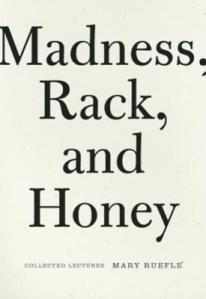
Madness, Rack, And Honey


Madness, Rack, and Honey

First things first: kudos to Mary Ruefle for using the Oxford comma in her title! I love that little comma. If you are a semi-regular reader of these semi-daily musings, you have probably already noticed that I use it myself. Generally, I like commas. Aesthetically speaking.

Ruefle is a poet, but Madness, Rack, And Honey is a collection of essays. I’m not a huge fan of her poetry, if I am being completely honest, but this book has been staring at my from the shelves of the poetry section in downtown DC’s Barnes & Noble for some time. Eventually, I submitted.

Ok then. It’s a good book, but it’s got its highlights and lowlights. The essays on ‘Secrets’ and ‘Fear’ are definite highlights. The inquisition about secrets and poetry, with some references to Jesus thrown in, is amazing. Similarly, the lecture on fear and poetry is great. Does fear inspire a poet? Stop a poet? Are you afraid when you’re writing or when you’re not? Is writing scary? Is being a poet scary or does it relieve fear? Is fear the source of knowledge, as Nietzsche claims?

But the ending drags, with a serious of unsystematic brief essays and ‘gobbets’ that add to something closer to laziness than insight.