 On sort of defending Vanessa Place. But not really. But, yeah.
And there may be a hurricane hitting me today or tomorrow. Wish me luck.
On sort of defending Vanessa Place. But not really. But, yeah.
And there may be a hurricane hitting me today or tomorrow. Wish me luck.
I watched Star Trek: Nemesis last night, the last of the Next Generation movies. It wasn’t a great movie (First Contact, however, was), but just before the credits started to roll, that music came on. You know it. Bright, hopeful, adventurous. The classic theme.
The new ones can’t compete. The miss what made the original series and its (best) subsequent movies iconic, as well as the joys of the Next Generation.
I was talking about this with a friend. Or, rather, I was complaining how the reboot’s version of Kirk gaming the Kobayashi Maru scenario missed the point that was made in (the real) Wrath of Khan (which was about fear of failure, but also a refusal to accept a no-win scenario, as well as the conflict between Kirk’s need to save everyone and Spock’s final statement, ‘The needs of the many, outweigh the needs of the few… or the one;’ in the reboot, it was just about Kirk being a snot nosed brat).
My friend made an excellent point: Chris Pine wasn’t playing Kirk in the two new movies; he was playing late period William Shatner was a young man.
Shatner has aged into a figure of good humored mockery, but as Kirk, he wasn’t that Shatner. You understood why he was the captain and what made him a good commander. When Chris Pine’s Kirk gets Spock riled up to show that he, not Spock, should be the captain, all it really showed (to me) was that sometimes the new Spock could be almost as much of a horse’s ass as the new Kirk was all the time.
Even a flawed film like Nemesis still had Jean-Luc Picard and the smiling, winking gravitas of Patrick Stewart, who understood what it mean to be in the Star Trek universe.
 As part of a series of plays by and/or about women that is currently appearing throughout the city, the Folger Shakespeare Library put on texts&beheadings/ElizabethR.
It’s far better than the title, which sounds like it was written by someone who’d just read of tone essays of by second rate Derrida disciples.
On stage are four ‘Elizabeths,’ each representing, in part, different periods of her life, but mostly different aspects of her life. For example, the last one to be featured (in what the cast declared to be Movement 4), mostly focused on her strident anger at attempts to marginalize her or threaten her reign or right to rule.
Each of the four movements featured one actress whose ‘lines’ were almost exclusively from the writings on Queen Elizabeth herself – from her prayers, her letters, her poetry, and her speeches to Parliament. The other three would speak more colloquially, providing background and context.
It was absolutely gripping and compelling and it seems petty to criticize, but I will anyway. One actress had a strong accent (Spanish, I think), which detracted, for me, from her portrayal as that quintessentially English figure. On a more existential level, as fantastic as it was, what was the purpose? What were we intended to learn or walk from it with? I’m not clear.
But still. A Shakespeare theater was the perfect outlet for this, because any production of Shakespeare invariably is at least partly about showing this centuries old writer, this man of his times, wrote works that are relevant and timely/timeless. If this play (performance? production? it’s not exactly a play, is it?) had a purpose, at least part is showing how Queen Elizabeth’s existential, feminist struggles for power, for the right to power, and for the right to determination are as timeless and timely as they are of their time.
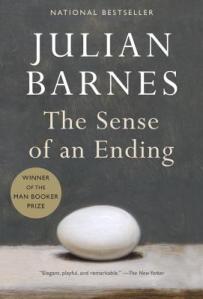 This is the second book I’ve read by Julian Barnes (the first being Flaubert’s Parrot). It was actually a birthday present from two good friends, received, due to schedules and a variety of circumstance, not long before my next birthday.
But, having already crossed forty and writing this just before leaving forty and entering my ‘forties,’ it’s an appropriate book. The narrator is in his sixties, but the idea of looking back and knowing that one’s history and memories could all be wrong.
An ordinary kind of guy, who receives an odd bequest from an ex-girlfriend’s mother: five hundred pounds and the diary of a schoolboy who committed suicide, but who had also dated said ex-girlfriend just before said suicide.
It’s all complicated and our more or less unexceptional narrator is poorly equipped to understand, but it turns out that he had written a vicious letter to the couple that he had totally forgotten about – it had been erased from his own understanding of his own history.
His dead friend, had, at some point, had an affair with the ex’s mother and there was a child with developmental disabilities. Understandably, the ex (I should just name her: Veronica) felt devastated, ruined.
Part of her anger fixated on the narrator. Not fair, of course, and I read some reviews that felt Veronica was not credible, but I didn’t. I can understand anger and I can understand that sometimes you need to be angry at something or someone. In this case, it was her ex, who wrote that note. Easier, maybe, then hating the dead man, the dead mother, or the disabled brother.
So, I liked this book.
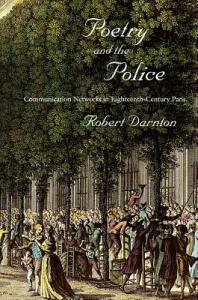 I had been looking forward to this read for a while. It had been on my personal ‘must read’ list for a couple of years. You can probably guess where I’m going with this: I was a little disappointed.
Part of it is my selfness as a lover of poetry and Darnton gives little shift to the importance of poetry in and of itself.
I suppose I should summarize a little. In 1749, the police went a little crazy trying to track down the origins of some satirical poems mocking King Louis XV (and some of his ministers; his mistress, the famed Madame Pompadour [her maiden name is ‘Poisson,’ French for fish and some of the songs used that fact and… let’s just jokes about fish and the smell of a woman’s privates go way back]; and the King’s apparent cowardice in sending Bonnie Prince Charlie to die at the hands of the English). The tale goes over how very strata of society intersected with these satirical poems, usually set to popular music of the day.
But I wanted to know more about the poetry itself, its writing, and its writers. Surely it means something that poetry, literature was considered a threat.
Also, the style of the writing of the book was a little undergraduate.
 It wasn’t that she found the idea particularly objectionable, but that she was out of town every time I went (purely coincidence, I assure you). She hemmed and hawed a little, but in the end, it was a great night and I think she enjoyed it.
Flying Guillotine Press launched new book of collaborative poetry by sixty odd writers called Breaking the Lines. I checked it out, but it wasn’t really my bag, but I did pick up another one of their books, Stephanie Balzer’s WED JAN 30 12:58:10 2013 – THU DEC 20 14:16:36 2012. There were also jam samples from PinUp Preserves, but someone I missed those.
The opening was some poetry by Lucian Mattison and… can I admit he didn’t really do it for me? From DC’s ‘Opera on Tap’ (wherein people sing opera at bars) were Kristina Riegle, Carla Rountree, and David Chavez. They actually sang from musical theater, but they were great performers, as well as being excellent singers. I even got some special attention during ‘I Hate Men,’ because when the line about men with chest hair arrived, well, I was the only person near the front with suitably Sean Connery-esque fur. I don’t get a huge amount of attention from ladies these days, so we take what we can get, even if it’s being singled out during a song entitled, ‘I Hate Men.’ Finally, there was a vaudeville style act by Mark Jaster and Sabrina Mandell (from Happenstance Theater) and puppetry by Sarah Olmsted Thomas and Alex Vernon (also occasionally from Happenstance Theater). The puppetry was absolutely magical, though it would take too long to explain, so if you live near DC, try and find a time to see it and if you don’t, well, sucks to be you.
 I actually have no article to post here about telecommuting, but his Holiness is visiting DC and, even though I am writing this Monday evening, I feel confident saying that traffic will indeed by horrible and snarling today (Wednesday). A lot of folks are telecommuting and, really, I’m hoping I will be allowed to, as well, though it’s hard to say and my office doesn’t really have a policy on this.
You will be missed, C.K. Williams.
A nice, balanced article about the new head of my favorite museum in DC, the Hirshhorn.
 I’d read a couple of books by McKillip in my teenage years, namely the first book in the trilogy of which Heir of Sea and Fire is the second, and a book called The Forgotten Beasts of Eld. She’s very much a fantasy writer in the vein of Ursula LeGuin, but without LeGuin’s interest in colonialism (or rather, anti-imperialism and post-colonialism); less political and more elegiac and definitely more influenced by Tolkien (not so much Lord of the Rings; check out a short novel of his called The Smith of Wooton Major).
But anyway… In most ways, it’s not as good as The Riddle-Master of Hed, having the ‘middle book syndrome’ or being most dedicated towards getting to place where the third volume embark on its conclusion.
In another sense, though, it has something more important than its predecessor: it is about a woman’s journey. Granted, she’s looking a guy, but still, she (Raederle is her name, by the way) gets her own book with her own arc and self discoveries. But it’s not as good as the first book. Her journey still isn’t as interesting as Morgon’s in the first book (and it doesn’t have the magic of my old memories of The Forgotten Beasts of Eld). I was also hampered by having waited too long between books and being a little unsure of the characters.
 I saw this collection on the shelf at a bookstore and while I didn’t get it at the time, for some reason it gnawed me. I did some googling and read about the book and the author and, somewhat trepidatiously, finally sat down to read it.
Machi Tawara is not Yeats nor Dante nor Milton nor Eliot nor Ashberry – at least not in translation (I know that I am missing a ton of information and shading, not in the least because they are all written in tanka form and Japan’s specialized poetry forms don’t really translate directly to English without losing their form). They’re a little sappy, more than a little youthful, a bit twee, and they should be trite, but, instead, they are delightful. I can see why the book became a bestseller in Japan.
Mostly about falling in love, losing love, being in love (and a bit about being a teacher and living alone), there is nothing groundbreaking about any of it, but as soon as I had finished, I wanted to go back and read it again.
The individual tanka are translated here as three line verses (in Japanese, they would be a single, vertical line). Each one makes for self contained poem, while simultaneously making for a continuous narrative.
From a poetic sequence entitled Hashimoto High School (where the then twenty-something Tawara taught):
Girls in middy blouses
scurry through the streets
as if keeping someone waitingWriting the character for “youth”
somehow I’m struck
by all those horizontal lines
Besides that first tanka‘s echoes of Pound’s metro station, each tanka works perfectly as a self-contained poem, but also lends itself to a clear, more or less linear sequence.
 the coffee philosopher