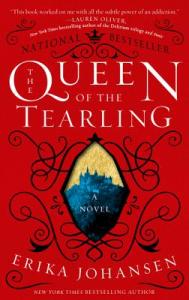
Queen Of The Tearling


9780062290380I can’t remember why I got this. I find myself reading a lot of genre fiction these days, but this one was better than many and most. A sort of fairy tale and a sort of new world myth (travelers take the ‘Crossing’ to a new land to build a utopia; science doesn’t always work, but some magic does; the Crossing is in the distant past and things have… evolved?… into a traditional, medieval-style fantasy world, with some tweaks like pre-Crossing books, including The Hobbit and cigarettes).

The political machinations remind me a little of The Hundred Thousand Kingdoms (perhaps not a coincidence that both are written by women and both feature female protagonists who are described as being plain-looking). Magic-wise, there are summoned demon-like creatures and a pair of necklaces (best compared to the titular elfstones of The Elfstones of Shannara).

At less than four hundred pages, it feels almost short and I read it in just a few days, once I started it (the novel had been sitting, unread, on my Nook for months). I’ll certainly read the sequel (and maybe very soon; I’ve got a trip to see family in Arkansas coming up and it could be a nice option for the flight). If I have criticism, it’s that, at times, it can almost feel like YA. I don’t think it is, or rather, I don’t think it was marketed as such, but it comes close. Though I say that having not really read much recently. I read the first few Harry Potter books (and did not love them; didn’t dislike them, but didn’t love them), but that’s really it. No Hunger Games, no Twilight. I have been known to reread a favorite Narnia novel, but that’s it.


Tarzan


Despite considerable searching, I have not been able to find the one from my memories.

It’s not possible for Tarzan not to be problematic. Simply not possible.

I have never actually read a Tarzan story, though I will confess to having read half a dozen novels by Edgar Rice Burroughs (four of his Mars novels and two of his Pellucidar novels). Growing up, there was one in the library. The library was small, dusty room with a piano that no on in the house could play. And there was a Tarzan novel (or, perhaps, a collection of short stories; I believe that many of the so-called books were just compilations of short stories originally published in magazines). On the cover was Tarzan and a crocodile in a fast moving river. I can’t remember whether they swimming (Tarzan being chased) or whether Tarzan was wrestling the reptile. Despite loving crocodilians, I did not read it, partly because my mother told me that the stories were racist. So I looked and looked, but never read.

My better half and I saw the movie, The Legend of Tarzan the other day. And I enjoyed it. It worked manfully, it not entirely successful to make the white savior aspects less horrible (though it would have irritated purists and white supremacists alike, it would have been cool if Jane had been played by black actress).

Maybe I will read one finally. One with dinosaurs or lost cities. Or not. Maybe I should not.

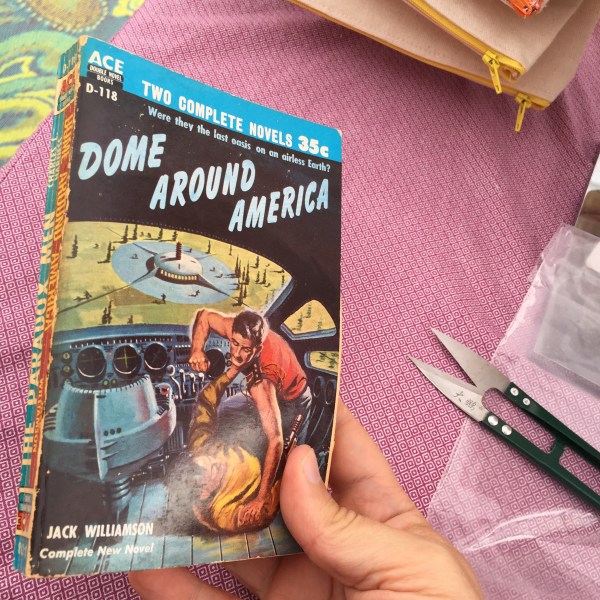
‘Dome Around America’ By Jack Williamson


The best part of Ace Doubles are a return to a time when a science fiction novel didn’t have to be heavy enough to crush a man’s skull. One hundred to one hundred and fifty pages of fast moving plot.
I’ve noticed that a lot of these novels seem to have radical changes in plot in the final third – an unexpected crisis/event that acts as a kind of reverse deus ex machina. Saw the same sort of thing in Agent of Chaos and Master of Life and Death.

Anti-communism was a theme. At first, it seemed like it was all prepped to be a criticism of American style capitalism, but then… it wasn’t.

I’ve already started the other side, The Paradox Men, and it seems much more imaginative.

‘Burr’ By Gore Vidal


Vidal signed my copy of his early novel, The Judgment of Paris, at the West Hollywood Book Festival some ten years ago. I read it, enjoyed it, but did not give him much more thought.

When The Best of Enemies, about the 1968 Buckley-Vidal debatescame out, I rushed to see it with a friend at the E Street Theater downtown and, for the first time, saw Vidal as a monumental figure.

But, in a way like Christopher Hitchens (who had a fraught relationship with Vidal), you wonder whether there will be any cultural memory of him twenty years after his death. Will his books and essays be read?

So, I decided to read one of his most famous (and best reviewed) novels, Burr.

Will Burr last?

Maybe. Yes. No.

A little, is probably the best answer. Much better than middlebrow (midcult?), but a shade below masterpiece or classic. It’s far, far, far, far, far, far better than Gone With the Wind, but I can see it having a similar lifespan. Mitchell’s novel has maintained an incredible cultural cachet and readership over the years, but is, I think, finally fading (mainly because it is unreconstructed claptrap).

But the real novel in question.

The character of Aaron Burr himself is a fantastic creation and the novel acts as a fantastic apology/redemption for the figure. For those who don’t the story of the novel, a man named Charles Schuyler finds himself becoming the biographer – or, really, the scribe for a memoir – of Burr. The novel jumps between first person sections from Schuyler’s perspective on his own life in New York City in the 1830s and then first person sections from Burr’s perspective, narrating major parts of his history (and, necessarily, the founding of America).

Based on my own (admittedly slight) readings of original texts from the eighteenth and early nineteenth century, Vidal has a nice sense of an earthy, pre-Victorian mindset for Burr (though it’s still a modern novel; also, thankfully, with regular and recognizable spelling) – less so for Schuyler. His Burr’s depiction of a craven, political Thomas Jefferson is as frighteningly hilarious as his thin-skinned, conniving, and barely competent George Washington.

American history during this period is not really my forte and I’m not going to act as judge on much of the accuracy of this – I just don’t know enough of Revolutionary and early post-Revolutionary American history to stand in judgment – and I know enough about Vidal to believe that, even if he would fudge for literary reasons, he did voluminous research. It’s certainly not news to say that Vidal is deliberately revisionist, in the sense of changing how we view the sacred icons of our founding fathers.

I have read that Vidal’s so-called ‘Narratives of Empire’ (of which this was the first book) is intended to show the evolution of America into an empire, but Burr ultimately feels elegiac. You could say an elegy for a dream lost to dreams of empire, but that’s not what it feels like to me. Schuyler missed the Revolutionary War and is somewhat in between epochs. Around long enough to hear the myths and truths of a great age, but not old enough to have experienced it.


‘A Philosophy of Walking,’ By Frédéric Gros


I had a B&N gift card, a coupon, and an hour to kill when I bought this book, which is light reading; something playful that is a very good way to kill an hour or two.

The structure is more or less alternating chapters, with a introspective musings by the author on the nature of walking (and of walking in nature; urban walking gets short shrift) being followed by a biographical sketch of writer or philosopher (usually, though also Gandhi).

Overall, the first half or so of the book is the best. The first author delved into deeply is Friedrich Nietzsche and his story of the German philosopher’s mental and physical decline was downright moving and his deftly illustrated the importance of (usually solitary) long walks in the countryside to his process and mental well being. The section on Rimbaud was almost as good. The one on Kant provided an interesting counterpoint to Nietzsche. The one on Rousseau… was okay. I said he gives short shrift to cities (the walking about which Gros philosophizes is more hiking than a stroll) and the chapter on, ostensibly, Baudelaire, the great flâneur, contrives to be mostly about Walter Benjamin and is not terribly respectful of that mode.

But shouldn’t criticize too much. It is not philosophy, in an academic sense, but a brisk read. Perfect, perhaps, to take on a long, silent walk. Silent because, as Gros writes, ‘But above all, silence is the dissipation of our language.’

The Sunday Paper – Shuffling The Tarot Deck


Economic model or astrological tool?

Economists use ‘mathiness’ to disguise their astrologies.

Old fashioned literary hate mail is the best literary hate mail. Today’s internet trolls just can’t compare to the greats of the genre.

We just don’t make good polymaths anymore.

‘Thunderbird’ By Dorothea Lasky


I feel vaguely guilty about this book, because I got it for free from Wave Books, because they were late getting some books I’d ordered sent out (Wave Books is a great publisher of contemporary poetry and I feel guilty about inconveniencing them and cutting into their margins; on the other hand… free poetry!).

This was my first time reading Lasky’s poetry and, at first, I found it a struggle. Not difficult, just not my kind of thing.

But I persevered and was pleasantly rewarded by a series of political and feminist explorations. Basically, I didn’t like the first two poems in the book, but thought everything else was pretty super awesome.

From ‘I Want to Be Dead’

I want to be dead
After all the ultimate act of self-indulgence is to be dead
Histrionic bareback

I will make one tiny objection, though. The fonts are terrible. Or rather, the titles of each poems are in a terrible, bold, gothic-y font that strains the eyes and take me out of the poem whenever my attention wanders to the top of the page.

The Ladder In The Sky


The Ladder in the Sky, one half of an Ace Double (the other half being The Darkness Before Tomorrow) is an oft told tale of an ordinary man given amazing intellectual, including mystical/psychic/super-science powers.


It does nothing very well, but nothing badly and I was entertained for an hour or so. If there was something, not exactly new, but different, was that it took place in ‘the future.’ Normally, the ordinary person lives in more or less modern times, but in this case, it was already a science fiction setting with interstellar travel and what not.

That day I’d brought two books with me to read while I was working for my better half at Eastern Market. Unfortunately, I’d misjudged the speed of my reading and found myself bookless by noon, so I ran to Capitol Hill Books during a lull and grabbed this Ace Double – mostly because it was an Ace Double and I just think the idea is cool – for four dollars twenty-four cents, including tax.

Happy Birthday, Ginsberg


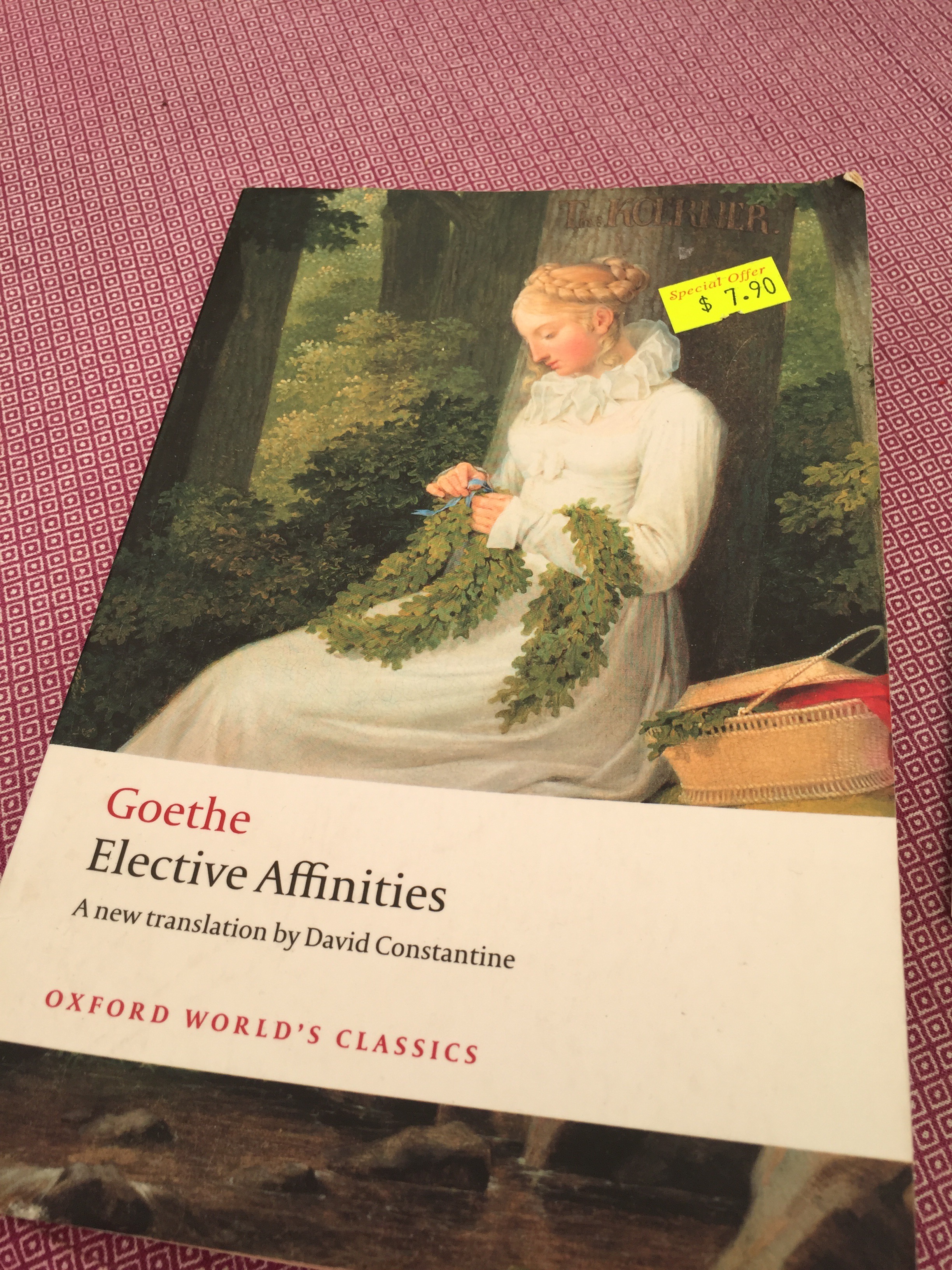
‘Elective Affinities’ By Goethe


I found this book in a used bookstore in Singapore and first heard of it from the great French film, Jules et Jim. But all you can ever find of Goethe in America, if you can find anything at all, is The Sorrows of Young Werther and (maybe) Faustus.

I can’t believe it’s not more widely read. It’s got a strong current of sexy running through it and it’s relatively short. In some ways, it reminds me of J.K. Huysmans’ The Cathedral, except it’s digressions are not so much philosophical-theological as philosophical-psychological and about gardens and landscape, rather than the great cathedral at Chartres.

Basically, there is a couple, previously married, but in love for years, who married each other after their first spouses died. They seem happy, but then some other feelings interfere, when the husband, Eduard, invites his friend, ‘The Captain’ (later, ‘The Major;’ and never given a proper name) to stay with him and Charlotte in their country house. Charlotte invites Ottile, her ward (semi-adopted to be a companion to her daughter from her first marriage).

Charlotte and the Captain fall in love over their shared love (though differing philosophies) of landscaping. He leaves so as not to break up the marriage.

Meanwhile, Eduard falls passionately in love with young Ottile.

Where it gets tricky for the modern reader is that Eduard is clearly showing signs of being an abusive type. Possessive and manipulative and childish. It’s actually kind of scary and you worry that he will actually be granted a divorce and marry the poor girl. The fact that he hardly seems to care or be discouraged by the fact that Charlotte gives birth to his son while he’s sulking in a country cottage far away is not a good sign.

I would love to keep this book, but it’s got some mold or mildew on it (Singapore is pretty tropical) and my throat gets itchy when I read it, which is too bad.