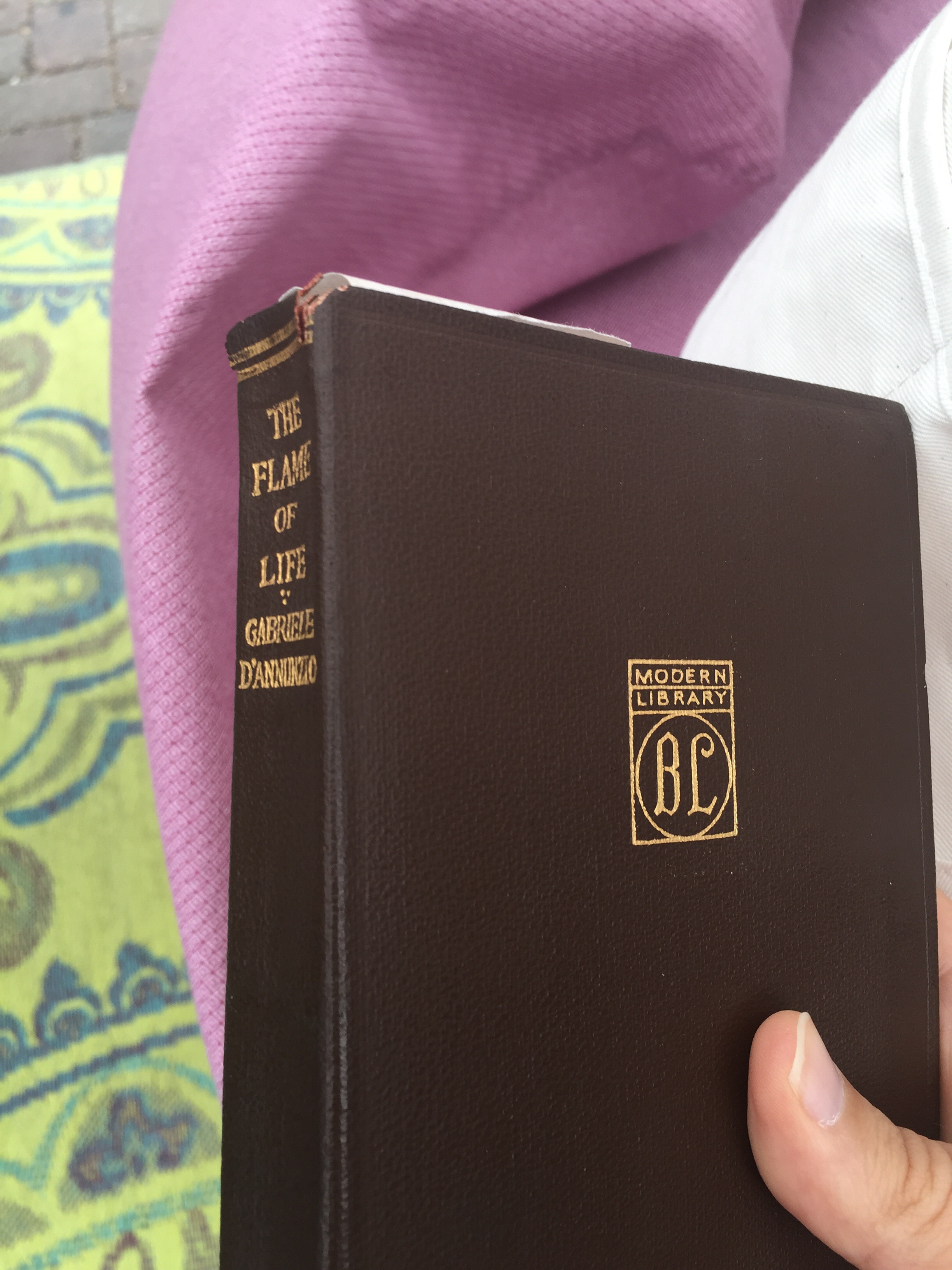
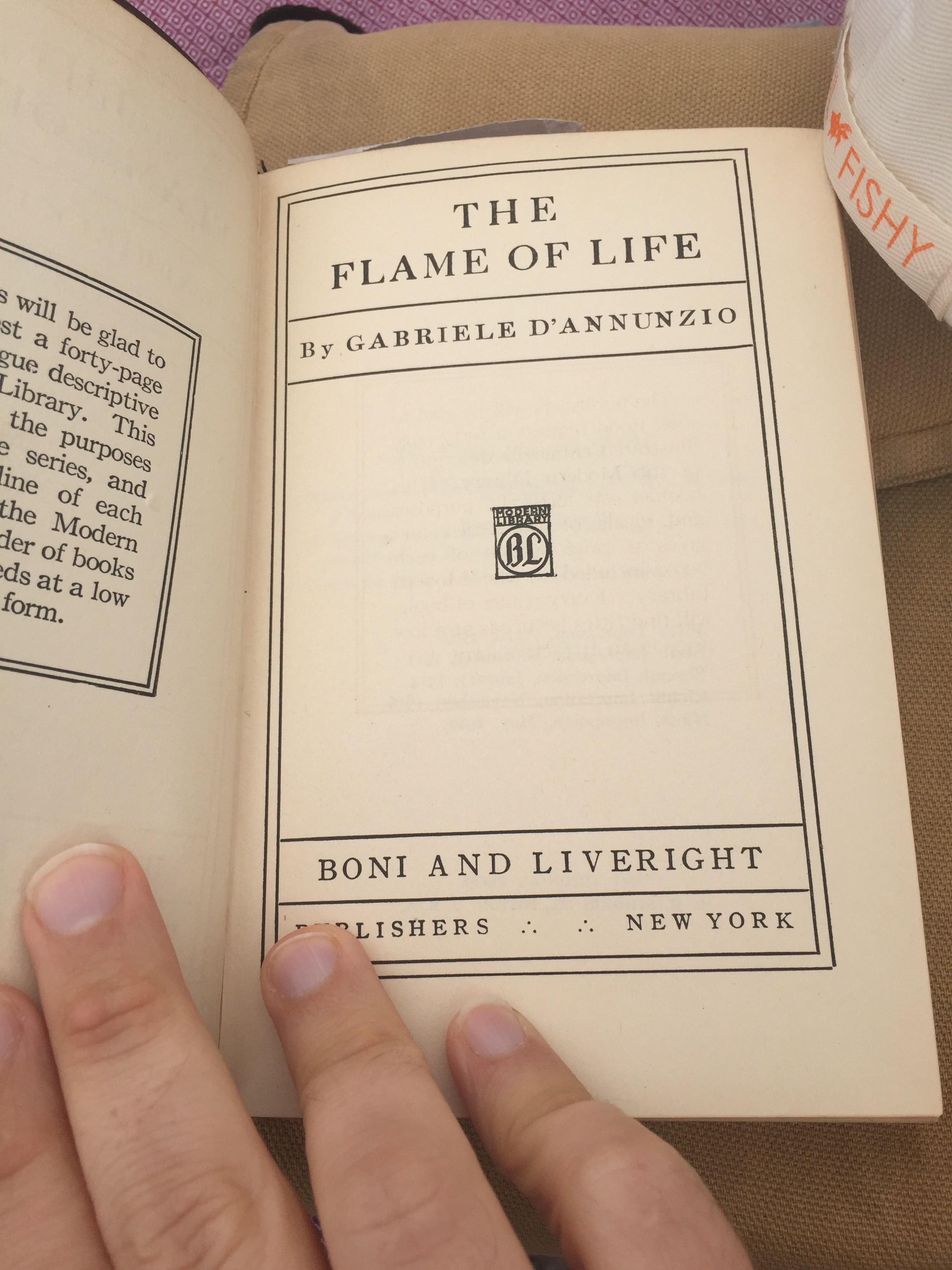
‘The Flame Of Life’ By Gabriele D’Annunzio


I bought this book in complete ignorance of anything buy visual and tactile beauty; as a physical object. But I wasn’t wrong in guessing that I would enjoy what would surely be some wonderfully overwrought prose.

The plot is wafer thin (Monty Python reference) and driven by issues and concerns that seem positively ridiculous. A dionysian poet named Stelio enthralls a lushly imagined Venice with his wild declamations on art and beauty. Among those enthralled a beautiful actress (former courtesan, too?) alternately called Perdita and La Foscarina. Their love (and presumably, their passionate sex, though that is never mentioned nor described) is voluptuously erotic, but it is haunted by La Foscarita’s greater knowledge of impending knowledge. Yes, she is a nearly decrepit thirty-four (I’m guessing the young genius poet is in his mid-twenties). I’ll admit, those concerns pulled me out of the narrative a bit. Maybe if he had been twenty and she was thirty-nine, I’d have seen the problem more clearly… She is also haunted by the memory of a beautiful and, needless to say, virginal singer named Donatella. Poor Perdita believes that Donatella is destined to be Stelio’s life partner.

But it’s not about plot. It’s about lengthy digressions on art and poetry and architecture and Richard Wagner’s death (which bookends the novel; placing the action around the year 1883). It’s about painfully decadent prose stylings that you will either love or that will force you set the book down before the fifth page.
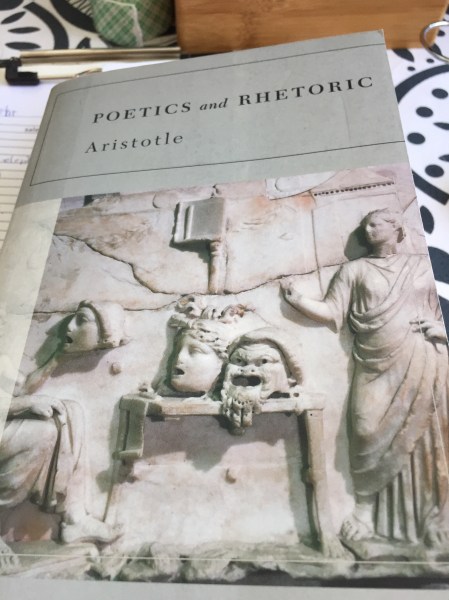
‘Rhetoric’ By Aristotle


I probably owned this book for at least a decade before I started reading it recently. Just a quick glance would have indicated it’s not nearly so long as it appears. First, because it also have the Poetics, which I’ve already read (not that it would hurt me to read it again, but we are focusing on reading Rhetoric for the first time) and second, because the left hand side of the page is just for notes on the text, which, even if you read them, means lots and lots of empty real estate on half of the pages.

I’ve been on a minor ancient (western) philosophy kick, having also read some Sextus Empiricus recently.

My motivation for picking this book was two fold: availability (I owned it) and a (misguided) belief that this would actually contain a great deal of logic. I don’t know where I got the idea, but I had been under the impression that a good chunk of Aristotle’s inductive logic writings could be found here. Smart readers of this blog will have figured out by now that I was wrong (less intelligent readers may still be waiting for the answer to be revealed).

Can’t really say that I got many deep insights in the actual art of rhetoric. In that respect, Quintilian is a much better guide. There was a little logic, in the form of Aristotle’s frequent references to enthymeme’s, a type of syllogism. But, of course, syllogisms themselves are discussed in the Topics, not Rhetoric.

So do I get some more Aristotle? Something beyond his Politics or De Anima and try to find one of his actual books on logic?

Maybe, but it seems like a lot of work and possibly relatively expensive and I’d have to hide the purchase from my better half.

No, I’ve got a nice looking copy of Cicero’s De Oficia on the shelf that I saw the other day, and that seems like a much more likely choice.

Amber


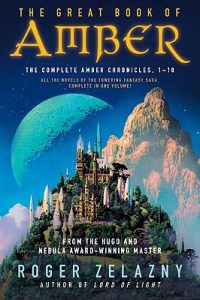
9780380809066Some years ago, I bought The Great Book of Amber at a used bookstore. The Amber books were one of those books I remember seeing on shelves in used bookstores when browsing for sci fi and fantasy as a kid, but were not ones that I read at the time.

These collection actually contains ten books and I only read the first five, but that first five contains the initial, extended story line of how Corwin saved Amber and possibly the entire known universe from… well, let’s just it’s a complicated plot.

The setting is interesting: the ‘real’ world is Amber and what we know as ‘Earth’ is one of many (limitless?) ‘shadows’ of Amber, some of which were created by the disappeared king of Amber and his many children. There is also the ‘Courts of Chaos,’ which is very poorly described and explained and winds up sounding very much like something from Michael Moorcock (Moorcock and Zelazny were both part of a new wave of British fantasy).

The hero, Corwin, embarks on a swashbuckling journey quest, which is thrilling, but, as you can probably guess, not as engrossing to me as it might have been. There are those who swear by these books. For me, I was totally gripped at the noirish mystery with which opened, with an amnesiac Corwin waking up in a mental hospital on ‘Earth’ and trying to figure out what the heck is going on, but once he learned, it became less interesting to me.

Nonetheless, better writing than most and not sorry I read it.

And Yet…


9781476772066The most recent (though probably not last) of the posthumously published collections of Christopher Hitchen’s essays lends itself to a sort of narrative arc, as the pieces inch closer to his terminal diagnosis with esophageal cancer and the reader’s mind naturally tends to see relationships (prophecy?) between his death and the chronologically later essays.

As someone who spent the first five years of the new millennium as a professional political campaign professional, the political essays around the 2004 election and shenanigans in Ohio were a painful reminder of a time that, until my memory was sparked, felt very long ago. Pleasingly, those and other discussions of then current events from the middle of that decade did not feel as dated as they could have.

His book reviews – at their best, excuses for lengthy rambles that show off, but provide the best platform for Hitchens ‘holding court’ – are the highlights, especially the long ones on biographies of Che Guevera and V.S. Naipul (Hitchens shows off his Britishness by referring to him as Sir Vidia).

It’s no secret that Orwell was a touchstone for Hitchens. As an essayist, he is often compared to Orwell; and I have often heard Orwell described as the great English essayist of the twentieth century.

But what have you read by Orwell? I’ll wager, gentle reader, that it doesn’t extend beyond his best known novels, 1984 and Animal Farm. And if you have read an essay, it was probably that short one he penned on the proper way to make tea. While an admirable tidbit, hardly what reviewers are referring to when they praise Orwell the essayist.

My point is related to a question that came to me when Hitchens died: how long will be remembered?

Having not written a pair of timeless novels, who will read his essays, beyond a handful of academic scholars, in twenty years? His reach will be less than that Edmund Wilson wields today (which, let’s not kid ourselves, isn’t much). His book length works are too timely, methinks. Maybe Letters to a Young Contrarian will be read, but it feels to self congratulatory to me to be the source of long lasting, posthumous relevance.

Supermarket Fantasy


I came across that term in an interview with the sound artist, Allen Mozek, and I instantly knew what he meant.

As a child, I remember that my mother would take me into this one, huge (it seemed to me) store. I think that it was a grocery store, but it might also have been something like a Target (though probably not a Target; maybe a Montgomery Ward). In that store was an enormous (again, it seemed so to me as a child) row of books and magazines. I loved best these hardback books that were mostly science fiction illustrations, like cover art for books and magazines. But that also had paperback fantasy and science fiction.

Recently, we visited my family in rural Arkansas. There was an old fashioned drug store that used to have a wire rack filled with cheap paperbacks.

Also, I can remember when supermarkets used to have books. I know that many still do, but back in the day, they were both cheaper and more varied.

I loved those supermarket fantasies. I wanted them all. I would read the backs of each one and pore over the covers with awe. Mozek is a little dismissive of them, but I am still engaged in an archaeology of those memories (hence, my love of Ace Doubles).

Another Bookstore Gone…


cq5dam.resized.270x180!While DC has been good about adding bookstores (like my neighborhood’s recent addition, East City Books), we do seem to be taking two steps back for every step forward (we lost Books for America and the downtown Barnes & Noble over the last year).

This time, it’s the only in DC World Bank Group InfoShop Bookstore.

That’s right. If you didn’t live in DC, you would never know such a thing existed. But it did. And it was super awesome.

In addition to World Bank publications, it had a fantastic array of very specialized books on economics and global development. I bought my copy of Tony Judt’s Ill Fares the Land from that particular bookshop.

And just… what a cool thing to have in your hometown?

Ugh. Another one bits the dust.

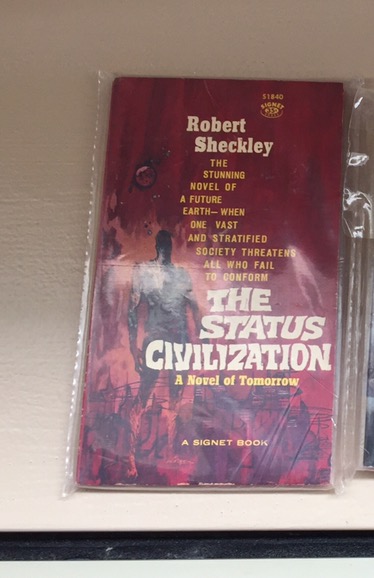
The Status Civilization


This 1960 novel by Robert Sheckley reminds me of a later book by Frank Herbert, of Dune fame. Herbert also wrote a novel about a place called Dorsai, which distilled ideas in some other of his books (including Dune) about an environment which hardens men into living weapons. After reading The Status Civilization, I have to think that Herbert read it, too. Now, don’t get me wrong – there is a reason Herbert is still widely read and this novel, maybe not so much. Herbert had a gift for world building, while Sheckley’s scenario is more tendentious.

In short, a man wakes up with his memories mostly wiped and learns he’s on a prison ship to take him to Omega – basically, a planet-wide prison. There is a surprisingly well-organized government, but it’s literally based around semi-legalized murder and the literal worship of Evil (always with a capital E). Our hero, like many heroes, proves not to be bad guy (he was sentenced for murder, but didn’t really do it) and also surprisingly physically adept and a pretty good fighter and killer for a non-murdering kind of guy.

The interesting bit is when he makes it back to Earth and finds a society which has been inculcated to extreme self-regulation. In fact, he realizes that he turned himself in for the murder, knowing he didn’t commit it, but also knowing that the ‘evidence’ suggested he did. There’s a weird, not terribly well done internal struggle (visualized through the recreation of his earlier battles, but with inner, ‘Earth’ self being the antagonist) where he tries to stop himself from turning himself in again.

It ends with him realizing he has to warn the incoming Omegans before they get their memories back and their conditioning and just wind up sending themselves back to Omega.

Ok.

The story is nicely paced and feels very full, despite being only a little over one hundred pages long and for the avid sci fi reader, there’s plenty to be had, especially if you are interested in some antecedents to a modern sci fi trope.


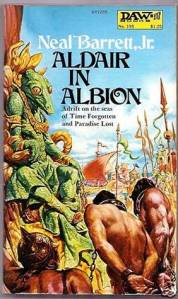
Aldair In Albion


Aldair in AlbionI was in Chicago a few months ago and used a few free minutes to walk from my hotel to the nearest, open bookstore (I forget the name). Whenever I’m in a new city, I like to visit a local, non-chain bookstore and buy a book. It’s just a thing I do.
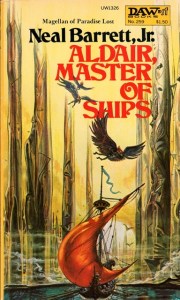
While browing an old fashioned metal wire turn rack (like they used to have on drugstores, stocked with things like Doc Savage novels and Harlequin romances), I saw Aldair, Master of Ships. It looked cool, so I bought it, but later realized it was a second book in a series.

So, here we are, reading the first book, Aldair in Albion.

It’s nothing groundbreaking, but does offer a nice, new twist.

The world is similar to late Republic/early Imperial Rome, with various people’s given names similar to things like Gaulish tribe (the Venicii) and the Vikings (Vikonen), but all filtered through a Robert E. Howard-esque, Hyperborean sensibility. But while not state outright, the author quickly lets us know that the characters are not human. They aren’t properly described, because the third person limited perspective of Aldair, via the narrative, already knows what people look like. But words like ‘pelt’ and ‘snout’ are dropped, as well as the fact that Aldair’s girlfriend, as it were, has more than the usual (for a human) number of nipples.

AldairMasterofShipsA reader of very basic knowledge will peg this as a post-apocalyptic novel, where animals have evolved and become dominant and the titular Albion is clearly England.
But, after 200 pages of standard, but generally exciting fantasy adventure, we get an interesting twist in the final five pages. No sign of a nuclear explosion, but rather, humans apparently genetically engineered the various humanoid peoples from animals (Aldair is descended from cows), dropped them in sci-fi style sleeper pods that opened all over the world. No word of where humans are, but the whole thing looks more like an experiment and Aldair commits himself to helping the genetically modified peoples of the world build their future, having been disgusted by humans.

‘Writers that only add their own verbiage to existing knowledge’


I was talking with a friend, about a mutual acquaintance who the friend of our good friend (did you understand that sentence?).

I don’t like this acquaintance. Never have. Just something about him.

He writes for blogs in a recognizable style of pseudo-ironic mockery. His writing, like much in the genre, can be funny.

But I was trying to articulate why that wasn’t enough. It’s not enough to mock the silliest and most mock-able aspects of modern life (usually politics) when it’s not combined with research and and investigative reporting of some kind.

Then my friend summed it up:

It’s writing that only adds its own verbiage to existing knowledge.

Quite possibly I have been guilty of that. Actually, I can say for certain that I have been. But it’s also becoming a problem, I think. I’m not talking about a Facebook post or meme, but writing that theoretically purports to be more – to be an essay, a polemic, an article.

Anyway. That’s my rant for today.

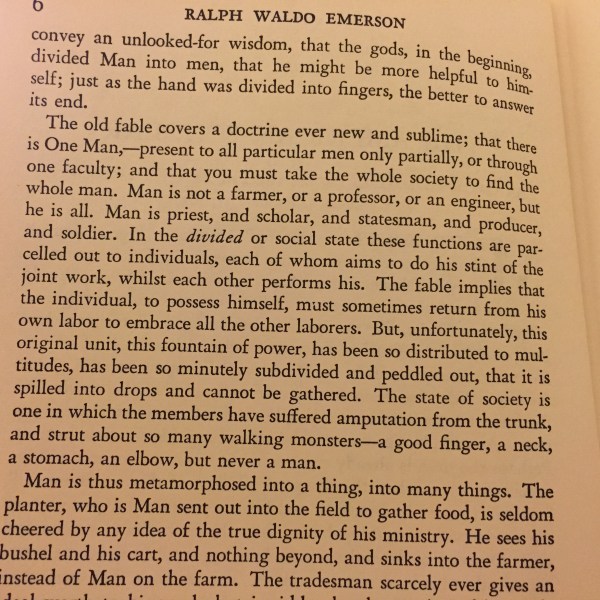
American Marxist


The paragraph is from Ralph Waldo Emerson’s essay, The American Scholar. While reading it before bed the other night, I wondered whether or not it was just or whether he really seemed to be describing the Marxian concept of people’s alienation from the fruit of their labors? Of course, his solution is more spiritual, combined with what might now be described as college town, farmer’s market, DIY liberalism (and Marx never really wrote out the solutions, did he? No, not really).