‘Phrasis’ By Wendy Xu


I read her chapbook, Naturalism, some time back, and this fuller collection has a few crossover poems (including the titular Naturalism).

Phrasis is a very good and enjoyable collection, but not truly great. It struck me as the work of a very good poet, but it wasn’t one of those that really bowled me over, you know? Wordsworth bowls me over, but that can’t be the standard, can it? The first books I read by both Cathy Linh Che, Charles Simic, and Anne Carson both bowled me over.

But I don’t want to damn with faint praise. It’s very, very good. Sometimes she engages in some colloquialism or profanity that never quite takes – I don’t think she’s quite ruthless enough in her use of it – but her more ‘poetic’ lines and stanzas (that vast majority) are great.
Journey To The Center Of The Earth


I read this book when I was in elementary and it was a little lost of me, not in the least because Verne almost always have a pedagogical goal, in addition to wanting to tell a roaring good yarn (which he did).

When I read 20,000 Leagues Under the Sea, I was somewhat disappointed in how the desire to educate got in the way of an exciting tale. Journey to the Center of the Earth had no such problem.

Though I will add, though I hope it’s superfluous, that much of the science has been… superseded by more recent discoveries.

If you have primarily seen the various movies (as a kid, I remember one with James Mason and I was inspired to reread the novel by having my daughter watch the surprisingly fun version with Brendan Fraser), you may be surprised by the lack of dinosaurs. There is a fight between a plesiosaur (of some kind) and an ichthyosaur (of some kind), each of a size that I think rather exceeds that of known members of those groups. There is also a herd of mastodons who are, apparently, being herded by a twelve foot high prehistoric man of some kind. Exciting stuff, but not really what I was looking for as a child. This would have been better for me to have tried to read in middle school.

But if you do want dinosaurs and want to stay in this sort of genre, Arthur Conany Doyle, of Sherlock fame, wrote a novel featuring Professor Challenge called The Lost World. Try that one.

Magician’s Land


9780147516145

So, I finished the trilogy.

It wasn’t bad. I get why people liked it. But I feel like it became more like just another fantasy series, as it moved away from the question of “what is worth doing if you are a rich and powerful magician under 25 who literally can just mess around, drink, and fornicate more or less indefinitely?” Read more

What Your Favorite Shakespeare Play Says About You


While not my favorite (for the record, I would, these days, say Twelfth Night), I loved the one for Antony and Cleopatra (arguably his best late period play)

The whole list:

https://electricliterature.com/what-does-your-favorite-shakespeare-play-say-about-you-c0d7d44d09b8

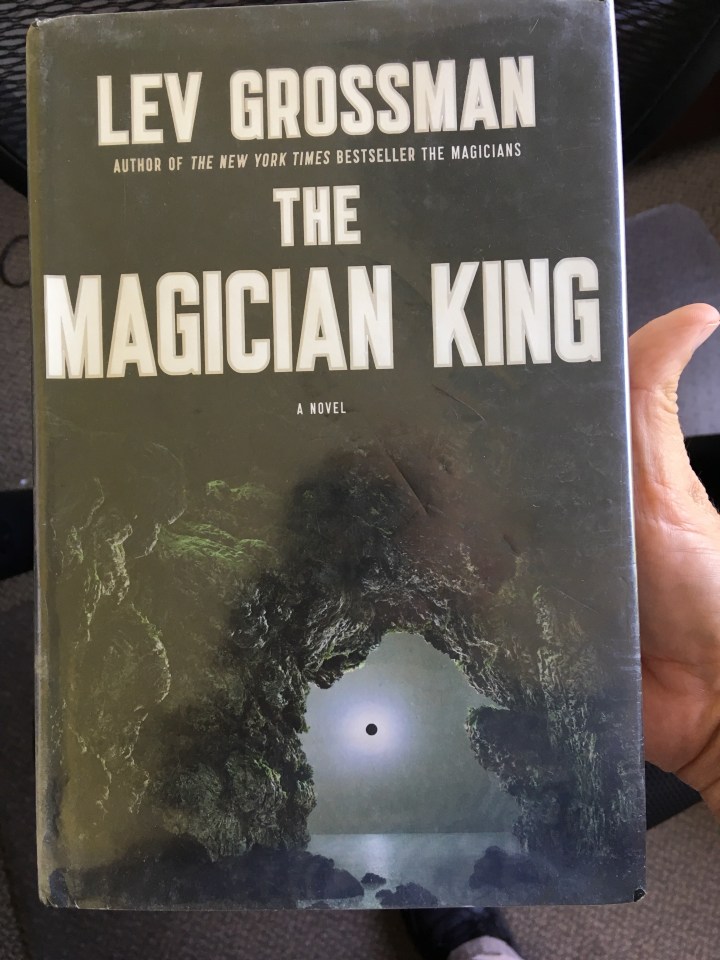
The Magician King


As a sequel to The Magicians‘ strange and fascinating tale of magicians as lost and debauched trust kids, The Magician King fails to build effectively on the asked question: what do you when you can do anything? Read more

The Magicians


I suppose I am rather late on this one. The Magicians came out long enough ago to have had three or four seasons of an adaption on basic cable, yet isn’t (and probably never will be) some kind of classic that future generations will discover.

But, credit where credit is due, some two thirds of the book is a very good, very interesting take on the school for magic. In this case, a college. And like real college, the stakes can feel unimaginably high for the students, but everyone else know that they are really not. And real life is invariably a bit of a disappointment. Because, we all know that if Harry Potter were real, he would almost certainly have spent his first half decade after Hogwarts drinking and doing copious quantities of drugs to both medicate his PTSD and to recreate the feeling of being the ‘chosen one’ again.

The Last Argument Of Kings


There is a genre of fantasy known as grimdark, to which this more or less belongs. Game of Thrones would among the list. The granddaddy, to my uncertain knowledge, would probably be Glen Cook’s Black Company. Basically, things don’t always end nicely for everyone and many folks don’t turn out to be so nice. A bit of the old ultra violence, as Alex of Clockwork Orange might say. Read more

The Warded Man


Enjoyable, but with notable caveats.

The world and the not too large cast of point of view characters is well done. The main conceit is that demons or ‘corelings’ manifest from under the earth from a ‘Core’ (the center of the earth) every night. Sunlight is fatal but they are nearly impossible to kill otherwise and the world must work around that. Buildings and property are protected with wards, which are usually carved, but a scratch to the carving or some other small disruption can make it useless, so families and whole villages are killed on a regular basis. A cultural effect of this is an emphasis on early marriage and procreation, because humanity is more or less in constant danger of being wiped out if not constantly replenished. However, this is no excuse for a male writer to have his female character talk about their ‘flower’ so often or even, really, ever.

Also, I was often disappointed in the action scenes. But the small things, like trade being done by Messenger (capital M), who use portable warding circles but are still respected for being willing to be outside at night for weeks at a time. Aspects of matriarchy creeping into societies, because motherhood is more than usually key to a locale’s survival.

Will I read the next one? Maybe. I’m not one hundred percent sold yet.

The Tattoo Murder Case


Rather like my first foray into Japanese mysteries, this one flips the script by providing a false protagonist for a large portion of the novel. Though the seeming person who will solve the crime, turns out not to, he (Kenzo, if you are curious) is, arguably the protagonist. Kyosuke, nicknamed the Boy Genius (I hope that sounds better in Japanese), a friend of Kenzo, is the one who solves the crime.

While a couple of items could have been guessed, like Doyle’s famed mysteries, the reader isn’t really given enough to definitively solve on her/his own.

I think I liked to the steady proceduralism of Points and Lines more than The Tattoo Mystery‘s more holmesian style.

Before They Are Hanged


I don’t know why I chose to return to this series, having read the first volume a couple of years ago, while visiting the in-laws in Thailand (pre-fatherhood, I used to get a lot reading done in Thailand; not that it wasn’t constantly fascinating, but a time whenever around you is speaking a language you can’t understand is a pretty good time to read a book).

While my memory of the first book isn’t as sharp as it could be, I felt that several characters got some nice fleshing out, relative to their introduction in the earlier volume, and some interesting new characters were introduced.

But we also got some clunky exposition dumps and… was the major, continuing plot thread a snipe hunt?

But I reckon that I will finish this series, regardless.