It’s Not You, It’s Me


I feel like I keep harping on this issue, but I wanted to direct folks to yet another mixed/dubious analysis of Merwin’s appointment.

I was originally drawn to this piece because it seems an incredibly well thought out explanation that seems to summarize many of my own vague feelings of unease and disappointment.

Now though, I am more struck by the first comment someone left below the article – a Mr. Conrad DiDiodato.

He notes that the appointment “seems to be sticking in everybody’s craw” and asks about the “hidden psychology of resentment underlies much of [it].”

So, the question becomes – how much of this is about me? Merwin has been a highly respected poet and man of letters for decades. I admit to admiring some of his earlier work. But he’s just not my cup of tea. Yet somehow, his appointment inspires in me (and others) a certain deeply held resentment.

What did we really want? What is he failing to personify?

Is this actually part of a feeling of disappointment that creative class has felt regarding the Obama administration?

Are we reacting to hidden statements about the poetry and the poet’s place in America?

I don’t actually have answers. But I suppose it is true that I have not honestly asked the question – if it’s not you, Merwin, is it me?

Where Is the Canon Today?


I would like to indulge in a classic activity that people over thirty have enjoyed for ever since the leading cause of death among humans ceased to be “killed by sabretooth tiger”: mourning the loss of a time and place that never was.

Much as Republican House Minority Leader John Boehner wishes to return to an America of strong unions, high taxes, and virulent racism, I feel a certain sense of mourning for the seeming loss of a certain brand of intellectualism.

I was partly inspired by reading this article on the feeling that the traditional black canon has lost its place in the development of young, black collegians.

My own feeling is partly driven by a reading of Arthur Koestler’s essay on leaving the Communist Party in The God That Failed and partly by a re-reading of Simone de Beauvoir’s The Mandarins.

I wonder whether young people entering college still feel the drive to read the classics of the intellectual canon. Do their bookshelves have copies of The Communist Manifesto, Howl, Naked Lunch, or God and Man at Yale (for the young conservatives out there)?

A friend famously noted that half of the movements we (my friends and I) made towards this intellectual canon were driven by hormones – we thought that, perhaps, there were some girls out there who might be intrigued by a man who could quote from either subversive political tracts or dirty-minded poetry from the Beats. But we did move towards it.

And I can still remember that first flush of discovery (much mocked by our parents, when they overheard us) of these seminal figures. Even though virtually all of them were long dead, we could still feel their subversive power and authority.

When hundreds of thousands of people read the latest poorly reasoned drivel by Glenn Beck, one wonders if anyone bothers to read and be amazed anymore by the intellectual “heft” or a true giant, like the late conservative public intellectual, William F. Buckley? Have the recent rantings against socialism driven anyone to pick up The Darkness at Noon by the once famed anti-communist Arthur Koestler?

If these books are no longer regularly read by young college students, what have we, as a culture lost?

I know that I am probably mourning for a place and time and that never were (much as Boehner is mourning for a myth of the American past the only exists in his head). But I still mourn.

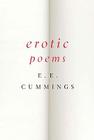
Review of “Erotic Poems: E. E. Cummings”


For me, e. e. cummings was someone you got really into your first or second year of college, but didn’t really think about after that. If I hadn’t gotten into Ezra Pound first, I would say that cummings is a sort of way station en route to Pound.

In short, since the early to mid 90’s, I haven’t given him much thought.

But, I kept seeing this edition in some of my favorite local bookstores (Kramerbooks and Bride Street Books). I assume it is a relatively new published collection (obviously, the poems themselves are not new), because I had never seen it before.

I am a big fan of erotic poetry (the Mary Ann Caws edited Surrealist Love Poem is a favorite of mine), so I picked it up.

To make a long story short, if you are like me, you have spent most of your life thinking of cummings as that modernist poet with a personal grudge against punctuation and capitalization. And, well, you would be right, but you would also be missing so much more.

A silly realization I know – one of the twentieth century’s truly canonical poets and I am surprised to find out he’s any good?

So, instead, let me say, this a wonderful way to reacquaint yourself with a poet you might not have considered in a long while and great gift for a broad-minded loved one.

Every Month is Poetry Month


April is National Poetry Month, but it is important that we preserve protect the poets and poetry as part of our national and global cultural dialogue year ‘round.

On that note, allow me to offer my humble suggestions for how to “celebrate” National Poetry Month any time of the year.

1) Buy a book of poetry. It seems obvious, but not enough folks actually take the time to buy an actual book of poetry. I spend a lot of time in the poetry section of bookstores and believe me when I say that I am rarely mobbed by “Harry Potter”-like hordes of fellow shoppers when I browse for verse.

2) Buy a new book of poetry. I love used bookstores (I live down the street from one), but when you buy a new book, the publisher gets royalties, providing some economic incentives for publishers to print MORE poetry in the future.

3) Buy a new book of poetry by a living poet. I love Eliot, Keats, and Frost, but they are dead and don’t need our support – on the other hand, living poets do. As a corollary to #2, we want to provide economic incentives to publishing houses to print new books of poetry (including maybe one day, something by the coffee philosopher himself), rather than just putting out new editions of the Lord Byron’s Greatest Hits.

4) If possible, buy a new book of poetry by a local poet. I stopped in to visit Bridge Street Books in Washington, DC and picked up a book of poetry by local poet and Bridge Street manager, Rod Smith – Protective Immediacy. My feeling is that if we, the locals, do not support local poets, who will?

5) Buy a new book of poetry by a local poet from an independent bookstore.  Independent bookstores are such joys to browse in. Their collections are eclectic, many have specialize in particular titles (books associated with a certain region, genre or subject matter), but they are businesses and they need our  economic support to stay in business. Nothing against Barnes & Noble, but when I am in Tampa Bay, for example, I would much rather do my book buying at Inkwood Books. You should, too.

6) Finally, consider buying a literary magazine that specializes in poetry. I picked up a copy of Physical Poetry Vol. 2 while I was in Bridge Street Books. It’s a nice little chapbook style lit mag, stapled and with a handmade look (and who knows, perhaps it was stapled by hand) and it cost only $5 to encourage the bookstore to continue stocking little ‘zines like this and provide some small level of support to the publishers of poetry ‘zines. In fact, my last publication and my next publication were and will be in non-glossy publications that represent a labor of love by the publisher – Black Books Press and Atlantic Pacific Press, respectively.

So, in sum, as a personal favor to me and everyone out there who loves poetry and who wants to see it supported and published, go and put your money where your mouth is and drink tap water for a few days rather than bottled water or skip the lattes or walk to work one day a week or whatever it is you can do to put a few extra dollars into the poetical economy.

Yours in solidarity,
the coffee philosopher
The Coffee Philosopher Has a Poem “Published” in Poets for Living Waters


Poets for Living Waters posted  my poem, A Full Page Ad in the Des Moines Register’s Sunday Travel Section Praising the Fine Climate for Poets in Florida: Paid for by a Generous Donation from BP That in No Way Represents an Admission of Liability.

Sadly, it was not published in the “Featured Poems” section, but merely in an “Open Mic” section.

One suspects that this means I was merely part of the slushpile.

The only indication I have that any consideration went into choosing my work was that they picked neither the first poem I included nor the shortest poem – suggesting that maybe they actually read and enjoyed some small part of it.

Or I’m just clutching at straws.

In any event, please check out Poets for Living Waters and please check out my particular poem. It’s not a bad piece. Though, I admit to having edited it slightly before submitting it (the original title was merely A Full Page Ad in the Des Moines Register’s Sunday Travel Section Praising the Fine Climate for Poets in Florida – yes, a shameless move, I’m sure, and only slightly rewarded), but it’s still a fine piece, I think, and might some day be worthy of a future, second publication. Or not.

More on Merwin


The Christian Science Monitor is also wondering about how Merwin will handle the (relatively) new expectation that the Poet Laureate also be an activist and cheerleader for poetry.

However, the author, poet Elizabeth Lund, is far more sanguine about Merwin’s prospects.

She is absolutely correct that his lifetime credentials as an advocate and activist for social and environmental justice are impeccable.

But I still wonder whether an octagenarian who lives more than 2000 miles away from the lower forty-eight can fulfill the role I now want our Poet Laureate to take in public life.

My Favorite Bookstores – Inkwood Books


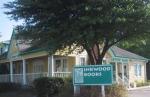
If you’re in the  Tampa Bay area and you need something to read, consider skipping the big chains and checking out Inkwood Books. They’ve got a great collection of books by Florida writers and have some great book signings.

Inkwood doesn’t have the national cachet of a Lemuria or a Politics and Prose, but if you’re a resident of Florida’s Gulf Coast, it doesn’t get much better than Inkwood‘s shelves down on Armenia.

What Do I Think of W.S. Merwin?


W.S. Merwin was appointed the new United State Poet Laureate. He takes over from Kay Ryan.

What do I think of this?

I think that I have tried to like Merwin. I can see his book Flower & Hand sitting on my bookshelf.

I think that Merwin and his feel “Deep Image” poet, Robert Bly, represent a certain aesthetic from the sixties that looks a little stale 40 odd years removed.

I think (though this also contradicts my previous statement) that Merwin some really good poems in the late sixties and early seventies (before, I suspect, he settled in Hawaii on a permanent basis) and that he has been re-writing those same poems over and over again in the decades that followed.

Kay Ryan was also a selfless educator and promoter of poetry (a role she had been fulfilling long before she was named Poet Laureate), but I fear that the semi-reclusive Merwin, though an aesthetically defensible choice, will not bring the sort of missionary zeal we got from Ryan (and from Hass and Pinsky, too).

I think it’s possible that I’m just jealous.

Ted Joans Lives


Ted Joans was not the most prominent Beat writer nor was he was nearly the best Beat writer.

If he is famous, it is for demanding that one of his poems be removed from the second and future printings of The Beat Reader (he had not been recompensed for its publication in the first edition and flatly demanded that it be removed from all future printings).

But he was one the only Beat poet I ever met.

I have mixed feelings about the Beats. Every good teenage boy should experience a literary crush on the idea of the Beats, but I feel their literary value is something of a mixed bag. Allen Ginsberg, for example, wrote at least one great poem (Howl) and arguably wrote two more (Kaddish and Supermarket in California). Similarly Kerouac wrote one great novel (On the Road) and then followed it up with a series of novels of varying quality, none of which measured up to the archetypal and literary quality of that early work.

Personally, I would suggest that only Gary Snyder and William S. Burroughs got beyond the “one off” curse (one work of enduring quality, followed by a series of works that never measured up to the effect of that early work) and actually produced an oeuvre of real quality.

But… I have no mixed feeling about what Ted Joans meant to me personally.

To a young man in Paris for the first time, he was an enormous and generous figure. I was just one of a several young men who waited patiently for him on Sunday at the Cafe Deux Magots and who drank vin chaud (hot wine, drunk with sugar and lemon) because that was what he drank. We imitated his shabby chic dress (though I never tried to pull off the felt beret he wore to cover a smoothly bald crown).

Ted Joans is gone now – as are his stories of his house in Timbuktu, his good-natured impersonations of Gregory Corso, and all his future poems.

When I became something more financial stable than a poor student and would-be poet, I should have spent more of those ill-gotten gains on the small presses that published his books.

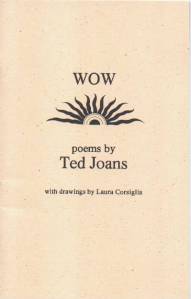
It’s too late for Ted to benefit, but I finally got around to purchasing his last book from Empty Mirror Books. If you have time, you could assuage the guilt of a former young man and send them a little love.

You can also check out Ted Joans Lives for some tribute to the late, great man.