The Waiting Is the Hardest Part


Tom Petty was right on the money when he said “that waiting is the hardest part.” Of course, I’m pretty sure he was talking about a woman, but I feel that most things in life can be succinctly explained using a Tom Petty song (I will argue incessantly for the stance that Petty is one of the great songwriters of last half of the twentieth century – and is still going strong, I might add).

I am not talking about women or men, of course. Or least, not in their capacity as objects of sexual desire.

We are still talking about my recent submissions to Saw Palm.

They are now evaluating another poem – The Creatures of Prometheus in Gulfport, Florida.

Percy Bysshe Shelley’s poem/lyric drama, Prometheus Unbound, is a personal favorite, as is Ludvig von Beethoven’s ballet score for The Creatures of Prometheus (interestingly, he cannibalized part of the score for his Eroica Symphony – which I also love, but because of an adolescent misreading, I always think of it as the “Erotica” not “Eroica” Symphony, and so find the piece to by inextricably wound up with thoughts of passionate, Romantic-era sex).

In any case… hoping that Winnona Pasquini is move amenable to Creatures than she was to Coffeeshop.

Sadly, It Was Not to Be


I have gotten my first rejection of a poem submitted via a content management system.

Yes, A coffeeshop overlooking the intercoastal in Gulfport, Florida has been rejected by Saw Palm.

They wrote:

Thank you for sending us “A coffeeshop overlooking the intercoastal in Gulfport, Florida.” We appreciate the chance to read it. Unfortunately, the piece is not for us.

Thanks again. Best of luck with your work.


Sincerely,
Winnona Pasquini
Saw Palm
sawpalm@cas.usf.edu

I am supposing this bodes poorly for the other three poems they have in their possession.

We can also see another downside of the short form encouraged by the online process – it positively encourages the editor to be dismissive of one’s efforts.

I don’t mean that they are more inclined to reject – but I feel that absence of real critique (“the piece is not for us”) is, perhaps, something endemic to the medium. Online, one feels encouraged to move quickly – knowing that the results will be apparent immediately to both parties. Does this, perhaps, discourage the deeper criticism, suggestions and even encouragement that keep the budding writer from becoming plainly suicidal?

Or maybe my work simply did not merit more comment.

It might not have been that good. Who knows?

* * * * *

A little post-script to this blog posting:

Well, this particular effort has come to a close – the remaining three poems that Saw Palm was holding onto were finally rejected. Even worse, I appear to have deeply offended an editorial assistant with this posting you are now reading, such that she wrote on Facebook (sarcastically, of course), in response to my blog that “[I/she] must be a real bitch.” (Apparently, this person did a search on their name and came up with my blog – but who among us hasn’t googled ourselves these days? I freely admit to doing it, myself).

Fortunately, there was at least one friend ready to defend the poor, beleaguered editorial assistant, commenting: Based on the rest of the blog, I’m guessing it just wasn’t that good. I doubt it has anything to do with the medium in which it was submitted. Just a guess though. Maybe their poetry editor is an ego-maniacal monster out to crush other poets beneath her feet.

The editorial assistant laughed it off and responded: absolutely. i want to crush other poets. especially guys who write about menstrual blood.

(And yes – one of my poems did reference having sex with a woman during her period. Not graphically, to be sure – I won’t say it was done tastefully, because surely that’s in the eye of the beholder, and also, clearly she did not find it so.)

I do feel bad that I touched a nerve. So let me say that my point was not that you, personally are a “bitch” – nor that publications (nor their editorial assistants) that rely on electronic transmission are inherently flawed. It was intended to be more of a question of how the medium affects the message (without going all Marshall McLuhan on everyone). Without getting into the post-structuralist weeds, I think we can all agree that writing done for instantaneous, electronic formats (instant messaging, email, blogs, etc) tends to be shorter. The burden of proof for a point made tends to be less than in traditional, print formats (is this posting itself an example of that? poorly argued and using the medium’s lower standards of evidence to coast by?).

Also, I am old enough to remember when we still wrote letters to people. Now, letter writing has become a self-conscious anachronism. Be honest – who out there really writes many letters anymore? Even thank you letters are more often done via a phone call now or even an email or text.

As a final note, the editor did email that I shouldn’t  “let the rejections keep [me] from continuing to write and study the craft.” She even wrote this before calling me out on Facebook, for what it’s worth.

But I can still remember when rejections (and even acceptances) came in the mail. Sometimes with fairly personalized letters, but more often with a form letter, but with note (often hand written in the margins) explaining what they did and did not like about the work, in what direction they would recommend taking the work. In some cases, even what they would require to get them to reconsider it in a revised form.

But maybe my poems did not deserve such treatment. As the editor assistant’s friend suggested, maybe “it just wasn’t that good.” If that’s the case, so be it. I was talking to a friend a mine who teaches at a local university and spoke in favor of the traditional gatekeepers whose job it used to be to tell us what is good and worthwhile and what is not. I did not speak in an unqualified fashion, but the decline of these traditional gatekeepers makes it more difficult to sort through the vast quantity of chaff produced out there in the ether (including my work? how sad to think that!) and show us what the true wheat looks like.

Somewhat ironically, this self same editorial assistant wrote in her personal blog about the struggle of trying decipher short and occasionally cryptic remarks that make up 90% of modern day rejection letters (not that acceptance letters tend to be more enlightening – the one time I got a very detailed letter back, it turned out to be paperwork I was expected to sign, affirming that I would not put these poems online in any way between now and their official publication). It would appear that she came across my little post not long after receiving some bad news from some literary magazine and, unsurprisingly, in no mood to be trifled with.

On the plus side, after all this, my little blog, which generally gets ignored (I haven’t even promoted it to family and friends) got a nice little spike in visits after the little Facebook/blog flame war sparked for a few hours.

Perhaps I should just close by saying, I wish us both luck and recommend that neither of us take rejections too seriously.
The Dangers of Online Submissions


The real danger in online submissions comes from the desire for a response and ability to constantly seek for one.

Since submitting four poems to Saw Palm, I have been checking their content management system every other day, at least, searching for signs of life.

Today, I found my first glimmerings.

My poem, A coffeeshop overlooking the intercoastal in Gulfport, Florida was gifted a new status – “in progress.”

How often do you think I’ll check back to see if others emerge into the state of “in progress?” To see if they move from “in progress” to “accepted/rejected?”

Reading Hemingway


I am still thinking about the books that young men read/should read.

Of course, I am also thinking of this in a limited sense.  I am a heterosexual white male of generally upper middle class background. Economically, I spent a certain amount of my childhood closer to the lower class than the middle class, but culturally, my upbringing was always that of the solidly liberal bourgeosie. I am, in fact, very close to the socio-economic ethnic group skewered by the website Stuff White People Like.

This is all a digression by way of an excuse for the limits of my recommendations and criticisms. The young person I am modeling is someone like an idealized memory of myself and product of my class and ethnic background.

But to continue…

The young man fascinated by Hemingway is an enduring image. Whether it is the young frontiersman with a copy of Nick Adams Stories in his backpack or would-be, ex-patriate, Euro-sophisticate with A Moveable Feast or The Sun Also Rises sitting next to their coffee.

The image is always, in my mind, of the works of the young Hemingway (except for A Moveable Feast, which was written by an older Hemingway, but is about the young Hemingway’s days in Paris).

Not being the outdoorsy type, I was always a fan of the Parisian Hemingway.

When I was in Paris and then in Madrid, there was a small coterie of us – young, white, and reasonably well educated – who followed Ernest so far as to develop a taste for the spectacle of bullfighting.

This would surprise those who know me now as a vegetarian. They would also be surprised that I cannot, even now, bring myself to condemn my youthful fetish for this particular form of animal violence and cruelty.

We stuffed copies of Death in the Afternoon in our pockets and defended the styles of matadors who died before we born and who we only knew in the pages of books. We even read The Dangerous Summer.

These were the days before Amazon.com, so we were forced scoured bookshelves for whatever we could find to feed our interest.

It’s been over fifteen years since I ate meat. It’s been over seventeen years since I saw a bullfight – and nearly that long since I read Death in the Afternoon (though I still read The Sun Also Rises, with its bullfighting sequences, once a year).

I now longer know where I’m going with this. Just mining my memories, now, I suppose. Perhaps I’m still asking what happened the canon? Why don’t young people read the same books I did? Why aren’t the influenced, moved, and motivated by the same things as me? But, I suppose, my parents looked at me and asked themselves the same questions.

Young Men’s Books


Young men should read certain books. They should read certain books because they are part of becoming a well educated and critical thinker. They should also read certain books because, when they are older, should they try to pick them up, having not been exposed to them in their youth, they will find that the moment has passed and they are no long capable of appreciating it.

Catcher in the Rye is an obvious example. Salinger’s novel has much to sustain the older reader, but true love, in this case, depends on a certain youth.

Lawrence Durrell’s Justine (as opposed the Marquis de Sade’s) is another. The lush language is ironically overwrought, but the initial love I felt for it emerged from the sensuous language. I love it now for other reasons (though I have found the succeeding volumes of the Alexandria Quartet to progressively disappoint in most ways), but would not had the first stirrings of love not emerged as a young man.

All of this goes towards a sort of backhanded apologia for one of the most deservedly derided writers of the twentieth century – one whose pernicious influence keeps reappearing. I am speaking of Ayn Rand’s The Fountainhead and Atlas Shrugged.

The characters are static bits of cardboard, mouthpieces for straw men, forced ideologies, and generally for round pegs and square holes.

But, I can also see how a young man (I don’t pretend to speak for or understand young women) could fall under its spell.

Especially The Fountainhead. Underneath the poorly wrought Austrian school of economics is a story about an artist striving to achieve his vision. Of course, underneath the story of a struggling artist is a steaming pile of crap. So it’s the heartwarming story of a struggling artist sandwiched between crappy writing and the right wing political economies of pre-war Germans.

The attraction of Atlas Shrugged is more difficult for me to comprehend. The failure of so many to see through the cut out figures and shameless straw men of the novel represents a general failure of critical thinking, but… I can see a young man, who sees himself as destined or desiring more from life, pulling out of the novel a vision of lone idealism – the sort that is very attractive to an alienated youth.

A Poet’s Beard


Some time ago, I came across a reference to a pamphlet that purported to rank poets by the weight of their beard.

While I would not subscribe to that particular taxonomy, I will confess that I have been a member of the clan of bearded poets for fifteen years – more or less the entirety of my adult life. In truth, my beard is something of an object of pride for me.

Typically, I lean towards the Jean Reno/Clint Eastwood as the “Man with No Name” style of stubbly beard. Close cropped, but a little rough around the edges. But every so often, I decide to go off the reservation.

After seeing some pictures of Allen Ginsberg in the local paper (promoting a staged reading of Howl), I decided to grow myself the sort of monstrosity that Ginsberg rocked from the sixties on out.

Like the Beat poet, my hair tends to be curly, so growing it long is a not a quick process. And aesthetically,  I am not sure what I think about the enormous white patch on my chin. When my beard if short, the white and gray hairs blend seamlessly with the red-blonde-brown stubble. Longer, the white hairs stand out like a foamy white waterfall (how’s that for a poetic metaphor for ya! I know – both corny and unenlightening).

I find myself torn between wanting to continue the process through to the end and just wanting to take this whole thing back down the heavy stubble. In some ways though, it feels like the situation has been taken out of my hands. Mainly because, from experience, when it gets this long and thick, you need an industrial strength trimmer, not the little toy sitting in medicine cabinet. No, I probably need a professional for this. And I’m not due for a haircut for at least another few weeks (and just going to get one’s beard done seems like a waste – particularly in the absence a good, cheap barber shop that will do it right – and I don’t feel like dropping $20 to get my beard done).

If I were still in Pennsville, New Jersey, I could go back to that little barber shop on Broadway. The woman there charged as little as $5 and did the whole thing right – shaved my neck and upper cheeks with a straight razor to shape the face hair, as well as the back of your neck. Cut your hair and would even take care of your eyebrows and the most extravagant hairs growing out of your ear. It was an elegantly and quintessentially masculine ritual that ever man should experience.

Here in Washington, my favorite place is in the basement of the Rayburn House Office Building, but now that I don’t work in the Capitol any more, it’s difficult to find time to go there. Downtown DC has some excellent places inside some of the office buildings, but the prices can be a little high. When I’m in Dunedin, the fine folks at McGuire’s Barber Shop on Main Street are my establishment of choice.

So for now, in the absence of tasty alternatives, I will continue to work on my “Ginsberg.”

The Instrument Matters


The instrument matters.

Or, at least, it matters to me.

I confess to doing a most of my final drafts on a PC – usually in Microsoft Word (I’m too cheap to buy a Mac). But the first drafts and the sudden onset of inspiration needs something more visceral.

For more than ten years, I used a fountain pen that was given to me to by two friends in Spain – Nico and Jose. The pen was compatible with Waterman cartridges and I only wrote with black ink.

Sadly, it died in December of 2009 – the section (as it is called) broke at a point that made repair impossible. I still carry the pieces with me in a black shoulder bag given to me by my Uncle Buddy and Aunt Anna on my graduation from college, but is no longer useful as a writing instrument.

These days, I use a Cross Century II with a medium point (I still use only black ink). I chose it because it was of conservative, rather than flashy design, with a relatively narrow build for a fountain pen (my old pen was unusually narrow – contrary to the recent trend towards fatter pens), and also because the part of the section that broke on my old pen is made of metal and not plastic.

I am hardly alone is having affection for particular instruments.

Ted Joans, in Honey Spoon wrote about using a “black warrior pencil.” I am far from clear what exactly that is, but to me, the idea of commitment to an obscure instrument rings true to me – like a tennis player who insists on using a type of racket no longer produced. The instrument may have been surpassed, in the technological sense, by latter innovations, but carries with it certain resonances that make it the best instrument for the job.

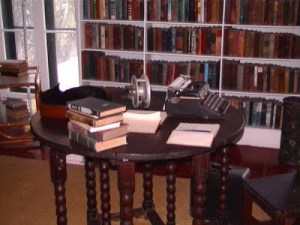
I also have an old fashioned manual typewriter with the classic “suitcase” carrying case. I confess, it is more for show than for use (though I would like to point out that Hemingway used to conspicuously keep a typewriter in  his Key West writing room, despite writing most of his works in longhand and having it transcribed later.

A manual typewriter is a demanding instrument (in this, the movie Naked Lunch was spot on). The keys do not respond if you are tentative. It forces you to write forcefully and to consider carefully what you are writing, because each letter must be addressed individually (particularly if, like me, you remain a two fingered typist) and aggressively.

A Dignified Book


Even though I do my best to support living poets, I am not above a good read of the dead ones.

When I hunt through a used bookstore for poetry, I usually stick with the dead ones (if I’m going to pony up for a living poet, I’d like some of my hard dollars to reach the actual poet).

Part of a finding a good, used book of poetry is the actually book itself – the binding, the cover, the feel of it. Even the smell. A good old book has a scent that beats “new car” any day.

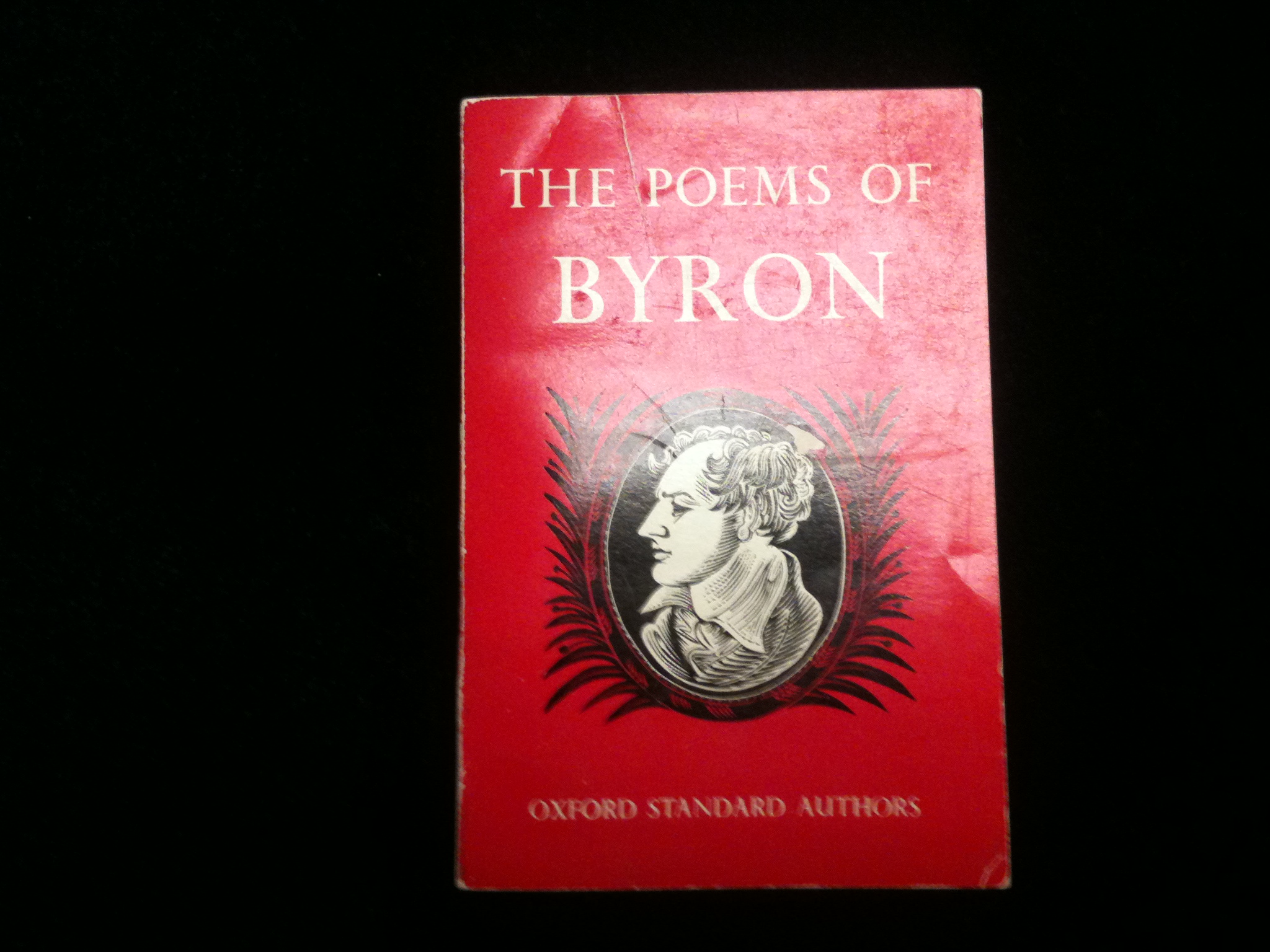
At Capitol Hill Books, I found this copy of Byron’s poems. It’s not absolutely, ideal (one day, I’ll show you my copy of Shelley, also bought at Capitol Hill Books – because that’s what a perfect used book of poetry look like!), but more than serviceable. It’s well read, but not disintegrating and though the cover is pinkish (I suspect that it was actually red when new, but has faded to something less masculine), it is generally what I would call a dignified book.

What has this to do with the contents? Nothing at all.

But for the record, I chose to dive into “Childe Harold” rather than “Don Juan.” All things in time.

The Dying of Christopher Hitchens


I don’t know what I think about Christopher Hitchens. And I suspect that a lot of young, left-leaning intellectuals feel that way.

He still sometimes describes  himself as a “soixante-huitard” and life a revolutionary-cum-public intellectual is one any would be poet worth his or her salt aspires.

But…

The whole Iraq war thing.

And it is clear that he welcomes my feelings of discomfort – which are mixture of disgust, a sense of betrayal, and raw envy. This is also compounded by my own Catholic faith and his own (and my once) strongly felt atheism.

I also wonder if Hitchens is not the Arthur Koestler of the those generations who came of age after Stalin? Will Hitchens, like Koestler, fade into a sort of gentle obscurity as the wars he gave his life over to cease to have meaning? Not just the Iraq war, but his polemics on such ultimately ephemeral figures as Mother Theresa and and President Bill Clinton. Which of his writings will survive?

My Aunt Millie gave me a copy of Letters to a Young Contrarian one Christmas. This seems to me to be the most likely to survive, though I could not take much of his advice. And perhaps, because I could not, it is not just envy and betrayal, but also shame he inspires.

But don’t we also want him to feel ashamed, too?

Anyway.

He is dying. His rakish hair is gone, but he still has the insouciance of a classic bad boy intellectual.

I don’t know how I should feel. In a strange way, I am reminded of the way I did not know what to feel when Hunter S. Thompson died. He was a larger than life figure from my adolescence I had outgrown by the time of his death.

That’s all. Except that maybe I’ll re-read Hitchens’ Letters.

Pulp Sci Fi: None But Man


On Saturday on I purchased and by Sunday I had finished reading Gordon Dickson’s None But Man, a science fiction novel from 1969 – towards the tale end of the silver age of pulp sci fi.

I had wandered into Capitol Hill Books‘ basement specifically looking for a good novel from the genre – preferably one from the late golden or silver ages of the pulps (roughly 1940-1970). I was inspired to dive into this preferred genre of my misspent youth by The Onion’s running feature, Box of Paperbacks, wherein Keith Phipps reads through a collection of 75 odd old science fiction novels.

While browsing at the bookstore, I was lucky enough to find None But Man, which had been recently featured in that very series.

When you pick up a book like this, you generally know what you are getting. Yes, writers like Ursula Le Guin have risen above the supposed limitations of genre to write Literature with a capital “L,” but even widely read and admired writers like Isaac Asimov (a clear influence on None But Man) are not, we should admit, ever likely to be confused with Leo Tolstoy.

But that’s not the point.

Taken for what it is, slipping into the pages of None But Man was like sliding into a warm bath for someone raised on used paperbacks from the period (though Keith Phipps was somewhat harder on the novel – dragged down by the sheer weight of reading some many similar novels).

The book itself is heavily influenced (I felt) by Isaac Asmiov – particularly Foundation. There is something of Asimov’s “psychohistory” in the way that the main character manipulates and manages the actions of large populations.

I also liked the way the author was clearly aware of some of the ways that the tropes of science fiction do not always line up with science. For example, the main character (Cully When) points out how fortunate they are, when hijacking an alien ship, that the aliens’ sensory range is roughly the same as their own, i.e., that they see roughly the same spectrum of colors. This would have been a problem if an important flashing light were only visible to a creature who could see in the infrared spectrum.

Giving the aliens (called the Moldaug) the same vision as us was a necessary part of keeping the novel flowing so as not to get bogged down in details, but the fact that Dickson addressed it suggests that he is aware that it is, in truth, unlikely to that the sensory capabilities of an alien species would be identical or even similar to our own senses.

He even has the plot of the novel revolve around the fact that he moral code of the aliens is radically different from our own (though not so different as Dickson suggests – I actually think he fails here to create a truly alien moral code).

Anyway… I’m looking forward to going back to Capitol Hill Books and picking up another bit ‘o pulp read later this week.