Is Modernism Sick?


I am not talking about some particular strain of post-modernist thought, but literally about people who don’t like modernism.

While reading Scarriet the other day, I saw Alan Cordle’s posting on modernism. He posits a couple of points – that the major figures of modernism (and also post-modernism) are primarily left leaning figures who view themselves as opposed to “late capitalism.” His second point is that this project was always doomed to failure, because modernism is intrinsically wound up with late capitalism.

I found some of the connections he made to be a little tenuous (Ron Silliman as a modernist? Post-modernism and modernism just lumped together?). Certainly, I don’t see modernism as inherently conservative (though I am very aware of the conservative trends running through post-modernism).

But what really got me thinking was his conclusion: “Centuries hence, Modernist art and poetry will be seen as sick, not great.”

He hedge his bets, by ending with a reference to Mann: ”

Of course, most of believe, without realizing it, what Thomas Mann told us: that artis sick, and therefore, yes, poetry like “The Waste Land” is a triumph. For now.”

Is modernism sick? I can buy, for example, The Waste Land as representing a sort of diseased and decadent sensibility (though I don’t mean that in any negative sense – Hamlet exhibits a diseased wit, for example).

Is modernism inhuman? Worse – is it dehumanizing?

That is the implication of Cordle’s accusation.

The whole discussion brings up all the nasty feelings inherent in appreciating the work of often unsavory people – Heidegger on account of his support of the Nazis; Pound for his anti-semitism and fascism; Hemingway for his misogynist streak; Eliot for his anti-semitism (anti-semitism seems to be a trend – linked perhaps to the relative importance of Jewish writers and artists to modernism?).

Tropic of Cancer


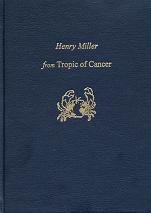
On my father’s bookshelf, in his apartment on the edges of the Old Cloverdale district of Montgomery, Alabama, was a three volume set of Henry Miller – Tropic of Cancer, Tropic of Capricorn, and Black Spring. They were smallish (about the size of a slightly oversized softback), black bound, hard cover books.

Even without reading them, they seemed to radiate a certain rough and dangerous sexual charisma. These were, I could tell, dirty and dangerous books. Books that impressionable twelve year old boys should not be reading.

In time, I pulled Tropic of Cancer down from the shelf. Partly because it was the first book and partly because it took place in Paris (an obsession of mine from an early age). I think my father noticed me reading it, but whether from disinterest or from a canny sense of when to let things be, said nothing.

Later, when I was in high school, Henry Miller became, like William S. Burroughs, a shibboleth for the circles I ran in. His vivacious and life affirming writing made for a strong counter to the natural adolescent tendencies toward depression and black moods.

Am I Abusing the System?


Whenever I download a free book on my Nook, part of me feels like I am abusing the system – the system of making sure that renumeration for books used and appreciated gets back to authors, publishers, and booksellers.

But it is just so easy on a Nook!

So far today, I have already downloaded free works by Ann Radcliffe, David Ricardo, John Keats, Andrew Marvell, Alexander Pope, John Dryden. Granted, I did also pick up this weekend $16 (plus tax) worth of histories on medieval and renaissance Florence from Capitol Hill Books this  weekend. But I do not doubt the total dollars spent on books will ultimately go down. While this may be good for me, is it good for literature?

Henry VIII


My mother, a dedicated reader of all things Elizabeth I (extending to her father, Henry VIII), will be very jealous.

As the nearby Folger Shakespeare Library prepares for the 2010-2011 season, one of the treats in store is a rare performance of Shakespeare’s Henry VIII. I know nothing about this particular play. In fact, I suspect that it is not very good, or else we should see it performed more often (it’s not a coincidence that the world doesn’t lack for performances of Twelfth Night, one of the Bard’s best plays). But a rarity has value simply in being uncommon.

Perhaps more exciting is the upcoming exhibition, Vivat Rex, celebrating the ascencion of young Henry to the throne of England. The exhibitions at the Folger, though not large, are always well curated and informative. My favorite, so far, was the one they had the other year on early newspapers and periodicals.

Fall for the Book Festival


Somehow, I didn’t know about this – the Fall for the Book Festival over in Northern Virginia (only saw it when I was looking up a journal I bought a few weeks ago, George Mason University’s So To Speak: A Feminist Journal of Language and Art.

Work responsibilities will almost certainly make it impossible for me attend (the election is in only a little over six weeks). But I’m hoping its a rousing success.

What Do you Think About Poetry In Translation?


What do you think about poetry in translation?

My father (a would-be poet, himself – though our styles and tastes are radically different) went for a time without reading any poetry in translation. His theory was that he didn’t have enough time to read all the good poetry that was originally written in English, so why waste his poetry-reading time on pale imitations of the original language. He applied this to prose translations, as well, but considered the principle especially pertinent to poetry.

He has not kept to that theory, but I understand the principle.

I was reading a collection by the Algerian poets, Abdellatif Laâbi.  It was a collection entitled The World’s Embrace, published by City Lights (yes – the City Lights). The edition presented the French and English in side by side format. My French is notably poor, but I recognized a line in the French as clearly referencing a line by Baudelaire. But the English translation showed no correspondence with Baudelaire.

Now, I greatly love the poems in The World’s Embrace, but I also don’t understand French well enough to read it in the original.

How much am I missing? Would I better off spending my poetry-reading time with books written in English, so that I am sure that I am getting the most out of my time?

Favorite 20th Century American Literary Period


The Cathedral


I am reading Huysmans The Cathedral and I am mostly just wishing I could remember more about his earlier novel, The Damned. During my late teens through my mid-twenties, I read a great deal of nineteenth century fiction. My mother would like to credit her deep love for Jane Austen for this fascination, but, in truth, I only read Austen later in this stage. The real point of entry was Alexandre Dumas’ and his rollicking, romantic adventures. But the fascination came about by the discovery of nineteenth century sex. I had been given a very chaste impression of the period (no doubt inspired by second hand images of official Victorian mores), so the discovery of some truly wicked (if not graphically described) sex in these novels was something of an eye opener. Madame Bovary, Dorian Gray, Jude the Obscure, and, finally The Damned followed.

The Cathedral contains, so far, none of the sex, Satanism, and black masses that made The Damned so delicious. But is does, so far, have a great deal of lush language which I can appreciate. For a convert to the Catholic faith and a would-be writer and intellectual (like myself); Durtal (the name of Huysmans doppelganger in the novels) is a fine figure to follow.

My New Nook


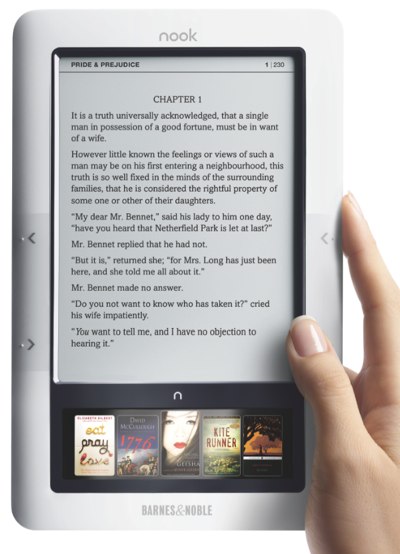
I am not referring to the fact that I am getting a new apartment – this time with a special room that will become my library/man-cave/spiritual sanctum. Of course, we are referring to my new e-reader. The Nook, developed by the good folks over at Barnes & Noble.

The Nook may seem a counterintuitive choice, but it was very deliberate (I say choice – but this was actually a gift, though the young lady chose this brand because of my evinced feelings towards the more popular Kindle).

I laid out most of these reasons earlier, but I reckon the world will not end if I repeat myself.

In the first place, I want to be supportive of bookstores. Those physical, brick & mortar buildings where we all browse and sip coffee and lounge in big, comfy chairs before going home to order something from Amazon. The bookstore is a precious place in western culture. When I was 18, I actually lived in one for a while; it was a bookstore that first published Ulysses (actually, both of those anecdotes are in reference to Paris’ famous Shakespeare & Co. Bookstore); a bookstore employee turned me onto the idea of found poetry; and how many famous writers, poets, and thinkers spent some part of their formative years working in a bookstore?

Bookstores are – or should be – our temples of culture and the humanities.

It is true, Barnes & Noble is not Shakespeare & Co. Nor is it City Lights, nor a dozen other centers for literature around the country. But, unlike Amazon, it is a true bookstore – a place where bibliophiles and can do congregate. For many people, it may be the only bookstore within reasonable driving distance.

We will never be able to attend a book signing at Amazon, never be able to develop a relationship with the staff of Amazon as you seek recommendation (and no – their suggested reading or “people who looked at [insert name of product] bought [insert name of other product]” does not count), Amazon will never work double and even triple duty as coffeehouse/performance space/university/employment program for MFA grads.

Barnes & Noble, by providing a large, well stocked bookstore in places like Montgomery, Alabama gave me a place to read and think. To browse a philosophy section that had real, academic tomes and not just some combination of the Bible and new age fluff. To scan the titles of shelves filled with poetry and poets I had never read – instead of nothing but a couple of sad looking copies of Shakespeare’s sonnets.

Though I may now choose to focus on taking my commerce to independent bookstores, Barnes & Noble holds a special place in my history and I will respect it for that. And if it comes to a choice between Amazon and B&N – I choose the one with the brick & mortar buildings every time.

My second reason for preferring the Nook is that the Kindle uses a proprietary technology. The Kindle, essentially, locks you into the Amazon store. But the Nook holds far greater promise of going beyond just a single provider through programs like this.

So what am I reading?

The Nook came pre-loaded with Pride and Prejudice (I will read that), Dracula (I could see myself reading that again, but not right now), Little Women (it might be sexist of me – but I don’t see myself reading it, no matter how much it changed my mother’s life).

For 99 cents, I purchased the French Decadent novel The Cathedral, by Huysmans (I previously read and didn’t particularly enjoy A rebours, but loved The Damned).

For $6.29, I went for Kim Stanley Robinson’s science fiction novel (the first of a trilogy), Red Mars.

For free, I picked up Cornelius Agrippa: The life of Henry Cornelius Agrippa von Nettesheim, doctor and knight, commonly known as a magician, by Francis Barrett (I had actually wanted to pick up something by Agrippa himself, but nothing was available).

Finally, and also for free, I downloaded The angels of Mons: The bowman and other legends of the war by early twentieth century fantasist/horror writer, Arthur Machen.

I Have No Idea What Brian Aldiss Is Talking About


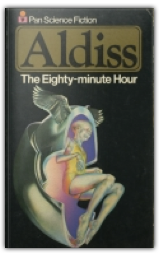
I grabbed a copy of The Eighty Minute Hour: A Space Opera from the basement of Capitol Hill Books a few weeks ago for only $3. The author, Brian Aldiss, had been recommended to me as one of the more high-minded purveyors of pulp. Even better – he was British and I confess to being a dedicated Europhile (even if the British have mixed feelings towards their own European-ness).

After considerable effort – and no little motion sickness resulting from mostly reading it on the subway – I finished The Eighty Minute Hour. But I have a confession to make. I have almost no idea what he is writing about.

Though apparently a standalone book, it reads like the third book in a tetralogy. But in such a case, one could at least expect a reasonable amount of exposition. Maybe a little prelude to catch us up. But not here.

Characters were picked up and their names thrown about but never fleshed out. Situations were tossed out there, willy nilly. And the whole thing seemed to come down to a series of deus ex machinas designed to summarily dismiss every challenge that showed up in the plot. To make matters worse – the final deus ex machina, taking place at the very end, wrapped up a plot point that didn’t even exist until 20 pages or so from the end. In other words – it solved the problem of a plot point that never existed for 90% of the book. I’d try to explain the plot, but I can’t. Suffice to say, time distortions caused by a war that is never described and which took place before the book even starts and a computer than magically disappears into the past play major parts. But I’m still not sure how. Oh – and I almost forgot: characters also randomly speak in song (hence, A Space Opera).

Say what you want about a straightforward writer like Dickson (and you can say a lot – he’s hackneyed, that he lacks any sense of pacing or characterization, etc), but I’ll take None But Man over The Eighty Minute Hour.