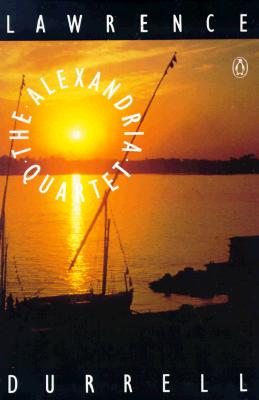
Justine & the Alexandria Quartet


I was watching the Spike Jonze movie, Stranger Than Fiction, and noticed that the literature professor played by Dustin Hoffman had written on the chalkboard a list of name’s and ailments. It wasn’t until the final name that a lightbulb turned on in my head – Pombal (who had gout) from Lawrence Durrell’s Alexandria Quartet.

My Aunt Anna and Uncle Buddy had the Alexandria Quartet high up on a bookshelf in their living room. When I would visit, Aunt Anna and I would stay up talking late into the night. For some reason, those four books kept catching my eye and I would ask her about them, but she was usually noncommittal. Finally, I took down the first book, Justine (not to be confused with the novel by Donatien Alphonse François de Sade, better known as the Marquis de Sade, which I once purchased at Bridgestreet Books in 2001).

I loved it. I am a little afraid to go back, though. I suspect that it is a book best appreciated by a slightly younger man.

Nonetheless, at the time. Such lush writing. The highest literary eroticism, without ever being explicit. The way that the narrative, rather than following chronology, revolved in a circle around a central event and a central theme.

I never finished the quarter, finally stalling while reading the fourth and  final volume, Mountolive. Each succeeding book after the first was less and less satisfying. The second book, Balthazar, while not nearly as good (in my eyes) as Justine, was at least enjoyable.  But the third, Clea, was more a slog. By the final volume, I simply had no more interest in trying to finish the quartet.

I didn’t take Aunt Anna’s copies with me and bought my own copy. I lost that first copy and sometime in my late twenties, I felt the urge to read it again. The only copy I found while prowling used bookstores had an embarrassing cover, with some sort of blonde on it (who I suppose was intended to represent Justine, though I can’t imagine her as a blonde – she was a Jew of Mediterranean descent, after all). Even worse, it made it look like some cheap romance and no guy wants to be seen reading that kind of stuff in public. I don’t know where that copy is now. I may miss those first, heady days reading Justine in high school, but I don’t miss that stupid cover.
One of My Favorite Bookstores; And Some Musings About Denny’s


One our way back from an early appointment, we stopped at Denny’s for breakfast. I don’t think I’d been to a Denny’s in several years. For your information, I had a veggie cheese omelette and coffee.

The coffee struck a chord with me. The familiar, thick Denny’s mugs. I remembered so many afternoon and late night trips to the Denny’s by the corner of U.S. 19 and Main Street/580 in Dunedin, Florida. How many times did I sit down there with Matt or Damian or Scott or Jeremy and pretend it was the Left Bank in Paris in the 1920s? Discussing our still nascent understanding of philosophy, literature, politics, and art?

Across from that particular Denny’s was a now defunct bookstore called Bookstop. Bookstop was (I believe) a subsidiary of B. Dalton (which was bought up by Barnes and Noble). Bookstop was the first bookstore near my home that was more than just your run of the mill, shopping mall based, Waldenbooks or B. Dalton, with their collection of bestsellers and tripe. This one had poetry and philosophy and literature in translation and hosted readings by authors. It blew my mind.

It’s gone now. And, if I could travel back in time, I wonder how it would compare to the bookstores I love now. But, based on personal history alone, Bookstop has to be considered one of my favorite bookstores.

The Marginalia Handwringing Continues


I don’t know I’m so fascinated by this, but now The Atlantic has gotten into the game. Read their writer’s take on it here.

Liberalism


This is a little embarrassing, but I’m about to quote an article from Slate.com.


Liberalism, at its core, is not so much a doctrine as a disposition, a habit of mind, and it’s compounded of two principal elements: An abhorrence of cruelty and a sense of the provisional nature of human knowledge.


Despite my lingering shame at admitting to reading Slate, I was struck by this particular phrase, within a piece about the French essayist (arguably, the original essayist) Michel de Montaigne.

I was struck by how well that sentence encapsulated my own sense of my ideology – and how it is not truly an ideology. Perhaps it is more truly something closer to Kantian categories than a true ideology, or doctrine, as the author write.

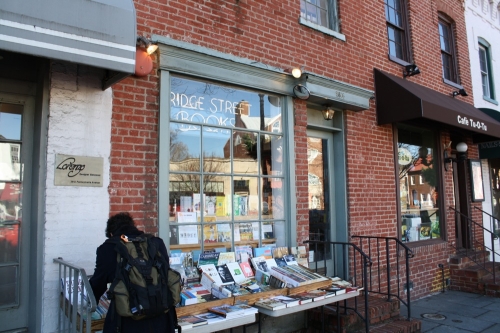
My Favorite Bookstores – Bridgestreet Books


Bridgestreet Books on the eastern edge of Georgetown is Washington, DC treasure. With a narrow, two story space, their collection is not large, but is rather impeccably curated. One of its employees is also the local poet Rod Smith (I purchased his 1999 collection, Protective Immediacy a while back).

Many, many years ago (actually, ten years ago) I lived in Georgetown. Somehow, I accomplished while also being poor. Part of my poverty was my insatiable habit of constantly buying books. I worked for a small non-profit situated just behind the Supreme Court building. Rather going home by way of the nearest metro stop, I would take the red line to Dupont Circle and make the long (ninety minutes or more) walk from there to my apartment near the Key Bridge. On my way home, I would pass so many bookstores that my mouth would water.

I got off the metro by Kramerbooks & Afterwords. Across the street from them was a now defunct used bookstore (I remember that I bought a copy of Kant’s Critique of Judgement from them). Around the corner was Second Story Books. On M Street, on my way home, was a Barnes & Noble.

And then there was Bridgestreet.

They would keep outside their store some racks filled with interesting (and cheap books) that were the immediate lure. And then there was the inside…

Such an enormous poetry section for such a small store! And filled with contemporary and avant-gards poets! Sections set aside for Cultural Theory! A bookshelf of just Greek and Roman classics! And so many small press lit mags (many locally published)!

It was my favorite bookstore among the ones I would pass. I recall that I bought a dozen of those inexpensive little Dover Publications books and a book of essays by Emma Goldman.

Nowadays, it is not so easy to get there from my home on the Hill, but I never visit Georgetown without stopping by.

Notebook of a Return to the Native Land


Despite my deep affection for the Surrealists, I had never before read the work of the New World’s greatest Surrealist – Aimé  Césaire.

For those who know nothing about him, this is the short version: He was born on the island of Martinique (then a French colony), studied and wrote in Paris in the 1930s (where he became close the Surrealist movement’s de facto leader, André Breton, who became a great advocate of Césaire’s writing), was a leader in the “Negritude” movement, and a prominent figure in Caribbean independence movements.

Notebook of a Return to the Native is a long poem about the isle of Martinique and the corrosive effects of French rule.

This was my first introduction to how the techniques of Surrealism could be applied to political aims. While many writers within the movement were involved in politics (Breton was active in left wing politics in the thirties and René Char was a soldier in the French Resistance in WWII), what I read was not explicitly political.

While Césaire will not replace Paul Eluard as my favorite poet of the movement, Notebook is unquestionably an inspiring read. It has the added bonus on containing a brief essay by Breton about his visit to Martinique and about Césaire.

More Marginalia


Apparently, this whole effort to keep marginalia alive is still rolling alone – at least in this New York Times piece.

I am very sympathetic to the idea, but I admit to also being one of those people who cringe at writing in their books. Perversely though, I love finding old books at used bookstores with notes written in it by a prior owner.

One of the few books I have personally marked up is Deleuze and Guattari’s Anti-Oedipus. It has been badly battered (I used to drag it to my favorite LA bar, the Pig and Whistle and read it while drinking and eating their nachos [their secret – using wonton chips instead of tortilla chips]). It’s also filled with tons of bookmarks, with little notes written on them. But I have also done a little scribbling of some marginalia.

The reason that particular book got special treatment is that it has been a real struggle for me. I don’t pretend to truly understand many of the concepts described (the “body without organs,” for example).

I should also mention a exhibit held at the Folger Shakespeare Library called “Extending the Book” about something called grangerizing. In the nineteenth century, folks used to expand their books by adding new pages to them. They would have them rebound to allow for the new, larger size. Often, the additions were illustrations that they thought had some correspondence to the action within the text. While not, technically speaking, marginalia, it is certainly the ultimate in book owners not holding their tomes sacred in its original form.

Robert Hass Coming to the Folger in May


On May 21, former Poet Laureate Rober Hass is coming to the Folger Shakespeare Library!

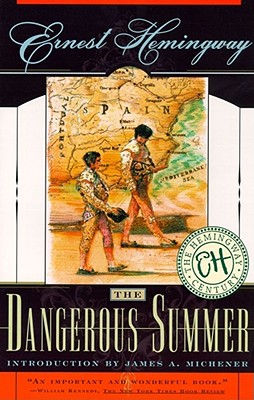
The Dangerous Summer, Or, Why a Vegetarian Would Read About Bullfighting


At present, I am a vegetarian. I also admit to a certain pacifist streak. That said, I was not always that way (well, maybe not the pacifist part). When I nineteen years old, I went to Spain, deeply under the spell of Ernest Hemingway. The Sun Also Rises was my favorite book and had been for several years, during which I read it at least once a month. If you have ever read The Sun Also Rises, the climax is centered around the bullfights that are one of the highlights of the Feria of San Fermin in Pamplona.

So naturally, I attended more than half a dozen bullfights (corridas, to use the Spanish term, but I suspect that if I spent this entire blog calling them corridas, I would come across as even more pretentious than usual).

To aid my informal study of the topic, I picked up a copy Hemingway’s 1932 book, Death in the Afternoon. In addition to some stirring descriptions of particular bullfighters and bullfights, it also instructed the novice in elaborate rituals that surround the spectacle.

Well, that was a long time ago. Like I said, I’m vegetarian now. Besides which, I haven’t been back to Spain since I was 24 (I’m 36 now).

But, for some reason, I wanted to read about bullfighting. Specifically, I wanted to read Hemingway right about bullfighting.

So I picked up a late work by him called The Dangerous Summer about the summer bullfighting season of 1952. My good friend Ryan Leonard gave me a Barnes and Noble gift card as a get well present after my recent surgery. Most of it went to purchase Georg Simmel’s Philosophy of Money (a work I first read about in an essay by Fredric Jameson, collected in Postmodernism, Or, the Cultural Logic of Late Capitalism,  [which was a gift from my high school buddy, Matt MacKenzie] and have wanted to take a crack at it one of these days).  Let’s see how it looks to born again vegetarian.

Skylight Books – One of My Favorite Bookstores


It seems shameful to me now that, while discussing my favorite bookstores, I have so far failed to mention Los Angeles’ greatest bookstore, Skylight Books.

Located in the hip Los Feliz neighborhood, it has successfully fought off the woes affecting other indies and the bookselling industry as whole and has nearly doubled in size in the last few years, annexing the space next to them.

I discovered Skylight when my friend and co-worker, Grace Lee, took me the Dresden, a bar in Los Feliz just down the street from Skylight Books. It was closed, but just looking through the big storefront window, I could tell it was a place I wanted to visit. The following weekend, I made my first visit.

It is one of those bookstores that makes a special point not to focus on picking up the latest bestsellers, but on books that are good or unique or interesting. Rather than stocking their poetry section with nothing but regurgitations of the greatest hits of long dead white men, they focused on local poets, on contemporary poets, on avant-garde poets, on women poets, on poets of color.

Their philosophy section wasn’t filled with stuff like The Matrix and Philosophy, but with volumes by Alain Badiou and Gilles Deleuze.

They had a whole rack devoted to ‘zines published by local artists and authors.

And their readings… oh the readings.

Skylight Books may very well be my favorite bookstore of all time. I would say that it is even worth a plane ticket to Los Angeles just to visit it.