Tea & Orwell


As part of my continued effort to restrain the urge to dive back into my old coffee addiction, I am drinking more tea. Non-caffeinated or low caffeine teas seem somehow less heinous, less abominable in the eyes of nature and all that is holy than decaf coffee (which I will still not drink). Luckily, down at Eastern Market there is a nice lady who sells teas and honeys.

With my brand new coffee pot and new, small cups – all recently bought from Cost Plus World Market (Restoration Hardware/Pier One Imports for people with less money) – I set about trying to make, not a perfect cup of tea, but at least better than I usually.

I know I don’t make a perfect cup of tea, because I never quite manage to follow all of the tea-related edicts laid down by the great one himself, George Orwell.

Among All the Independent Bookstore Closures, Some Good News Sprouts


A poetry only bookstore just opened up in Boulder, Colorado. The W.B. Yeats inspired Innisfree Poetry Bookstore & Café is only the third poetry specific bookstore in America – the other two being Grolier in Cambridge, Massachusetts and Open Books in Seattle, Washington.

While extremely pleasing, it also points to the problem of poetry’s place in contemporary American society. More and more communities are becoming “book deserts” as bookstores close up and leave many towns and cities without a single bookstore within an hours drive. While they can probably find some books at the grocery store or at Target, where will they have the chance to browse shelves of poetry?

All three of the bookstores listed above are in “blue” communities. Will poetry be the sole domain of progressive communities, while red states see their opportunities to encounter poetry dwindle? Of course, this occurring because of demographics. Red states and communities tend to have higher rates of illiteracy, higher unemployment, and lower incomes. Blue states and communities tend to be just the opposite.

Also, two of the three bookstores exist in college towns. Could a new poetry bookstore even open up outside of a college town now? Could any city or town in Alabama, South Carolina, or even my home state of Florida support such an institution?

Don’t get me wrong. I am overjoyed that Innisfree has opened. I hope one day to make a pilgrimage to all three bookstores. But is poetry in America doomed to be like opera, deeply loved by its limited and scarcely growing following (among which I include myself), but scarcely able to impact the nation at large?

Kit Robinson


I saw Kit Robinson read at Bridge Street Books this evening. Besides Bridge Street not really being well suited to this kind of event (like a lot of places in DC, it is very narrow and that is not terribly conducive to cramming 20+ people inside to listen someone recite poetry).

But it is a great bookstore. Like Skylight Books, what sets it apart is not the size of its collection, but the quality. Makes you want to work there just to participate in their book selection process.

Robinson is associated with the magazine L-A-N-G-U-A-G-E and with Language Poetry.

I’m batting 50-50 when it comes to the Language Poets. Ron Silliman‘s work (with its frequent, an Oulipo-like forms) just confuses me. Lyn Hejinian I just can’t get into.  But Kay Ryan (who at least some people associate with Language Poetry and who I saw her at the Library of Congress after she appointed Poet Laureate), I very much enjoy, along with the evening’s star, Kit Robinson.

I found the latter two reasonably accessible and the first two not so much, so maybe this is simply a failure on my part.

But on to the night’s reading.

Robinson is a tall man with carefully trimmed white hair who appears much younger than he actually. Very wiry, outgoing, and energetic, he is the exact opposite of the tormented, melancholy, and Byronic artist. His poems are playful and very fun to listen to (and to read).

He read from his most recent book, Determination, though I brought my copy of an earlier book, Messianic Trees. He was all business when it came to reading. Though he took a little time to respond to audience reactions, but basically, he got up there and read poems for about thirty minutes.

Not bad, eh? Poetry – pure and simple.

Though let me take another moment to talk about how awesome Bridge Street Books. They have an amazing poetry section (with at least twice as many books as your neighborhood, big box, chain bookstore) and their political section is just chock full of fantastic (mostly left leaning) titles. I happened to pick a chair next to the politics shelf and while waiting for the reading to start, I flipped through about half a dozen books that I desperately wanted to purchase (but didn’t, because, you know – I’m poor).

Ayn Rand Rises Again to Promulgate Really Bad Ideas for America (Or, Really Good Ideas, If Your Goal Is Turn America’s Economy Into A Third World Port-a-Potty)


Ayn Rand’s resurgence is really baffling to me. She’s like J.D. Salinger. Sure, we all read Catcher in the Rye when we were younger, but who over thirty who isn’t an English teacher actually re-reads it? It won’t hold up, because it’s a book for people of a certain age.

If Catcher in the Rye is for adolescents, Ayn Rand is probably meant for people from age 19-24.

My Aunt Anna told me about Rand, specifically The Fountainhead. She explained that it had really affected her when she first read it. Naturally, I expressed an interest in reading it, too. Then she started hemming and hawing. I couldn’t understand why, but now I realize she was trying to express the fact that once you get a little bit older, you realize that, well, her thoughts and writing style are more than a little adolescent and you quickly get embarrassed to be seen reading her books.

So, I read The Fountainhead and Atlas Shrugged. Then I turned 25 and never looked back.

In a weird way, this makes sense. Congressman Paul Ryan gets credit for being a big and bold thinker when he releases a genuinely stupid and heartless plan (you want to see what a real “death panel” looks like? check out his healthcare policy). Though I guess it is big and bold, but so is my next door neighbor’s fourth grade daughter’s plan to solve with the world’s ills with some combination of tropical fruits and a really fast, sporty looking car.

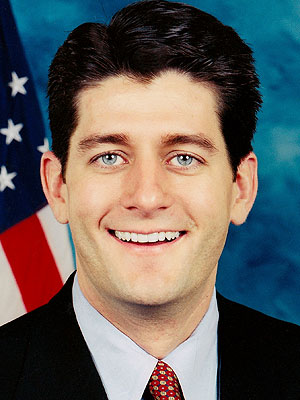
But anyway, why is Represenative Paul Ryan creating a budget based on Ayn Rand’s “philosophy?” He’s in his forties, but he kinda of looks like teenager on camera. Clearly, his mind is also trapped in his freshman year in college. Your freshman year is when would-be intellectuals are at their most insufferable. They are discovering all these thinkers for the first time and proceed to explain them to us in great (and frequently) inaccurate detail as if we’re both stupid and didn’t read these same thinkers ourselves back when we were in college?

Maybe Ryan’s mind also got stuck at age 20, along with his appearance. If you look at this eager beaver, you sort of expect him to start explaining to you about these cool new thinkers he just discovered that you should totally read and quote you some aphorism by Nietzsche (invariably taken from Beyond Good and Evil) or part of Mersault’s outburst at the trial in Camu’s The Stranger.

To me, this would explain why Ryan thinks Ayn Rand’s books will help fix our government.

But why are other people paying attention? Alan Greenspan was a self-described Objectivist (Rand’s ridiculous and poorly reasoned “philosophy”) and he didn’t just help to drive our economy into a ditch, he drove into a ditch filled with raw sewage piped in from a dysentery clinic.

If our government is going to continue to be influenced by people who are caught in some sort of time loop and are repeating the same ridiculous, faux-intellectual discussion held over instant coffee at the student lounge, what hope do we have? It’s time to grow up, guys. Time to drop the Ayn Rand and pick up Tony Judt. Time to learn that there are other Bob Marley albums besides whatever greatest hits compilation you picked up in the discount bin at Tower Records in 1991. Time to stop thinking people are impressed when you spout pompous, poorly reasoned nonsense based on a half-understood lecture in an introduction to philosophy class.

Ugh.

Check this awesome cartoon about Ayn Rand in the 21st Century.

Even More on Marginalia


College professor Pamela Newton wrote this article purporting to explicate a flaw in the Kindle (and in e-readers, in general). The flaw, it turns out, is the difficulty and awkwardness involved in annotating volumes.

While she uses the far more studious sounding “annotation,” as opposed to the dilettantish “marginalia,” it amounts to the same thing.

I have never done much writing on the pages of my books, yet now it seems to the raison d’etre du jour for bemoaning the rise of e-readers.

DC Poetry Lovers Have a Choice


On Tuesday, April 12, we can either go to Politics and Prose and hear Billy Collins or go to Bridge Street Books and hear Language Poet Kit Robinson.

Guess where I’m going?

Does This Mean Borders Will Be Saved?


Does this mean Borders will be saved? The bookstore chain finally presents a business plan to its unsecured creditors (which basically means the landlords who own the shopping centers where you find the stores and the publishers who print the books that they sell). One thing that caught my eye was moving their corporate headquarters from the relatively affluent college town of Ann Arbor to the struggling former industrial leviathan of Detroit. The Motor City could certainly use a major company moving their HQ into town, even if it is a struggling a company. Should Borders ultimately survive, it may even draw other businesses into Detroit.

Unfortunately (?), analysts are not so sanguine that this will work. Specifically, whether publishers trust that Borders has actually figured out a business plan going forward that will enable them to be pay publishers in full and on time for, you know… books. This has been a long running problem, as the bookstore has been trying to classify the money they already owe to them as “loans.”

As I have noted before, I cannot wish ill on Borders. Though I may prefer to shop at an indie bookstore, the book publishing industry as whole will be gravely hurt if the second largest chain in America falls. And those hurt won’t just be the Random Houses, but also the Copper Canyon and Graywolf and Coffeehouse presses.

National Library Week


Monday marks the beginning of National Library Week (are the libraries trying to steal the thunder from National Poetry Month?). These days, I tend to be more of a haunter of bookstores than of libraries. It’s very American of me – I want to own my books, not borrow them.

But that doesn’t mean I don’t have very fond memories of libraries and don’t respect and value (and am willing to pay additional taxes to finance) them.

As a young child, we lived in Scottsdale, Arizona. At the time, I was too young to realize that Scottsdale was an overgrown, soulless, suburban strip mall. But  was not too young to love going to the library – mostly because they had these enormous (or so they seemed at the time) white sculptures you could climb on.

Later, I loved the Dunedin Library. They spent what seemed like a long time building a wonderful new building, but it was well worth it. It’s not a huge library, but it’s comfortable and inviting and hosts some wonderful events (I remember attending a performance of an artist and scholar dressed as Zora Neale Hurston).

Even later, there was the Gulfport Public Library. A short walk from my apartment, it was a cozy place. A satisfying if not overwhelmingly comprehensive collection. Mostly, I went there to read both daily papers and numerous magazines. It was a daily ritual that I treasured.

April 14 Is “National Poem in Your Pocket Day”


Are you planning on celebrating “National Poem in Your Pocket Day?” I am. I may even try some of the suggested “guerilla poetry” maneuvers.

It is fortunate that most poetry collections are not so large. It  is also fortunate that I like to carry a black canvas shoulder bag with me. Though I may change my mind at the last minute, I’m inclined to bring some Fanny Howe.

Derrick Weston Brown’s “Wisdom Teeth”


Busboys and Poets featured a reading by their poet-in-residence Derrick Weston Brown in honor of his first collection of poetry, Wisdom Teeth.

I had not heard Brown before the reading. I never went to the open mics nor the slams he hosted. In fact, when I looked online for some of his poems, I felt pretty sure that I would not like his writing.

Much of the reason for this is cultural differences – differences at least partly resulting from race. I am white. I was raised by white people who primarily inculcated me in the cultural specifics white American and Anglo-European culture. The culture of the poetry at Busboys and Poets is inextricably tied to Washington, DC’s African-American history and culture.

The disconnect for me is that, for me, poetry is always most deeply informed by the written word. By the physical page and appearance of the words upon it (my parents each spent much of my childhood reading in silence, especially during difficult or upsetting times, and this made my ties to the written word almost unavoidable). Slam poetry, hip hop inflected poetry – these are forms more deeply informed by the oral word.

But…

Once I was able to flip through Wisdom Teeth, I loved it. Really loved it.

Brown’s poetry is still intimately and predominantly informed by oral culture, but also by the formal techniques of the written word. A series of poems near the beginning about a group of slaves in the American south is especially affecting in its combining of colloquial language and oral traditions with the contemporary forms of written poetry.

Of course, now the question becomes, do I like his poetry only because it touches on the poetic traditions of “my” (read: white, European) culture?

Such tricky ethical, philosophical, and sociological questions aside, check out Wisdom Teeth.