
Ezra Pound: Canto LI


Finished the Fifty-First Canto and yet not even a quarter of the way finished!

This one is equal parts glorious and frustrating. It opens thusly:

Shines
in the mind of heaven   God
who made it
more than the sun
in our eye.
Fifth element; mud; said Napoleon 

The rare, explicitly religious reference (though the Cantos have been chock full of references to popes and priests, they appear more in their temporal capacity than spiritual) then almost immediately knocked down by the ‘mud’ and ‘Napoleon’ line.

Almost immediately following, he goes on a tirade about usury or ‘usura’ (he wields the latter almost as if it were the name of some Greek deity. as when he writes I am Geryon twin with usura). Throughout though, he uses strongly archaic language – like a pre-Raphaelity poem – and some hints of a back to the land aesthetic. Much of it is beautiful. Like some other sections, I am reminded of nineteenth century translations of classical Greek and Roman poets.

He ends with a disconcerting switch to what we might call ‘Pound’s Chinese style.’ The next to last line reads very much like a line from one of Pound’s translations from the Chinese: in the eel-fishers basket

Then, he ends the Canto – and also this section of Cantos, for a new one, LII-LXXI, begins after this – with the (I assume) Chinese character shown in the photograph. Any one understand its meaning or provenance?
Ezra Pound: Canto L


Revolution ‘ said Mr Adams ‘ took place in the
            minds of the people
            in the fifteen years before Lexington ‘ ,

I take this opening stanza to be a reference to John Adams and the American Revolution, but the entire rest of the Canto is about Italy (there is a reference to Marengo, and famous early victory by Napoleon in Italy, so I take the years referenced to be the very early nineteenth century, though other references, such as to the Medici, counter that – but who ever said a poem had to be chronologically consistent?) and finance and frankly I do not understand how these first lines fit in with the whole.

He gets more ‘normal’ towards the end, but the first half of the Fiftieth Canto has Pound playing a great deal with different line indentations.

Sadly, we also see this line:

Pius sixth, vicar of foolishness, no Jew God
wd. have kept THAT in power.

Arguably, this is the most explicitly anti-semitic line to appear yet.

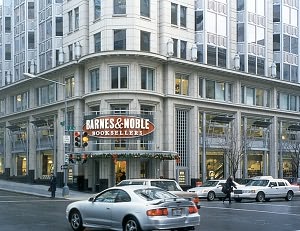
Is Apple Considering Buying & Then Gutting, Skinning & Leaving To Rot Nation’s Largest Remaining Bookstore?


Apparently Steve Jobs and Apple hate Amazon almost as much as Borders did and Barnes & Noble still does.

Even though iPads are still selling well, people are mostly reading books on them with the Kindle app and no one is really buying or reading much of anything from/with iBooks (I assume that is the cutesy name they picked for this particular product; certainly, I am too lazy to look it up and be certain).

In classic Silicon Valley fashion, the folks over at Apple are considering solving this problem by buying a competitor to the Kindle, namely the Nook. And they will buy the Nook by… buying Barnes & Noble.

I wish I was obscenely wealthy and could solve my problems this way. Then I could solve the parking problem on my street by buying the street from the city.

Of course, in this scenario (which is still purely hypothesis and rumor), Apple isn’t really interested in managing bookstores. Maybe some stay open. Maybe none do. Certainly, the best locations get changed into glossy, cold Apple stores.

All bookstores are, in some fashion, repositories for some portion of our world’s knowledge and culture. That portion, as a percentage of the whole, is insignificant, but that portion is also hugely significant as a percentage of the means of dissemination. The same also applies, of course, to libraries.

To see such  a comforting and inviting repository disappear to be replaced with something of less cultural importance is sad.

To see hundreds of them replaced with stores that sell consumer techno porn is not just sad, but bordering on the immoral. It calls for priests, ministers, rabbis, monks, and lamas to thunder invective down from the pulpit.

God, I hope this isn’t true or doesn’t come to pass.

The Itinerant Poetry Library


The Itinerant Poetry Library. I have never seen it, but the concept sounds great. Just setting up a table or a booth or a pop up shop featuring poetry and lit ‘zines you might otherwise never have seen.

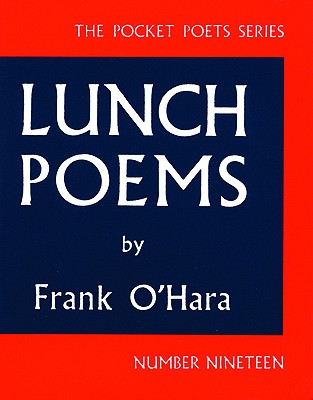
Frank O’Hara: ‘Lunch Poems’


The New York School is a group of poets I’ve only recently made much effort to get into.

Many, many years ago, I bought a copy of one of John Ashberry’s books, knowing that he was considered a great poet, a seminal poet. But I went into it way too early in my poetical education and could not, for the life of me, get into it. The strategies he was attempting made no sense to me and so his poetry made no sense.

Since then, of course, I have tried to slowly school myself on Ashberry and the New York School and to teach myself their styles, tendencies, and tropes.

I’ve read up on some Ashberry, though I’ve yet to read either of his most important books – The Tennis Court Oath and Self-Potrait in a Convex Mirror. A year ago, I got myself a copy of some edition or other of selected poems by Kenneth Koch (it’s in the other room, but I’m too lazy to go find it right now). I haven’t yet picked up any James Schulyer or Barbara Guest.

But I am reading Frank O’Hara’s Lunch Poems.

Had I started with Frank O’Hara, rather than Ashberry, all those years ago, things might have gone much smoother. He is far more approachable (by which I do not mean simplistic) than Ashberry and more serious than Koch (I can only stand so much light-hearted poetry). His deeply personal narration – chronicling small moments from his life in New York City (the city itself featuring far more prominently than in Ashberry and even more than in Koch) – nicely mixes up lighter, amusing fare with more serious musings on privation, politics, and art. While mostly narrative, I should note that several pieces toss in there the kind of surrealism one associates with the New York School (which might be better associated, perhaps, with automatic writing than with Surrealism – though all of the New York School was deeply influenced by French poetry, with Ashberry just recently translating Rimbaud’s Illuminations).

Lit Mags & The Struggle for Survival


Roxane Gay writes about it at HTMLGiant.

Megan Garr at Versal.

Ezra Pound: Canto XLIX


The Forty-Ninth Canto is an anachronism, reflecting back on Pound’s earlier, imagist poems and on his translations from the Chinese. The lines and stanzas mostly depict a leisurely (though not indolent) rural life.

Autumn moon;  hills rise about lakes
against sunset
Evening is like a curtain of cloud,

This is very much reflective of Pounds “wet black bough” period than it is of what we have read so far.

It’s often beautiful, though sometimes also a little trite sounding, and very different from the dense, political, and historical Cantos we have been reading.

Last Trip to Borders?


I went to Borders last night. I meant to go before they closed, as much to say good bye as anything else. But I hadn’t meant to go yesterday. But then unbearable traffic drove me in an alternate direction that took near it.

Nor had I meant to buy anything. Frankly 20% off most books didn’t seem like much. After all, Borders was sending us all 25-30% coupons twice a week not so long ago.

But periodicals were 40% and they were never covered by those old coupons, so I bought the most recent copy of Dissent, looked for a poetry or sci fi magazine, but couldn’t find one.

Then I left.

My idea, when going in, was to stay a little while. Grab a cup of coffee. Indulge in a little nostalgia.

But I couldn’t find any nostalgia.

Maybe if I’d gone to the one in Columbia, Maryland. When I was still recovering and unable to work much, I would go with my better half to shopping trips next a Borders. While she bought fabric and supplies, I would browse books.

Certainly if I’d gone to the one in Hollywood. That one meant something to me. It was a frequent excuse to get out of the house and look for something new and interesting. A place to browse for an hour or more, undisturbed. A place to get coffee before seeing a movie at the nearby Arc Light movies theater.

But this one didn’t mean much to me. It was just kind of sad. Especially because I may never go back. And soon, I won’t be able to go back.

Yikes. Too metaphorical.

But I get misty eyed over good bookstores. A mystery bookstore in Los Angeles where I took my mother, a fan of British mystery writers, to see a place devoted to her favorite genre, is now gone.

It’s not gone, but will I ever go back to Skylight Books in Los Feliz? Or Revelations in Fairfield, Iowa? Lemuria in Jackson, Mississippi? Probably not.

Conceivably, not even City Lights will be immune from my absence.

Ugh. Need more coffee.

Ezra Pound: Canto XLVIII


Eighty percent of more of this Canto is all about banking and finance (again). It opens up thusly:

And if money be rented
Who shd pay rent on that money?

But instead of using this to jump off into a philosophical or historical poetics, he seems to just dropping historical names, places, and dates (Martin Van Buren, the Horn, 1926) without pulling it all together into a coherent and enjoyable whole.

Fortunately, he makes it all worthwhile with his final, gorgeous stanza.

Falling Mars in the air
bough to bough, to the stone bench
where was an ox in smith’s sling hoisted for shoeing
where was spire-top a-level the grass yard
Then towers, high over chateau –
Fell with stroke after stroke, jet avenger
bent, rolled, severed and then swallowed limb after limb
Hauled off the but of that carcass, 20 feet up a tree trunk,
Here three ants have killed a great worm. There
Mars in the air, fell, flew.
Employed, past tense; at the Lido, Venezia
an old man with a basket of stones,
that was, said the elderly lady, when the beach costumes
were longer,
and if the wind was, the old man placed a stone.

Apple Getting Tough On E-Book Shops


Apple’s modus operandi has always been to funnel all transactions taking place on their mobile devices (iPods, iPhones, and iPads) through their own merchant account.

This has been nothing but distressing to every other seller, especially e-bookstores and periodicals. It’s not just about the money and the cut Apple takes. It’s also about Apple holding on to the data acquired – so Amazon can’t mine the data acquired through your purchases through apple for their own marketing (though Apple can and does use that data).

So, virtually every major e-book retailer has changed their iPhone and iPad app so that you can’t purchase directly. This includes the Kindle, Nook, and Kobo. The GoogleBooks app is just gone.

By changing the way their app works, they will lose some spur of the moment sales, but will be able to keep the data and not pay Apple a middleman fee.