Rockville, Maryland, a suburb of Washington, DC (and, incidentally, not far from my office), will be having a conference on the great F. Scott Fitzgerald.
Details here.
Rockville, Maryland, a suburb of Washington, DC (and, incidentally, not far from my office), will be having a conference on the great F. Scott Fitzgerald.
Details here.
Lord be praised, the Times finally reviews a book of poetry not written by Merwin or Collins or some other safe white guy.
I have never read this particular poet (though I will check her out now), but I am just glad to see the paper paying attention to someone new and not just the usual suspects.
The Fifty-Sixth Canto, even more than in earlier ones, juxtaposes depictions of history (still Chinese) with American slang: licked ’em, swat, gimcracks, damned rascals, etc.
One line that stuck out for me was this:
And litterati fought fiercer than other men to out the mogul
Was this how Pound saw himself? A ‘litterati’ (sic) standing against the ‘mogul?’
And who were the mogul?
The illiterate and uncultured hoi poli?
Or are these moguls the moguls of finance? The bankers and financiers Pound blamed for so many ills?
Please sign this petition to save the St. Mark’s Bookshop.
St. Mark’s has been a critical institution for poetry in this country and we have to pray it stay open.
I pretty much never agree with the folks at Scarriet. Their kneejerk hatred of modernism and all its fruits (fruit of the poisoned tree?) runs right in the face of both my appreciation for modernism (especially high modernism) and for what I perceive to be sort of iconoclasm for the sake of iconoclasm (though in the guise of defending ‘true’ poetry – as a sort of dernière garde against the ravaging evils of modernism, post-modernism, L-A-N-G-U-A-G-E, etc).
This particular posting, is more than normally riling (which is, I suppose the point).
Leaving aside such items as the introduction of Wallace Stevens to the poetry reading public being considered, apparently, a bad thing (item number 7) and also bashing a young poet’s first book as being the final nail in the coffin of all that was bright and beautiful in poetry (item number 10), I would like to draw your attention to number 3 in the list.
3. The Waste Land, 1922
Publishing scheme launched by Pound & Eliot’s crafty lawyer and Golden Dawn/Aleister Crowley associate & British Intelligence agent, John Quinn.
Yes, that’s right. It is never said outright, but the author is clearly trying to suggest that the publication of The Waste Land was not, in fact, the result of someone recognizing the work as an important poem.
No, it’s actually a Satanic plot (‘scheme’) by foreign spies.
Sweet mother of god, people! Really?
And don’t try to deny it. No one in their right could see the referencing of the supposed ‘scheme’ (plot? conspiracy?) of this ‘crafty’ occultist spy as being anything other than a bit of paranoid conspiracy mongering.
Ugh.
A blogger cum poet on death row writing about the failures of the penal system. And poetry.
Here’s an article about him in the St Pete Times.
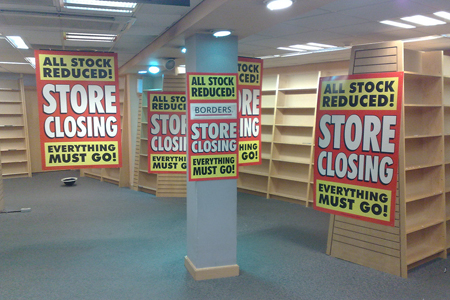 A litter after midnight, on Labor Day, I received an email from Borders announcing the last ten days of its existence were upon us. So I stopped in the one in the DC suburb of Columbia, Maryland that day while my better half visited a Jo-Ann’s Fabrics next door.
Lord, it was a sad sight. The cafe was closed in order to sell off the espresso machines and the like. A crowd of folks (little different from myself, of course) gathered to munch on the chain’s price reduced corpse.
For $22 I picked up John Ashberry’s Self-Portrait in a Convex Mirror, Charles Wright’s Sestets, and Claude Levi-Strauss’ The Savage Mind, and Elizabeth Moon’s Victory Conditions (I’d never heard of the book or the author, but it is clearly some kind of space opera in the classic style of the Lensman or Lucky Starr). Oh, and a book I bought for a Christmas present for one of the few people who read this blog.
Even Amazon should be a little saddened. After all, how many people have (and I don’t condone this) walked into a Borders or a Barnes & Noble or an independent bookstore, browsed through the selections to find something they liked, and then gone home and ordered it on Amazon.
Hell, Amazon should be subsidizing brick and mortar bookstores.
Publishers, too. After all, word of mouth from dedicated bookstore employees and shoppers is cheaper than paid advertising to promote a new book.
Of course, Amazon can afford to do a little subsidizing whereas the contemporary publishing industry really can’t. Not that I expect Amazon to do anything to roll back or at least hold back the bookstore apocalypse they were the cause of.
This Canto is very much like the previous one – a history of Chinese rulers with a focus on economics (viewed from the top, of course – no Marxian social history for Pound). In fact, it picks up with the other one left off: LIV ended at 756 a.d. and this one picks up at 805 a.d.
I am beginning to see some sense in how Pound arranges his stanzas here. To a limited extent, the Canto is broken into stanzas that represent incidents or mini-themes within it.
Much of the economic discussion is about taxes.
He also throws in some little futurisms – at least relative to the topic of medieval Chinese history – such as:
Y TSONG his son brought a jazz age HI-TSONG
Red Mars, Green Mars, Blue Mars.
I don’t remember how I first heard of them or where I read the strong recommendation of them. It certainly came as I was busy (as I still am) digging into science fiction and fantasy.
These books by Kim Stanley Robinson are definitely in the genre of hard science fiction – which is to say, sci fi that works very hard to scientifically accurate. My friend Ryan once told me that the best sci fi (and he is definitely someone who prefers hard sci fi to its counterpart, space opera) has single scientific conceit. Something not currently believed to “real” or possible – faster than light travel, some kind of mutation… whatever – and then extrapolates everything else from there based on known science.
In this case, it is the settlement, colonization, and slow terraforming of the planet Mars.
I am currently just beginning the third and (I think) final book.
It is definitely not space opera. It focuses primarily on two things: the socio-political implications of the colonization of Mars (who controls it? what would ‘martian nationalism’ look like? what factions would arise?) and how would a realistic terraforming process evolve? Robinson’s main conceit, used to keep the original colonists present in a multi-generational epic, is the development of a gerontological process to extend life spans dramatically.
So far, I have read them all on my Nook. In fact, it could be said that I deliberately purchased the last one on for my Nook just to keep up the tradition.
I still won’t say that hard science fiction is my absolute preference, but these are definitely great books. Well written, detailed in their science. Not always completely compelling, but always able to pull you along based on the underlying belief that the author is, within the boundaries of science fiction, trying to put forth a truly realistic depiction of how things could (would?) play out.
 the coffee philosopher