Books by and about that most American of modernist poets, William Carlos Williams.
Arts Advocacy Day
I”m a little dubious of this, but it’s in Washington, DC on April 16th and 17th and you can register here.
Childhood’s End
 Years ago, I read Arthur C. Clarke’s Rendezvous with Rama. It was very, very good. But I never got around to reading anything else by him nor felt much driven to do so. Wasn’t my style. When it comes to science fiction, I like my space opera and that’s just not Clarke’s thing.
But Childhood’s End kept coming up as being one of those books one really ought to read if one read much sci fi at all. So I picked it up for something like $1 at a library book sale around the corner from my home here in DC and finally got around to reading it the other week.
Clarke writes what one might call sociological science fiction. He’s not particular interested in individual characters and their relationships with each other, so far as I can tell, except as necessary to move the sociological (or anthropological, if you prefer) questions that really interest him.
Childhood’s End does present an interesting scenario. A highly advanced alien race shepherds the human race as we move towards our next stage of evolution, which is essentially a group mind, living, depending on how you look at it, either outside of space-time or within space-time but able to experience it as a whole. The aliens are actually unable to make that evolutionary leap themselves. They are rather like a people who have knowledge of heaven and who can show others the way, but will never be able to reach it themselves. So once one gets through all the stuff before the final 20% or so, a kind of melancholia permeates it all (increased by presenting to view of the last human, watching his former fellow humans become something else while he stays behind, so to speak).
Childhood’s End is not on my top ten or top twenty-five list for science fiction. It might be in my top hundred. I don’t know because I’m far too lazy to figure out a top one hundred list. But it’s good.
Weekend Reading – iPads & Other Books
Yusef Komunyakaa
 It was a great concept. The measured, yet musical poet Yusef Komunyakaa reading his poetry in correspondence to the photography/painting exhibit, Snapshots.
Except that it’s at the Phillips Collection. Which is in Dupont Circle. And it started at 6:30 pm.
Have you ever tried to get from anywhere outside the city into Dupont Circle before 7:30 pm on a weeknight?
Needless to say, I was late and missed at least one third of the reading.
Komunyakaa, fortunately, is a great reader. Relaxing, deeply felt.
He dresses like a jazz musician (the black cap, camel hair jacket) and his writing has a very melancholy quality. During the question and answer session, he described his style as based around observation, ‘but not clinical, detached,’ he said. But for me, it was the word ‘melancholy’ (which he didn’t use) that kept coming to mind.
Years ago, I’d bought a copy of his Talking Dirty to the Gods and I brought that for him to sign. He was personable and chatty, but not excessively so. If this event had taken place at the Folger Shakespeare Library, it would have been perfect.
Midweek Staff Meeting – Montmartre Edition
Though my high school buddies and I singularly failed to recreate the creative and artistic atmosphere of the cafe culture in Paris from 1900-1929 at a series of diners and coffeehouses in Florida in the early nineties, at least we can read about the real thing.
Do writers intend to by symbolic?
Remind me again, what was Modernism about?
It wasn’t about forgery, was it?
Of course, if literature has died again, it might not even matter.
Happy Birthday, Charles Dickens

Tuesday Morning Staff Meeting – Is That My Tidal Basin?
Mistborn
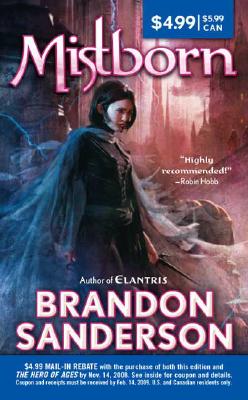 Brandon Sanderson’s Mistborn grew on me as I read it.
The characters are pretty well drawn and nicely three dimensional. The world (Mistborn is book one of a trilogy, by the way) has unique feel, mainly driven by a unique magic system. Certain people, called either Mistborn or Mistings, depending on their level of powers, can ingest small quantities of certain metals and ‘burn’ them internally to give them abilities like increased physical prowess, telekinesis (though only affecting metals), nudging the emotions of others, and even one that gives the ability to see a few moments into the future (useful in a fight for knowing what one’s opponent will try to do next so one can counter it). Even the big bad villain – the Sauron of the series, if you will – is depicted s having more than one or two dimensions (though, as you’ll see if you finish it, that’s something of a red herring).
The main character, a teenage girl and thief named Vin, initially didn’t work for me. But she grew on me over time.
At first, it appears this will be a classic ‘farmboy/farmgirl learns they have magic powers/a special destiny/possess unique item and are picked up by Obi Wan and Han Solo/Gandalf and Aragorn to go and defeat the evil tyrant.’ And actually, it kind of is. But, while that’s the form, Vin also fades into the background a little to appear as just another piece in a big puzzle, which makes her seem more ‘realistic’ than Wheel of Time‘s Rand al’Thor/Dragon Reborn.
I compare them because Sanderson was the author picked by the late Robert Jordan (who knew he was dying) to complete his lengthy and ponderous Wheel of Time series. Good choice, because there’s little doubt that Sanderson is a better author than Jordan. Now if only I can make myself read the other Wheel of Time in order to reach the ones written by Sanderson. I’ve been trying, but it’s getting harder and harder.
Monday Staff Meeting – The Parents Are Fighting
Anis Shivani says teaching creative writing is bad.
Karen Babine calls him out as sexist.
My own two cents:
Shivani is kind of a douche. I was very irritated by this sentence – ‘Literature as we have known it through history springs from genius — that most politically incorrect of words.‘ – and it went downhill for me from there.
It’s the kind of macho posturing I hate. It’s a variation of ‘I just tell it like it is.‘ Whenever someone says that, you know they’re about to be a real a–hole.
It’s also that faux rebelliousness. I’m a rebel. I’m out there. I’m going to say stuff you won’t like because I’m such a freaking independent thinker.
And all that for ‘genius.’ Really? That’s your anti-politically correct statement? Great literature partakes of genius? No one considers this politically correct, you’re trying to make yourself sound cool by pretending you’re saying something politically incorrect.
The whole issue of what is and isn’t politically incorrect is just stupid anyway. ‘Genius’ is not politically incorrect. In fact, I think you’ll find that most politically incorrect stuff you hear is better classified as racist stuff.
 the coffee philosopher