 Christopher Hitcens’ last review.
So that’s why poet laureates do.
The new poet laureate for the state of Washington should be informed of the job description.
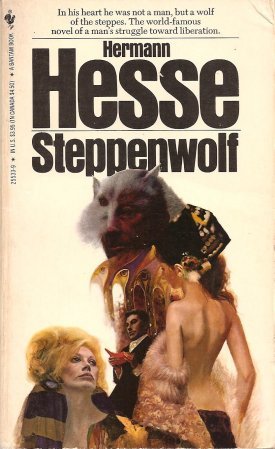 Not the band, the book.
I’m even reading the same Bantam edition with the same unfortunate cover (see photo) as the copy I read as a teenager.
I’m re-reading Herman Hesse’s Steppenwolf to see how my perceptions of it might have changed. Not because I expect my opinion of it to have decreased, but because Hesse himself complained how it was his most misunderstood book on account of it being a book about a man nearing fifty but was most frequently read by young men. I don’t know if young people still read it, anymore than I know if they still read Naked Lunch or On the Road, but I certainly read it as a young man and I have no doubt that I misunderstood in the fashion as all the young people Hesse complains about.
But I’m older now, ten years younger than the steppenwolf himself, Harry Haller. Has my understanding changed?
I am not so sure. I wonder if I am not still an angry young man inside. A slightly mellower angry young man, but and angry young man, nonetheless.
I also wonder whether Harry Haller is not himself just an angry young man with gray hair and an older man’s creaks and pains.
But because I am older, I am also less sympathetic to Harry. When I was much younger and put myself in his shoes, I didn’t see anything wrong with pursuit of and love affairs with young women because I pursued and had love affairs with young women because that’s what young men. Now it strikes me as unseemly, though that is also just one of my particular irritants.
While I agree with Harry’s muse who, when they first meet, calls him a ‘baby’ because he had indeed spent that evening acting like a child. But, as Hamlet says, ‘all which, sir, though I most powerfully and potently believe, yet I hold it not honesty to have it thus set down.’ Which is to say that I don’t hold with young folks speaking so to their elders upon first meeting. So maybe I am getting older. And as I get older, I’m not so blinded by idealizations of women to fail to recognize that Hermine is, to be blunt, a very nice call girl.
The dime store mysticism of Hesse is of less interest to me these days, which means that the famous Treatise on the Steppenwolf within the novel was a distraction rather than a revelation.
The finale is, ultimately, just an extended hallucinogenic drug trip and I have little patience for those who argue that such experiences are mystical and enlightening. Sensational and fun, but not a route to spiritual gnosis. I found Pablo’s theater for madmen to be something akin to Jim Morrison-esque pseudo-poetic platitudes.
I will also say that even though Hesse may have seen the young people who read his book as being mistaken, I can still see their point of view. Especially because Haller’s courtesan/muse, the lovely, gender bending Hermine, is that young person who sees themselves as the Steppenwolf.
Overall, I think that I could have done without re-reading Steppenwolf .
 National Airport in DC used to have a Borders Express. Naturally, that’s gone, but to my delight, another bookstore has taken its place.
As I expected (and as usual in airport bookstores), the selection was a little too popular for me, but they did have several entire bookcases devoted exclusively to Penguin Classics. So the next time I fly out of DCA, I won’t have to worry if I neglect to bring reading material.
The Atlanta airport (where I had a layover on my way back to DC from Florida) had a smaller bookshop called Simply Books. It had a small selection of Penguin Classics on a small, circular metal rack. They also sold Amazon’s Kindle Fire and there was a small cafe attached to the shop.
Upon news that the faster than light neutrinos actually were maybe just a teeny bit slower, as in not actually faster than light, I was forced to scrap the epic science fiction novel I was totally writing that hinged upon these supposedly faster than light neutrinos and which was going to make me freaking rich (the novel, not the neutrinos, which I have not yet figured out to how monetize, even after building my own particle accelerator using empty cardboard toiler paper tubes and the light fixture from from my refrigerator).
Apparently, the new explanation hinges less on super awesome, faster than light particles and more on faulty wiring.
On the other hand, while I was unable to replicate the original experiment, I am pretty confident of my ability to replicate bad wiring.
 Okay, I actually dived into the second book of theVatta’s War series faster than anticipated. Apparently, I underestimated by desire to devour science fiction and fantasy novels.
The second novel is Marque and Reprisal and it suffers a bit by being in the middle of the series, as one of the connecting novels, if you will. The author is moving us along to the real meat of things, but without the newness and character building of the first novel.
Kylara ‘Ky’ Vatta also seems to be pushed along in her development a little faster than seems natural and her preternatural skills at tactics and combat seem to be coming along faster than I can completely accept.
And sometimes money seems to be problem for Ky and her spaceship and then sometimes she seems to be able to afford an awful lot of stuff.
But, that won’t be a deterrent to reading the next book. It’s a fast paced bit of military science fiction and it’s got me sufficiently hooked. I’m eager to find out what happens when Ky starts using her letter of marque authorizing her to operate as a privateer on behalf of the interests of her homeworld, the improbably named Slotter Key (which confused me a bit in the first book – I had trouble catching on this was the name of an entire planet and not just a picturesque island on a planet, but maybe that’s the Floridian in me; I hear a place called ‘key’ and I think ‘Key West’ or ‘Key Largo,’ not ‘Earth’ nor ‘Mars’)
Look, it’s genre fiction. No one expects it to be Thomas Pynchon or Leo Tolstoy. We expect it to be Isaac Asimov with more explosions.
Read and enjoy.
I feel like I gave Liberal Theology: A Radical Vision, short shrift last time, so I want to delve into a some things that stood out and made me think.
I talked about tragedy before, but I want to highlight this remark he makes:
Tragedy is excluded as a Christian category and is replaced by a theology of sin that focuses on personal guilt, divine punishment, and substitutionary atonement. A radically liberal theology must find a way to affirm both tragedy and redemption. [page 52]
Later he writes:
If there is a divine comedy, it is a tragicomedy, a story of a crucified God who undergoes the suffering and conflicts that render historical existence tragic. To affirm tragic suffering in God is a deep revision of the classical metaphysics, which exempts God from the pathos of world. [page 52]
There is also what he writes about the relationship between Christianity, Christ and, culture – written within the larger context of what should be the relationship. The larger relationship includes questions such as, should Christianity (and this could apply to any religion) be above culture, be something beyond mere human affairs as befits something so intimately connected to the divine. Or, does it have an obligation to culture, to guide it down a path that will lead humanity to its salvation? And if so, should religion dominate culture, become inextricably intertwined in culture? Or something more subtle? This question seems particularly relevant as Rick Santorum takes a lead in national GOP polls. He clearly sees culture as something which should be forcefully dominated by religion by the force of law. This is very different from the more liberal view of religious interaction with culture exemplified by civil rights movements that use the moral authority of the church to give support to larger ideas of justice.
He actually comes up with five different paths:
Christ against culture – wherein belief in Christ is assumed to against culture.
Christ of culture – wherein Jesus is a ‘great hero of human cultural history,’ the creator of the values of Western civilization.
Christ above culture – ‘views Christ as the fulfillment of cultural aspirations and the restorer of the institutions of true society.’
Christ and culture in paradox – a complex one, but one that respects both the dictates of human culture (such as government and laws) and Christ while accepting the contradictions; though never explicitly said, the Christ’s remark about giving unto Caesar seems relevant here.
Christ the transformer of culture – is described as creative, with culture as a ‘perverted good’ (as opposed to an inherent evil) that can be transformed and redeemed.
Later, the author presents a new (to me) view of God’s interaction with the world, taken from a reading of Hegel (I told you, he loves Hegel), writing that ‘if God interacts with the world, God must take on the diversity of the world, just as the world takes on the oneness of God – a oneness that is not sameness but a perpetual play of many, unified in love.’ This brings to mind things like Liebniz’ monads or ancient Greek conceptions of the world as oneness, ideas which I never properly saw as at all compelling before, but I also never tried hard to understand how to resolve the contradictions before and this seems to give one way of doing so.
He writes of how Christ transformed the old view in a way particularly relevant to feminist theory:
He transformed the patriarchal concept of divine fatherhood into a maternal or nurturing concept of God. [page 74]
Another quote that struck me:
God acts redemptively in relation to nature both directly, as cosmic eros, and indirectly through human beings.
His writing about Spirit leads me to think of certain agnostic visions of God (such as God as being the sum of physical laws, which was, I believe Einstein’s view):
…Spirit introduces a principle of universality, the wholeness from which the spirit proceeds as God returns to godself from creating, indwelling and redeeming the world. The Spirit proceeds not just from Christ but from the whole world, from a diversity of religious figures and traditions as well as from diverse natural powers.
The author makes a connection between Buddhist ideas of detachment from the world (though he also admits that his understanding of Buddhism is limited) and the concept of Grace. The emptiness and letting go implied by what one might call the Buddhist theory of redemption correlates to the letting go implied by Grace. Each involves a certain detachment from the physical world as one touches an aspect of the divine.
Okay. I’ve rambled enough. I just felt I gave the whole thing short shrift the first time and thought I’d try and rectify that.
Go back about your business.
 The Washington Examiner is still a terrible publication run by terrible people, but it’s cool that they’re writing profiles of DC poets.
 This was one of the issues that I worked on while I was a congressional staffer, so I will affirm what the author says – the United States Postal Service is not broke.
 Contemporary Marxist theory.
 the coffee philosopher