Translating Sacred Writings
 I am sympathetic of the criticism’s Leon Wieseltier voices in his review of the translation, New American Haggadah.
He laments the declining literacy in Hebrew among American Jews and how that necessitates translations of holy texts that, like the Qu’ran, are inextricably and spiritually tied to their original language.
Latin does not have quite the same importance in Catholicism. Though it is deeply bound up with the liturgy, it does not have the same ‘originalist’ aspect that Arabic and Hebrew have in the faith traditions of Islam and Judaism. That said, ‘Logos’ (ironically, a Greek work) is a crucial concept.
Also, the critic’s broader critique of the translation brings to mind my own mixed feelings of the newly released English language liturgy. It’s not exactly a new ‘translation’ – translation not being the right word. It is part of a continuous process of incorporation of theological understandings into the liturgy.
One thing that paved the way for a, not easy, but less us say ‘less difficult,’ transition to the Catholic church was my childhood in the Episcopal Church. Many of the wordings were similar or the same. While the Catholic Church, naturally, does not use the King James Bible, neither does it use one of those stylistically abominable ‘modern’ translations.
But now, the wording is moving further from my childhood memories and feeling less familiar and more alien.
On a much more personal level than even my childhood memories, the old phrase, spoken before communion, ‘I am not worthy to receive, but only say the word and I shall be healed,’ was infinitely comforting while I struggled with a life threatening and debilitating illness. While I understood that the promise was not that God would necessarily physically heal me – some live, some die, some suffer, some do not – but the words themselves were reassuring. The new wording ‘and my soul shall be healed,’ feels almost like a betrayal of that earlier comfort. Irrational, I know. And ‘soul’ betters reflect what the sacrament offers. But nonetheless…
Tea House Culture & Dissent
 There’s something of a throw away line in this interview with Chinese poet-dissident Ran Yunfei:
There is this teahouse culture here—you have these places where you can meet publicly. Not a lot of Chinese cities have these. Everywhere there are tea houses and people meet and talk.
Ran is explaining why the Sichuan province is known for its disproportionate number of dissidents.
But it does get one thinking, doesn’t it?
Like most people, I tend to idealize portions of the time of my youth. In this case, it is the coffeehouse culture that grew up in the early nineties. I’m also love reading about the early coffeehouse culture in England in the seventeenth and eighteenth centuries, as well as cafe culture in France.
Right now, America does not have a cultural venue for discussion of the type Ran describes in Sichuan.
Starbucks is a place to get coffee and go. Even places where one hangs out are primarily venues for wireless internet.
We don’t have a place where the primary beverage is non-alcoholic (we want discussions and debates, not sloppy brawls), even if some alcohol is served, where discussion and debate, including with relative strangers, is fomented. And that has to be hurting our national political and intellectual culture/capital.
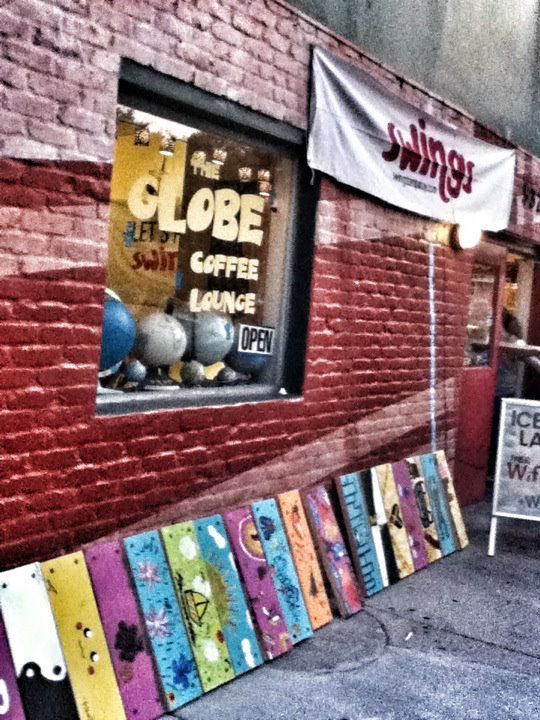
I will give a shout out to the Globe in downtown St. Petersburg which makes a special effort to engender that sort of environment
Tuesday Staff Meeting – What Scares Scott Turow?
 Amazon does.
Belated Happy Birthday To Lawrence Ferlinghetti
 Yesterday was Ferlinghetti’s 93rd birthday. If you were a teenager in America and you didn’t read A Coney Island of the Mind then I have to ask, what’s wrong with you?
And if you’re ever in San Francisco, you need to check out his iconic bookstore, City Lights.
Sunday Book Review – What Is Poetry Without A Proper Font?
Mayakovsky

World Poetry Day
Kind of embarrassing. Wednesday was World Poetry Day and I had no idea. None. Didn’t celebrate it all. It’s the sort of thing I expect myself to be up on.
Thursday Staff Meeting – Long Live The Rebellion!

Publishers still believe in print. Maybe.
 the coffee philosopher