 A while back, I wrote about the first book in Brandon Sanderson’s trilogy, the eponymously titled Mistborn. Well, I was at the laundromat last night and while waiting for some clothes to dry, I finally finished off the third volume: The Hero of Ages (which follows The Well of Ascencion). And they’re all three pretty good. They’re don’t rise to the level of ‘literature,’ assuming we want to get into the argument, but they’re very good. And perhaps let me find a nicer, less controversial way to put it than to bring up the ‘L'(iterature) word: Brandon Sanderson is a solid writer with good plotting and characterization skills, but he’s no J.R.R. Tolkien nor Ursula K. Le Guin nor the lately lamented Ray Bradbury (he’s also not a George R.R. Martin, but maybe that’s another discussion – where does Martin fall on the ‘L’ word scale).
I’m not interested in rehashing plot, but his characterizations, as I’ve said, is pretty good. Mainly his heroes (his villains are actually a little unimaginative, except when one, in particular, appears as voices in the heads of other characters, but that’s more about those other characters than it is about that villain; and the names, too – ‘Lord Ruler’ and ‘Ruin?’ – c’mon, take some time with it and come up with something better, and that last book’s title, too – The Hero of Ages? – pretty unimaginative name for your prophesied saviour). And their relationship, including the romantic ones, feel less cheesy than is the norm in the genre.
I will say that the last two books read a bit like Sanderson hadn’t necessarily intended to write a trilogy or at least hadn’t fully mapped it out (though he clearly had done so when it came to writing the final two books).
He’s written a sequel to the trilogy, taking place hundreds of years later and called The Alloy of Law. I’m not driven to read it.
But Sanderson is clearly a skilled and enjoyable writer of fantasy. Right in the sweet spot of all those rows of thick paperbacks (when I was a kid, in used bookstores, sci fi and fantasy books were all old pulp and mostly relatively thin, but in the new bookstores, like the B. Dalton’s at Countryside Mall, they were thick tomes of at least four hundred pages) with the colorful, detailed covers that I would frequently manage to convince my mother to buy one from.
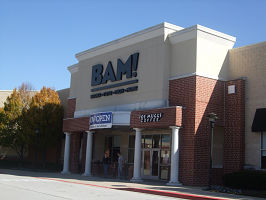 Apparently, that’s what Books-A-Million is now calling itself (BAM – Books-A–Million).


 I certainly hope not!
 I actually used to use the L.A. Metro a good deal when I lived in Hollywood.
 the coffee philosopher