Barnes and Noble takes a stand in ebook pricing case.
The incredible craptitude of Jonah Lerner.
The Little Blue Book… no relation to little black books.
A poet on the Norfolk school board? Maybe someday, but not today.
 A woman pointed to the bookshelves in my study (which do not contain all my books) and asked which one was my favorite. She was very intense and repeated the question several times.
Initially, I was a little stumped. Or, perhaps, floored.
My first reaction was to stumble through a ‘desert island five’ scenario, mentioning my copy of the King James Bible, among others.
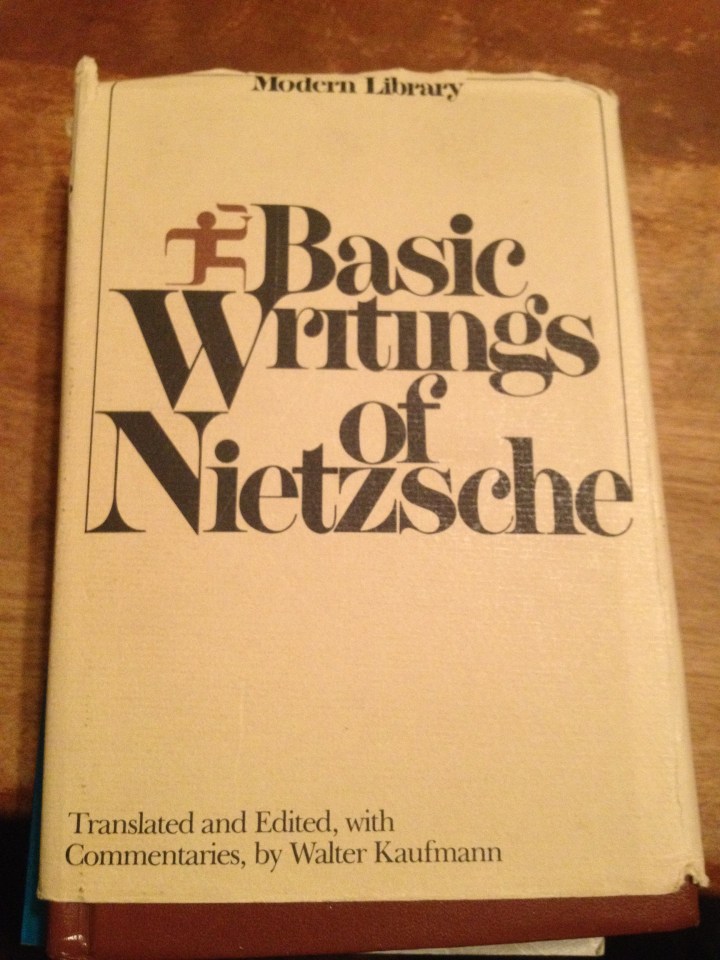
Somewhere along the way, I saw my copy of the Walter Kaufmann edited and translated Basic Writings of Nietzsche. And I pulled it out. That was it. This was the same copy I bought back in high school, the brown paper sleeve worn by use and too many moving days.
The Kaufmann translations have received some criticism for neutering Nietzsche. I couldn’t say; I don’t read German. But weren’t we all breastfed on his Nietzsche, for good or ill?
The selections are a little idiosyncratic, I admit. The Birth of Tragedy, Beyond Good and Evil, and On the Genealogy of Morals make sense to me. Selecting The Case of Wagner and Ecce Homo over The Twilight of the Idols and The Anti-Christ makes rather less sense. And I won’t pretend to know what to do with Thus Spake Zarathustra.
But, my Nietzsche is Kaufmann’s Nietzsche. And like any good rebellious youth, Nietzsche held a special place on my youthful shelf, alongside Salinger, Marx, Kerouac, Burroughs, and Ginsberg.
These days, Kerouac and Salinger are almost never pulled from the shelf to be read. Marx and Burroughs, occasionally. Ginsberg, too. Only Nietzsche, among those, can be said to be still perused with any frequency.
So, that’s my book. The Basic Writings of Nietzsche.
 I read a dozen Doctor Who novelizations long before I ever saw a single episode of the actual show. My sister, who lived in England for a bit, told me about it and when I was in the third grade, I purchased novelization from a booth at a science fiction convention in Norfolk, Virginia.
Initially, the only novelizations available were a series of ten books published by Pinnacle. Nine of the ten were based on episodes featuring the Fourth Doctor, the inimitable Tom Baker (though one, the first one I ever read, Doctor Who and the Dinosaur Invasion, was actually a Third Doctor story on television).
I am re-reading a bunch of these.
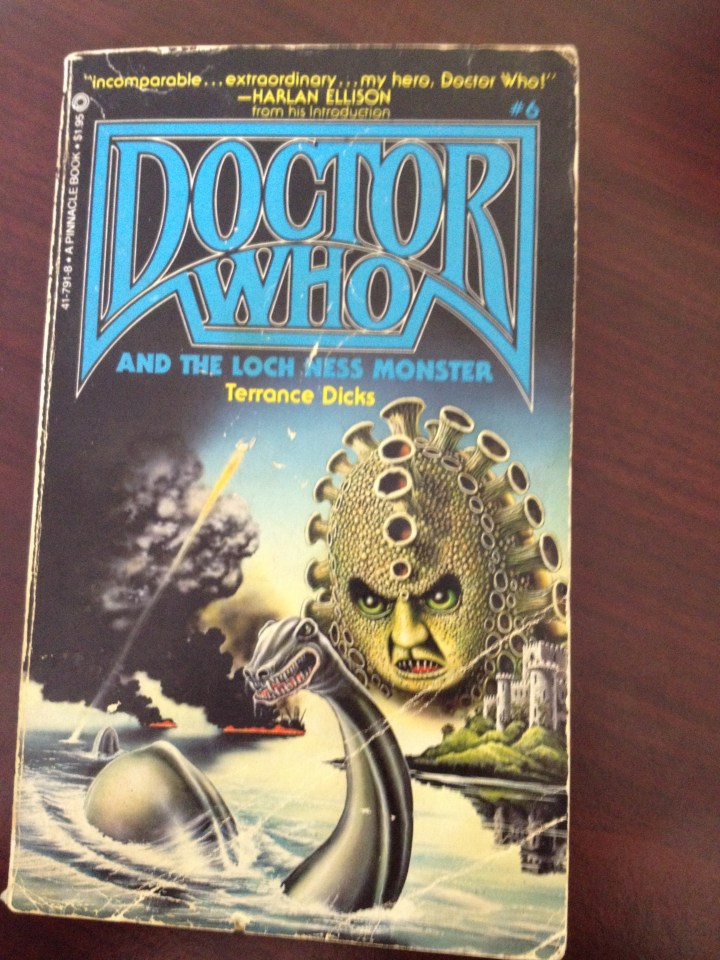
Today, Doctor Who and the Loch Ness Monster.
Like a lot of novels, it was written by the producer who managed the show that particular season (and either wrote or had a hand in writing many of the scripts). As you can imagine, that person might have been busy, so yes, these are just dashed out novels. So stylewise, it’s pretty minimal. You read them because you’re fan.
The actually read a bit lit scripts, with occasional internal musings by the characters, as if the writer suddenly remembered that this would be read and not seen on the screen. So the style is your basic, propulsive pulp style – which is just fine with me, by the way.
When broadcast, it was called The Terror of the Zygons, which was just silly, because no one knows who the Zygons are, whereas ‘Loch Ness Monster’ is a pretty recognizable brand name, so it made sense to rename it when they got the chance.
You can tell this was done early in the Fourth Doctor’s career, both by the presence of Harry Sullivan and Sarah Jane Smith as companions (who were holdovers from Jon Pertwee’s Third Doctor) and by the fact that, stylistically, it is a Third Doctor style alien invasion of earth story. Otherwise, it’s got a kind of 1950’s paranoid style sci fi feel to it (body snatchers, mists, unstoppable monsters).
I was a big fan of monsters as a kid and I love the Loch Ness Monster (I still sort of believe it exists, mainly because I want to believe) and I’m glad that, even after the Zygon conquest is thwarted, the monster (a Skarasen, which is a sort of giant Zygon milking cow/killing machine) goes back to Loch Ness and lives happily ever after.
Incidentally, I purchased this book with a gift certificate I won as a ten year old after being named co-winner of a costume contest for my awesome dragon costume that my mother made for me (with an awesome tail with a surprisingly complicated system for attaching it while also allowing it ‘play,’ i.e., to swing about in imitation of Godzilla destroying Tokyo).
 When my lady friend and I were visiting my sister and her youngest daughter in Lewes, Delaware (a favorite weekend getaway spot for Washingtonians) this past weekend, we wandered into downtown Lewes, I saw, catty corner from where we were waiting for niece and her friend to join us, Biblion: Used Books and Rare Finds.
I was so excited to see such a pleasant looking bookstore, the immediately ran to it in such a way that my friend and my sister were convinced that I had seen an old friend (or so they told me later; it would explain why they waited so long to look for me – they wanted to give me time to chat with my presumed friend).
Bibilion is not a particularly large nor widely stocked bookstore. They opt for clean lines and neatness over stacks upon piles of books up to the ceiling. But the selection is good and well curated. Most books tended to be priced at five dollars, which is, perhaps, on the high side, but well within the pale for a decent paperback in good condition.
I nearly purchased Virginia Woolf’s A Room of One’s Own, but while looking through their small poetry section (it’s a mixture of poetry and drama and mostly contains editions of individual Shakespeare plays), I saw Black Poets, an anthology of African American poetry, edited by Dudley Randall.
My knowledge of the poets of the Harlem Renaissance is limited, but that being something I wanted to fix and since Black Poets has a nice selection from Harlem Renaissance and the book also being just $2.50, or half of what A Room of One’s Own or costs (and, indeed, half of what most every book I picked up cost), I bought it.
Inside were half a dozen poems by Frank Horne.
Haven’t heard of Frank Horne? Don’t feel too bad. Neither had I until that day.
In his non-poetic life, he was an optometrist, occasional adviser to FDR, and an official in the U.S. Housing Authority.
Letters Found Near a Suicide (selections from which – or rather ‘letters’ from it – are included in Black Poets) is, I gather, his most famous poem. And it’s very good. But all of his stuff was good, and more startling for being so completely unknown to me. The forms are a little old fashioned, but the way that they are used to convey and deeply political message is very well done.

 the coffee philosopher