Intellectuals & Artists In Politics


The role of artists and intellectuals in political resistance is a well documented and generally well respected modern and contemporary feature, but their role in actual governance has been littered with failure and ignorance.

Up until fairly recently, art and intellectuals were primary supported by (or actually part of, by way of birth) the governing class, which placed them in a different role vis a vis politics.

But at least since the Romantic period, certainly artists and also, to a great extent, I think, intellectuals have been put into a role as outsiders.

This is all about Ezra Pound and what to do with him. Because that question never goes away, does it?

I was reading this article about Pound’s relationship with Mussolini and the impression is that Pound was roundly duped by Il Duce.

Listen to this comment by Mussolini’s aide:

This is an eccentric proposal thought by a foggy mind lacking any inkling of reality. Keeping in mind the affection Pound has for Italy and the enthusiasm that motivates him, it is sufficient to let him know that his interesting proposal is being studied…

Pound as a stupid little man, tossed meaningless sops to keep him happy with being effectively ignored so he could be blithely trotted out as a meagre tool of propaganda when time permitted.

The great genius… reduced to so little.

Poets Francisco Aragon, Carl Phillips & Eduardo Corral At The Folger Shakespeare Library


20120919-141913.jpg

Folger Poetry Series Kicks Off


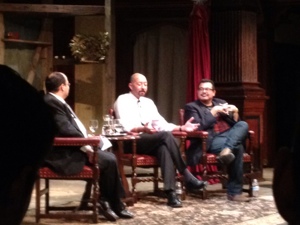
Carl Phillips and Eduardo C. Corral kicked off the 2012-2013 O.B. Hardison Poetry Series at the Folger Shakespeare Library on Monday night. Phillips was the judge for the last Yale Series of Younger Poets and Corral was his chosen winner.

Corral was introduced, both by Phillips and by the program with some beautiful, haunting, and challenging lines from a poem in his debut collection. And it was all down hill from there. His poetry never hit those heights again, which is why I purchased a book by Phillips (I limit myself to buying just one book at these things, no matter how much I want to splurge; discipline, discipline).

Can I admit to being a bit hierachical? I found Corral to insufficiently respectful beside Phillips. Or maybe I found his efforts to portray himself as Phillips’ equal too forced and overdone. Corral may become a great poet. But he just published his first book and the man beside you has been there and done that, as it were.

During the question and answer portion, the last question came from a local poet, Sandra Beasley (well, sort of local; I suspect she doesn’t live in SE). She asked about how first books and publishing had changed.

I rather felt her question was more about the contest culture of getting first publication and perhaps the greater difficulties of the process now (but what the hell do I know? I’m inserting myself into the mind of a stranger; but she spoke like she’d memorized the question and seemed to orate as much as interrogate, which leads me to believe that there was some point in there that I don’t think was addressed). The answer given was actually about ‘project books,’ as both men called them – things like books about just one thing (fleas were mentioned – though Virgil wrote a poem of that title and Phillips did say he liked Virgil; also collections of just sonnets).

Many of Phillips’ poems spoke lovingly and elegically of sexual love and desire, frequently tinged with memories of when sex and love between men was more verboten than it is now. His known for the influence of Greek and Roman literature on his work (though he dismissed that being overemphasized; he also said that, excepting The Iliad, he didn’t much like classical poetry, but preferred to read the great orators, like Cicero and Quintulian) and of the two books available (the other being Double Shadow), I made my selection because Speak Low featured more poems the explicitly referenced the classics.

When I asked Phillips to sign my book, he was extremely personable and reached out to me (I tend to be a pretty basic, ‘here’s my book’ kind of guy when it comes to getting autographs) and spoke for a bit. Certainly, I can see him as very generous teacher in many respects (he does teach university).
This Is Why I Don’t Buy From Amazon


You think they have your interests at heart? You think that once they’ve driven out all the brick-and-mortar stores, from Barnes and Noble to Inkwood Books, that they’ll keep prices low? If so, I’d like to sell you mineral rights in Costa Rica.

And our Justice Department carryied Amazon’s water for them, helping them to build monopoly.

Plainly, Amazon’s behavior didn’t resemble that of a retailer laser-focused on serving consumers. It resembled the behavior of a cable company fighting with a TV network over transmission fees by cutting off its viewers’ access to the network’s programming. You want to buy your books from a company that models itself on your cable provider? Me neither. – Michael Hiltzik, Los Angeles Times
http://www.latimes.com/business/la-fi-hiltzik-20120912,0,1949778.column

Book Reviews


The nature of book reviews has become rather controversial lately. Especially as high profile book reviews, in magazines and newspapers, have become more precious as newspapers and magazines reduce or eliminate the amount of space given to books. One question is: should one be critical? Not critical in the sense of critical thinking, rather, in the sense of writing negative things about a book. This is an especially poignant questions when it comes to poetry. With so little space left (and please, let’s not count blogs like this one – they are no substitute for the Sunday book reviews that your local newspaper hopefully still includes), is writing about a book we don’t like worthwhile? Or should we focus on book reviewing as promoting quality books? But even when writing online, if we truly care about book culture and poetry culture, does writing harsh reviews hurt it, but making it seem less worthwhile, or support it by building an honest dialogue and culture of critical thought? It’s easy to take the high road and say, the latter, of course. But it is true that literary culture is suffering from a debilitating sickness, I think. And if it is, does the latter actually speed its sickness towards a nasty end?

Below are some articles and arguments on this subject:

Against Enthusiam

Some Notes Against Enthusiasm

In Celebration of Enthusiasm

Has Twitter Made Book Reviewers Too Nice?

Arthur Krystal: The Excuses of a Mean Book Critic

A Critic’s Case for Critics Who Are Actually Critical

Is This Book Bad, Or Is It Just Me? The Anatomy of Book Reviews

How Is the Critic Free?

Nice Book Reviews

How to Be a Critic

A Failure in Four Parts

Meet Your New Dungeon Master


Well, not yours exactly. Not unless you want me to be. And even then, I’d have to run it by my lady friend and I can’t see her agreeing to it.

But I’m someone’s dungeon master! But not my lady friend’s because, well anyway, what I mean is, that I’m trying to run my own Dungeons & Dragons campaign.

One hundred percent from the ground up. I’m kind of proud. I’ve only done it once and that was semi-successful, but we’re up again next weekend, in our secret space (actually a large meeting room above a bar in Alexandria, just outside of DC). And my three companions have been patient with my learning curve (which has been relatively steep). And they have graciously consented to let me continue on.

I’ve never written fan fiction, but part of me relates the process to what I suspect the process of composing fan fiction to be like. The characters were created by someone else (in my case, by the people you play the game with) and the plotting is driven by many nearly oulipian level restrictions that make for what can be a satisfying game (or fan fiction story), but which is rarely of publication worthy quality – but which can still be (I hope) useful in learning how to plot (especially because one’s fellow gamers and, I suspect, the fan fiction community, can be tough critics of one’s failures).

Maybe later I’ll tell you what it’s all about. But not for a few more sessions…

Poetry Currents


Is Free Verse Killing Poetry? (I don’t think so)

Has Poetry Changed? (I certainly hope so – change is part of life)

What Are Poets For? (I don’t know… poetry, maybe?)

Melmoth The Wanderer


Can I just admit it? Melmoth is a slog. I bought this book for my Nook at least two years ago and I’m just now finishing it.

A late period gothic novel (which is the say, the 1820s – well after the gothic novel’s Radcliffe fueled heyday of the 1790s), has the anti-clerical bias of the form, but without the intricacy of Radcliffe’s best novels or the over the top salaciousness of Lewis’ Monk.

I think The Monk is the best comparison, or rather it is what Charles Maturin is attempting to re-create in Melmoth the Wanderer. But The Monk kind of killed off the form by taking it nearly as far as it go (a priest rapes his sister at the suggestion of the Devil; Lewis didn’t hold back much).

This has the supernatural elements of Lewis (which Radcliffe famously eschewed), but lacks his lushly, filthily erotic sense of elan.

To give a quick overview: there is a sort of Wandering Jew character, except he’s not Jewish and he’s an instrument of diabolic temptation. His name is Melmoth. There’s also the Melmoth family in Ireland and it’s sole heir who sees a painting of this other Melmoth and maybe sees that other Meltmoth in person. And then there’s the Spanish dude who shipwrecks on the Irish shore after escaping from a monastery and the Inquisition (all of which occurred because of some incredibly evil yet also incredibly over complicated and poorly thought out plan by the confessor of this Spanish dude’s parents). And then there’s the story within the story found by said Spanish dude about how Melmoth finds a beautiful shipwrecked girl who is innocent and pure, who then gets found by her real parents and discovers that the Catholic Church is bad (unlike the pure spirituality in her heart) – oh, and they fall in love, too, and run off to get married.

Anyway…

I don’t mind the complications and permutations – I love Almodovar films, after all – but it just lacks… I don’t know. Something. If you’re going to write something nearly six hundred pages and not put any sex in it, you need to do something to make it pop. Maturin doesn’t make it pop. But you should read The Monk. That s–t is freaky!

Ted Joans Lives! (The Movie)


Possession


I know that there is a movie out there by the same name, but I’m actually talking about the A.S. Byatt novel.

Despite it’s good reviews, I resisted the novel on account of having been young (sixteen or seventeen) when it came out and it also seeming like too much of a ‘chick novel’ (I was more into The Three Musketeers and manly womanizers like Albert Camus).

I can’t even remember where I finally picked up Possession. It was somewhere ’round here and it was used. I think maybe I grabbed it from a box of free books on the sidewalk outside someone’s house. I started it, put it down, and was inspired by an NPR story to pick it back up again, though enough time had passed that I had to start over again.

The ending was necessarily anti-climatic (and the little grave digging bit seemed like a irritating action sequence that was mostly there to sloppily tie up some loose threads) after the breathless archival discoveries and literary sleuthing of the first half, but it was still marvelously put together. The distance from which the characters is interesting, with only Roland Mitchell (who is a sort of hapless hero) getting much interior description of his thoughts.

The dynamic between the characters – specifically the modern day (romantic?) leads and the Victorian (definitely) romantic leads – is interesting. The romance between the Victorian poets is certainly more fiery and more passionate than the tentative one between the contemporary literary scholars, but in each case, the female is the dominant figure in the relationship. In the Victorian case, it is because she is a simply a more powerful figure (the male poet, modeled, I gather, on Robert Browning, writes narrative poetry that deliberately sublimates his own personality into characters and historical figures). In the modern world, it is because the woman is more financially secure and, more importantly, a more prominent and (it is bluntly implied) all around better scholar. I even got the impression that she (I should give her name – the modern scholar is Maud Bailey) likes that he (Roland Mitchell) is passive and her professional inferior.

Good book. Worth reading. Worth reading again. And skip the movie. It’s okay, but only okay. And Roland Mitchell is transformed from hapless (and English) academic hack into a blonde, muscular American who manages to find at least one excuse to take his shirt off (no disrespect intended to Aaron Eckhart, an actor I have liked since the nastily mean-spirited Your Friends and Neighbors).