Invisible Classics


I stole this from Michael Cunningham (author of The Hours, which I tried to listen to on tape – actual cassette tape, which you kids should ask your parents about – when I was in Iowa and driving a battered old Honda with no air conditioning across great rural expanses, but failed to finish, but I’m not actually all that sad about that) who wrote about the idea in a Huffington Post piece.

And there are so many of these books out there, almost like the cult movies of graduate students in literature.

I had that ‘invisible classic’ moment when reading Goblin Market. I had a moment of ‘how is it that I wasn’t assigned this in high school?’ A marginalized poet from a marginalized school, but reading this beautiful, twisted poetry that would be just perfect for so many people, but while you know she (Christina Rossetti) exists, you never actually read her.

There’s also Persuasion. Sure, you’re saying, c’mon, it’s Jane freaking Austen… how ‘invisible’ is it really?

Point taken, but who, besides Austen completists, have actually read it? You read those ones that were made into movies with that skinny British chick who was in that soccer movie or that American actress who pretends to be English all the time or with that actress who totally got topless in Titanic (which might almost have made that movie not a colossal waste of what felt like a year of my life, except that even if she had walked out of the screen buck naked and propositioned me in the most explicit terms possible, the time I spent in that theater would still have caused me to question whether I had not already died and was receiving the most fiendish torments Gehenna’s master could conceive).

But do you ever read Persuasion?Is it ever assigned in school? No. And you should. While those other books had a larger feel – with the deus ex machina of handsome rich men waiting in the feel – Persuasion feels smaller, more desperate and more real. The handsome man in the corner is less handsome and less wealthy and the happy ending less secure (I mean, the dude is going off to fight Napoleon’s France, which, at least to me, feels fundamentally different than the situation of the handsome rich dude who sits in his huge house and collects 10,000 pounds [figuring in inflation, that’s approximately ten bazillion gazillion dollars in contemporary money]). There is just a sort of desperate, grimy, grimness to it all.

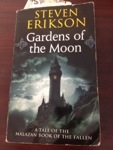
Gardens Of The Moon


Gardens of the Moon is volume one of the Malazan Book of the Fallen. I know another damn, multi-volume series (this one is ten volumes and counting).

It’s pretty redolent of Glen Cook’s Black Company, but somewhat better (I read the first three books in Cook’s series and left feeling underimpressed).

Like that earlier series, it portrays a grittier side of war, that purports to capture some of the experiences of folks caught up in events larger than themselves (the little people, as it were), but Erikson sometimes seems to shy away too much. A character that I had grown to like was suddenly killed, which was sad, but I respected it. I respected less when a bit of deus ex machina legerdemain brought her back into the series.

But he’s good at humanizing characters and at showing the good side of villains and the bad side of the semi-heroes. Of course, George R.R. Martin does that much better, but we’ll be waiting another five years, at least, for the next volume. There are already ten or so Malazan books out there.

And as I’m writing this, I am actually reminded of those old Thieves’ World books, which were collections short stories taking place in an a shared fantasy environment, so writers had to be careful not to mess things up for their fellow writers by upsetting the balance of the world or killing off too many characters. This has that feel, that the author is trying to write his epic while staying inside these fixed lines. I don’t know. Something like that. I don’t have enough desire (actually, I have exactly none) to go back and read any of those to see if my comparison holds true.

Credit where credit is due: the finale is a blockbuster. But it’s also dominated by characters who appeared later in the book. A lot of loose ends get cut, but the mysteries associated with them, not so much. Maybe the author will return to them, but it felt like he’d moved on.

I’m not actually sure I’m going to continue reading this series. While Jordan’s Wheel of Time may skew towards to nearly unbearably turgid and his ability to write about romantic relationships in ways that non-embarrassing me effectively non-existent, but you do care about his characters (especially his female characters, at least for me). I am unsure whether I really care enough about Paran, Tattersail, Crokus (now that’s a Black Company style name!), et al to get the second book, unless it shows up at a used bookstore at a decent price.

Sean Connery Reads C.P. Cavafy


Happy International Translation Day!


Not incidentally, this is also the feast day of the Bible translating Saint Jerome.

I want to recognize Lemuria Books, the best thing about Jackson, Mississippi (narrowly edging ahead of some of the blues clubs), which, at least when I lived in town, had a section entirely of literature in translation.

So pick up book in translation today. Something good. Don’t just re-read one of those Swedish mysteries. A classic. Or the Bible. But just the good one, the King James Version. Or poetry. Something that will impress your friends and neighbors and make your bookshelf look smarter.


Nine Princes In Amber


If you were, like me, a haunter of the science fiction and fantasy shelves of used bookstores in the 1980s, Roger Zelazny and his Amber novels were a frequent resident of his shelves, though I never took the final step of pulling it down and asking my mother to buy this one or that one for me (she would have if I asked, but I always made other choices).

When poor old Borders was going out of business, I often looked at the Great Book of Amber, a collection of, shall we say, the ten canonical Amber novels. But I always waited for the prices to go down just a little bit more and when they did finally go down ‘enough,’ the copies were gone.

C’est la vie.

And it all worked out anyway, because I saw a used copy for ten dollars at trusty old Capitol Hill Books.

The first book, Nine Princes in Amber, breezed by quickly and pleasurably, so much so that I was about a quarter of the way into the second book before I stopped to ask where I was.

The hero, Corwin, is definitely a post-Michael Moorcock, specifically, a post-Elric, hero. Elric was conceived as a sort of a fantasy new wave version of the redoubtable Conan. The difference is not in intelligence (Conan was written as an intelligent and well-read character) nor in moral ambiguity (Conan rarely acted in a truly heroic manner, except in some of the stories where he has become a king), but rather in introspection and retrospection, something Conan was not known for. But Elric – and Corwin – frequently ponder their current ideas and ideals and their past actions.

But, onto the book itself…

The opening is blockbuster. Really great. Fantastic. A brilliant, noirish nailbiter. Naturally, the rest of the book cannot live up to it.

Corwin awakens in a hospital room, where he is both recovering from an accident (car accident, as it turns out) and being held against his will. And he has little or no memory, including his own name. The tale of how he escapes, which is partly by the threat of physical violence, but mostly by bluffing his way around his memory loss to hide it from those encounters, is great. Clearly, he is someone important and clearly part of some conflict or conspiracy or… something. It’s written from the first person perspective, so we learn who he is (one of the nine Princes of Amber referenced in the title, in case you hadn’t guessed), but by the time we’ve learned everything important there is to know, well, it’s become a much more prosaic (though still very, very good) fantasy novel.

One cool thing: Corwin’s sword is called Grayswandir – surely a reference Graywand, as Fafhrd, the Gray Mouser’s inimitable companion in crime and adventure, always names his broadsword.

And, again, I find myself committed to some multi-volume fantasy series. I’ll be dead before I finish all these, I fear.

Make It So


Fans of Jean-Luc Picard will know what I’m talking about.

Anyway… warp drive!

Michael Moorcock


The Onion asked, ‘Where to start with fantasy overlord Michael Moorcock?

The unsurprising answer were his Elric stories.

As a youthful fantasy nerd, Elric was one of the shibboleths used by my fellow travelers. To be totally honest, I actually discovered him because he was written up in a 1st edition Dungeone & Dragons rulebook entitled Deities & Demigods. But that was how things were done. In the absence of the internet, such things seeped into the brain by different means.

And, in the mid eighties through the early nineties (roughly my Moorcock period), those books were damn hard to find. Naturally, once I’d succeeded in tracking down the books, one at at time (mostly from used bookstores), they became popular and were reasonably widely published.

That’s one of the things that rarely gets mentioned when talking about liking something before it was cool. Before something is cool, you can’t freaking find it. It’s like trying to put together a puzzle when you have to buy pieces one at a time. And you’re buying the pieces from guys who like they live in their moms’ basements and you try to not ask yourself if that’s your future, too.

I haven’t read the Elric stories for a long time and one wonders what it would be like to read a deliberate attempt to read a Conan novel written for a David Bowie, counter-culture world – which is pretty much what we’re talking about.