Which Iliad?


When I was either in junior high or high school, I spent a summer reading The Iliad and was very taken by it (though, as I think many modern readers feel when they read it, I was more sympathetic to the Trojan side and was disappointed at how easily poor Hektor was dispatched and how cowardly he was made in his next to last moments).

I read the Richard Lattimore translation. Not for any particular reason, it was what I found in, I think it was, A Blue Moon Bookstore in Clearwater.

This LA Review of Books piece looks at the various English translations out there.

After reading it, I’m glad I happened to read Lattimore. It seems like he’d most be my style. It also makes one want to go back, though to be entirely honest, I find it hard to imagine going back and reading The Iliad again, which does not, I admit, reflect so well on me. And if I did, I don’t know. I might read Chapman, just because he comes so high recommended by John Keats.

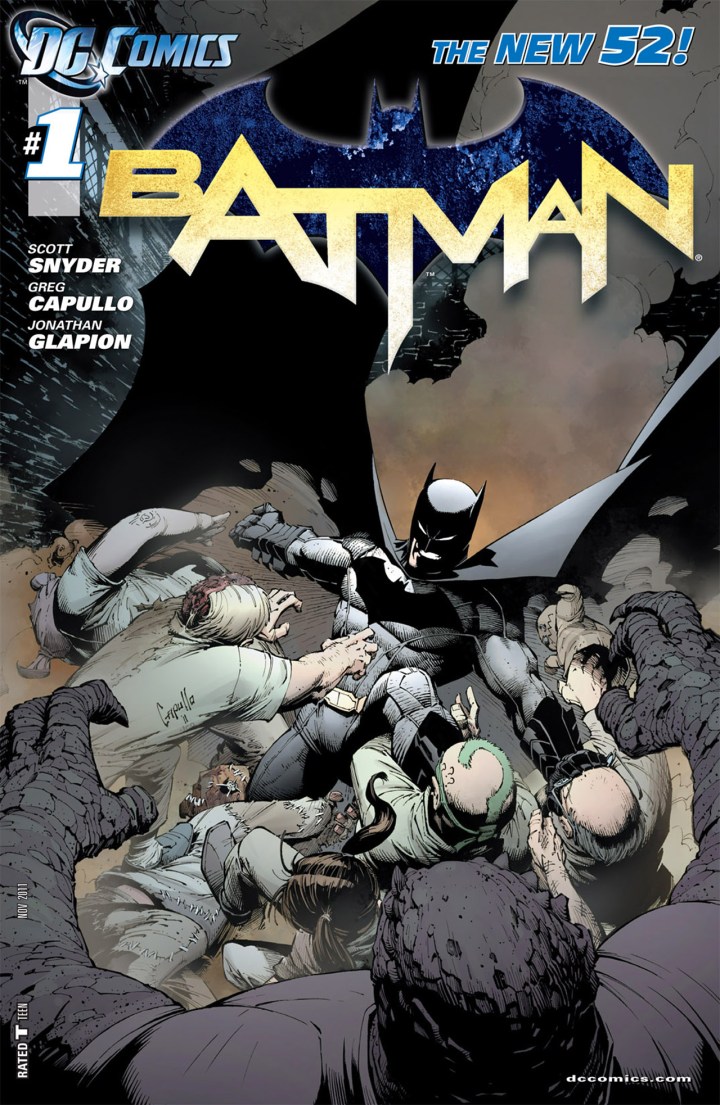
The New 52 – Batman


I always get the urge to walk inside when I pass by a comic book store, but I’m frankly intimidated. I haven’t even remotely kept up in, quite literally, decades (not since I used to buy comics at the 7-11 style convenience store near our home in Norfolk, Virginia when I was a kid).

But I read about DC Comics relaunch, The New 52, it seemed like a perfect opportunity to start fresh and maybe keep up with a series.

There’s a comic store near my office, and I was in a frustrated kind of mood. It was actually about money troubles, which makes purchasing comic books sound counter-productive, but I needed the distraction and, oddly enough, doing this would, I felt, give me a certain feeling of accomplishment.

Because the various series have, nonetheless, been out for a while, I’m like 13 issues behind, so I went for one of the bound collections containing the first six to seven issues.

I told me story, in brief, to the owner and asked for his help and recommendation.

Firstly, he told me I’d be better off buying one of the bound collections, because he was unlikely to have the first thirteen issues of any of the series in stock.

He himself particularly enjoyed Batman, Batman & Robin (there are, something like three of four New 52 Batman series, including the original ‘DC’ of ‘DC Comics’ – Detective Comics), Wonder Woman, and Swamp Thing.

I’d rather had it in my head, as a sort of token nod to history, to get either Detective Comics or Action Comics (which is Superman), but I settled for the owner’s advice and got Batman.

Batman is still friends with Robin. And Actually, several former ‘Robins’ have advanced on (one becoming Darkwing and another becoming Red Robin; the current Robin in this series being uncomfortably young looking for a reader approaching early middle age who has concerns about child endangerment). This was a little worrying, not being a fan of the whole concept of the Robin, but it worked okay here, not in the least because none of the current or former Robins were major players (though the oldest former Robin and current Darkwing looks to maybe be a bigger player in future issues).

The artwork was generally very good, though Bruce Wayne and a mayoral candidate named Lincoln looked entirely too much alike (strong jawed, broad shouldered white men; the only way I could be sure is that Lincoln brill creams his locks while Bruce Wayne sports a disconcerting looking, mussy, curly, bedhead thing). The fight scenes were well done and walked carefully that fine line between the Batman who is just a really fit guy in a black and grey suit and Batman who something more, who is, well, a superhero. Good work on closeups of the face and using those to advance the emotional core of the story and to dramatize the inner life of the characters.

They build this new mythology about the ‘Council of Owls’ well (though the whole ‘owls eat bats’ thing is a bit of stretch for me) and I’m looking forward to reading further issues.

And I think I’m going to start reading one other – maybe Aquaman. Or Action Comics. I’ll see what happens when it happens.

At The Folger Shakespeare Library – Red, White, and Blue: Poets on Politics Nikky Finney and Brian Turner


Before the reading, I picked up a copy of Phantom Noise by Brian Turner. It wasn’t that I necessarily had a preference, merely that I was in a bookstore and they had a copy of one of his books and not one by Nikki Finney.

I am always unsure about poetry and politics. I think we desperately need political poetry, for the sake of both our inter/national political discourse and for the sake of poetry (which must be engaged to be vibrant; though that is not to say that all poetry needs to be engaged, merely that if there is no engaged poetry or very little, poetry becomes too disconnected from the life of the people and risks becoming little more than a pretty art for the wealthy and comfortable).

This one was originally scheduled for October 30, but that pesky hurricane postponed that, of course. I can only imagine they worked hard to get this rescheduled so as to at least take place before the election, but nothing could help the comparatively sparse crowd that we can surely blame on the new date.

Nikki Finney was relatively quiet. Whether she is naturally restrained, or felt constrained by the garrulous Brian Turner and the too intrusive host/moderator, Alice Quinn.

Alice Quinn is executive director of the Poetry Society of America, she a wonderful and erudite speaker on poetry, but I frankly did not attend to hear to her speak. I just didn’t. But she really seemed to want to speak.

I rarely ask questions during this things, but this time I did. My question was about success – that if there is a purpose to political poetry beyond aesthetics, how is success judged. And Quinn asked who I wanted to answer this, seemingly thinking maybe she was the intended recipient.

Oh, hell no. I came to hear Nikke Finney and Brian Turner read poetry and speak about their work and the night’s theme, politics and political poetry. I would happily attend a future lecture by Alice Quinn, but that’s not what this was.

Turner was a very open and talkative man. He knew my old boss, Congresswoman Grace Napolitano, on account of her work with veterans and on PTSD and mental health issues. He gave me his email address and told me to send him my address and he would send me copies of his first book, Here, Bullet – one for me and one for her. Well, I couldn’t have that happen, so I bought two copies, in addition to Phantom Noise, and asked him to sign one for her. He asked me to offer her his assistance, any time, any place. Once he found out I worked for union, he made the same offer to me.

I enjoyed Phantom Noise more than I expected. It’s very much about the experience of coming home from Iraq and the ongoing trauma of PTSD, which I don’t always feel makes for very good poetry. Phantom Noise is a bit of an exception (or perhaps, I just haven’t read enough in the genre to understand how good things have gotten, poetry-wise, even if its mere existence is a reminder of how bad things still are and can be for veterans). It does tend to be a bit much. Too many poems about bloody memories interrupting ordinary, man-woman relations.

He did ask me how I read books of poetry, whether I skipped around or read them front to back like a novel. I told him, like a novel. Perhaps his work is better read in a different fashion and he realized that. In bunches, too much. His own reading style was very conversational and dialogical in between the poems, as if he knew the importance of the spaces between poems (and not just within a poem).

Anyway… super excited about Kay Ryan coming up. Saw her read as Poet Laureate and saw her once when I was still living in California.

The Sunday Newspaper – Death & Poetry


The dying poet.

If you want a confessional, read his books, not his diaries.

The (not so) secret radicalism of Paul Ryan.

Has she seen Episode II?

Send someone you know (or someone you don’t know) a book of poetry.

Pound Is Dead


I can’t believe I forgot. This day in 1972, Ezra Pound died. God rest his soul.

Want To Order A Book From Shakespeare and Company?


It’s Not Much


But for what it’s worth, I’m glad that Random House sealed the deal with Penguin. Penguin is a great resource, with those distinctive, lovely orange spined paperback volumes and their focus on classics and should be classics (not that I always agree with their choices for the latter). And it might have been nice if they’d stayed on their own, the British-based bastion. But when I heard that Rupert Murdoch might be getting his culture crushing, deceptive, and just plain nastily evil arthritic claws on Penguin, I was horrified.

Bertlesmann (Random House’ parent company) is broad-based German media company and while anyone should be nervous at the idea of 25% of publishing being controlled by one company, it’s not nearly so unnerving as the monopoly on distribution that Amazon is in the process of constructing. And the europhile in me trusts a German company to be better caretakers of the cultural ideal and symbolism that books possess. I trust Rupert Murdoch and News Corp to publish risible editorial opinions, tap my phone, and lie to my face. See the difference?

But there other, more depressing ways to view this whole thing.

Embarrassing


I point to this piece only to note what c–p it is.

‘In the face of the openness and honest labor of engineers, the priestly class closed ranks.’

So, authors and publishers were the ‘priestly class’ (Pharisees?) interfering with these yeoman engineers. Nothing at all about the fact that their intellectual property, which is also their economic property, was being put online to used however one like without the creator having any ability to control its publication nor receive compensation. And a (I don’t say the) reason, let’s face it, was for Google to make money. To make Google to source for one more thing (literature), thereby making their ad sales that much more valuable.

The essayist tries to create the unsubstantiated straw man argument that the ‘priestly class’ acted out of some kind of luddism, a refusal to accept change (some pointless crap about literature becoming data; correct me if I’m wrong, but isn’t ‘data’ really just information, knowledge? and was there ever an argument that, Great Expectations, for example, contained words which conveyed information and knowledge?), when it was actually about something far closer to theft of future economic value.

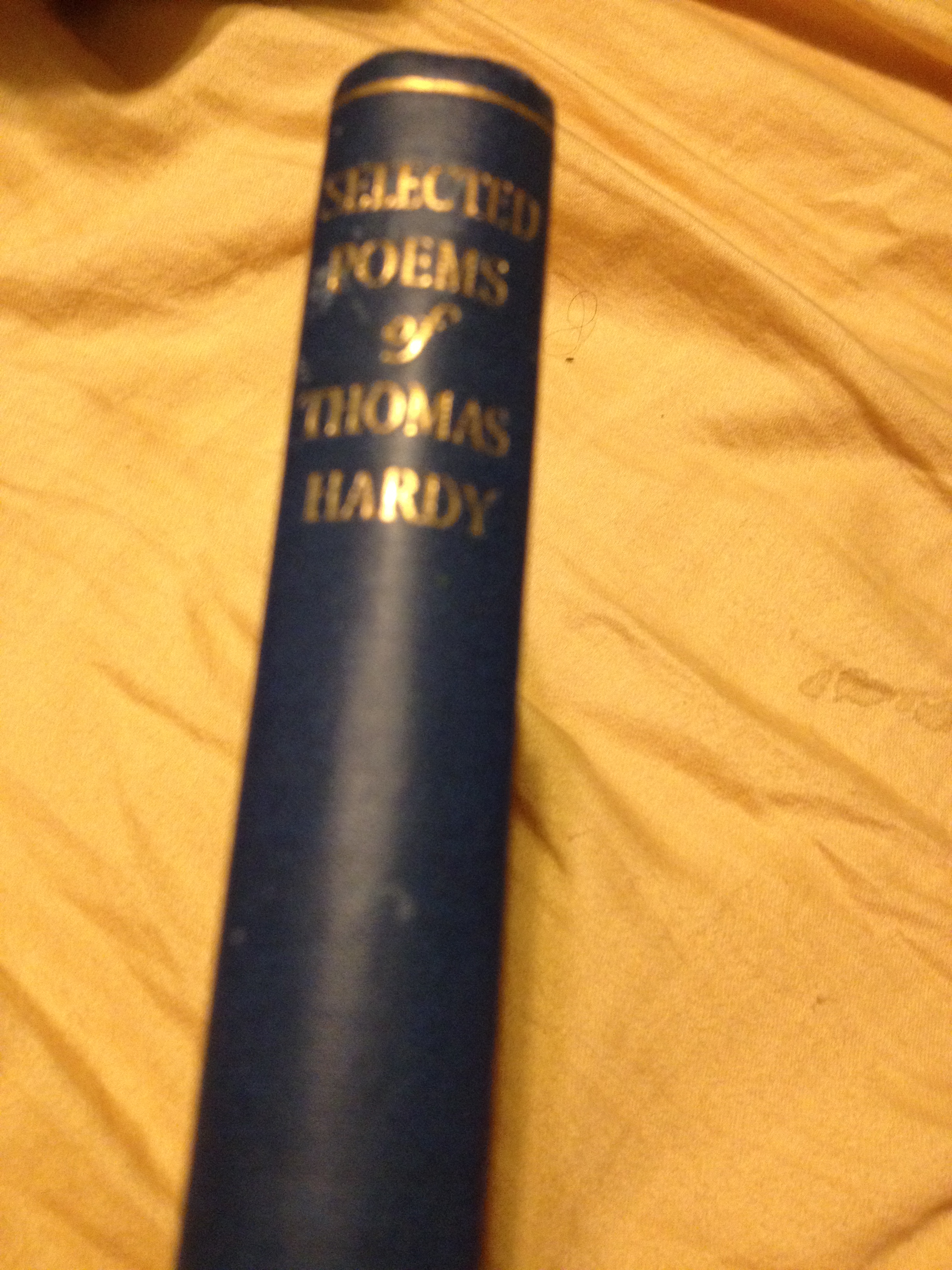
Selected Poems Of Thomas Hardy


For some reason, they made us read several books by Thomas Hardy when I was in high school. Jude the Obscure, The Mayor of Casterbridge, and Tess of the d’Urbervilles. The first was unrelentingly depressing. The second I can’t even remember (some dude some sells his wife and kid to some sailor who turns out to be a good guy; some dude feels bad, stops drinking, becomes upstanding citizen and titular mayor; wife and kids move to Casterbridge and hilarity ensues; did I say ‘hilarity?’ I’m sorry, I mean hundreds of pages of unrelentingly depressing prose). The third had one really good scene: when the whiny b—h Tess got herself hanged at the end. I liked that part, but the rest had a lot of depressing pages where you were in the presence of the supremely irritating Tess.

So, is it a wonder that I did not go out of my way to read anything that came out of the suicidally bleak and muddy mind of Hardy?

Hell no. It’s a miracle that I’m still willing to read the English language after the kind of torture put together by whatever moron came up that high school English curriculum (I mean, folks, what about including some swashbucklers or romances instead, like the novels of Dumas or Austen? something that won’t encourage teenagers to put down books… forever).

But, I kept running into references to Hardy’s poetry.

So I finally bought some.

Like his prose, it’s muddy, mournful, and parochial, but the compact nature of a poem compared to a muddy doorstop of a book makes a huge difference. Formally, he is very old fashioned compared to what others poets were doing in the late nineteenth and early twentieth century, but even that reinforces his depictions of these rural communities, which are necessarily behind the times.

His focus (obsession) was the dirty, rural lower classes who failed to live up to supposed Victorian ideals. By which I mean a lot of unwed pregnancies and more than a few abortions (generally by use of folkloric abortifacients and rarely very successful). It’s all very slow and mournful. Elegiac, even. He is writing about a lost, or at least dying, culture. He doesn’t pretend it’s a great culture, only that, like anything that is passing, deserves remembrances. In later poems, you can feel Hardy, who still comes across as more of a nineteenth century writer, feel left behind by the approach of modernity and the very different ravages of the Great War.