‘A Memory Of Light’ Arrives Today


9780765325952The wait is over. Kind of.

I mean, it’s over for other people, just not for me.

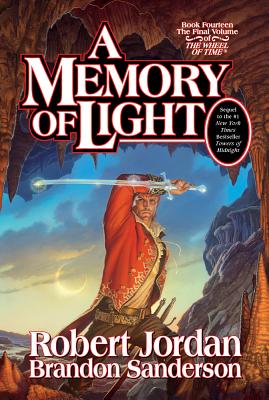
The final book in the Robert Jordan’s epic fantasy fourteenology (completed by Brandon Sanderson of Mistborn fame) came out today. I’m excited. I almost wish I were done with book thirteen instead of still buried in number nine so that I could participate in the festivities. And I’m not kidding, either. There’s even a big party in New York, but it would be wasted on me (and pricey, and I have family staying with me). This sort of thing may not come around again in my lifetime, at least not until George R.R. Martin finishes his Song of Fire and Ice.

On the plus side, by the time I reached A Memory of Light, it will be out as a $7.99 mass market paperback, same as all the other editions I’ve read.

Startide Rising (New Year’s Resolution, Book One)


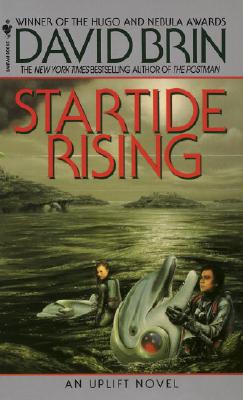
9780553274189Sundiver was an Asimov-style sci fi mystery, but it’s ‘sequel’ (it takes place in the same universe, so it’s a sequel in the same way that a book about the sixteen century is a sequel to one about the fifteenth century), Startide Rising is more like an old fashioned space opera (though definitely with deep roots in Asimov’s hard sci fi style).

I had trouble finding this one in bookstores, so I ordered this one from a bookstore (not Amazon! not Amazon!) and had it shipped to my office to hide my book buying habit from my best gal (Peg at the front desk was very understanding of this need).

Brin’s characterizations are good for genre writing (not great, but more than adequate), but sometimes his dedication to a carefully crafted, scientifically sound (he does have an advanced degree in applied physics) universe gets in the way of writing an exciting yarn.

But, he’s clearly head and shoulders above most sci fi out there.

Some of his most space opera-y moments come in brief, italicized chapters or interludes that capture a space battle going above the surface of watery, earth-like planet where a small group of intelligent, genetically modified dolphins (who make the bulk of the crew, including the captain), a few humans, and an intelligent, genetically modified chimpanzee scientist seek ways to: repair their crashed space ship; escape from the angry hordes of warring galactic fleets above them; and take back to Earth their scientific/archaeological discoveries (lost artifacts and space ships from the Progenitors, the first space faring race and the source of most of the universes’ scientific and engineering knowledge).

In those interludes, he quickly dives into a particular aliens’ ship and their efforts to win the battle for the planet on which the Earthlings are trapped so as to acquire whatever information the Earthlings have uncovered. Though short, they are a marvelous way to describe the space battle going on and also to give the reader a glimpse at various alien societies in Brin’s ‘Uplift Universe.’ It also provides the reader understanding that the battle is long and complicated, so that no one starts questioning how the stranded dolphins, chimps, and humans are able to hang out on the planet for weeks without being, you know, captured and killed.

When he drops some of the dedication to hard sci fi and starts in on some really fascinating fights and escapes in a metallic sea and between warring varieties and between warring allegiances of dolphins… well, things get good. His characterization may not be great (frankly, I couldn’t really distinguish the personalities of several of the dolphins ; generally, the ‘good’ dolphins were pretty similar to each other, and likewise the atavistic, ‘bad’ dolphins were sometimes hard to tell apart). He just needed to start that sooner. He’s not skilled enough at the building up process to wait two hundred pages (almost half the novel) to really kick into gear. By the end, it’s moving very, very quickly. Frankly, too quickly. It’s exciting and well done, but I can’t help but keep harping on the pacing issue.

Will I read the final novel in his first Uplift Trilogy, The Uplift War? Probably. Will I read his second Uplift Trilogy? Maybe, maybe not.
Pricey Used Books


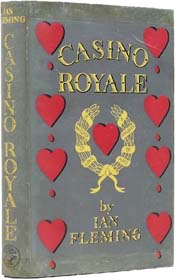
Casino-Royale-Ian-FlemingSo AbeBooks has released a list of the most expensive used books sold in 2012.

The first place this year is occupied by Johann Bayer’s 1603 celestial atlas, which sold for $47,729.

Number two was, apparently, an inscribed copy of Ian Fleming’s first Bond book, Casino Royale.

Belated 121st Birthday, Professor Tolkien


I can’t believe I missed his b-day.

John-Ronald-Reuel-Tolkien

Weekend Reading – Selling Yourself


Selling your e-book in the brave new world.

Let’s hope not.

Kids don’t need to learn how to ‘read’ any more than they need to understand ‘critical thinking.’ Pfft. Silly whiny liberals, always wanting kids to ‘understand’ and ‘think’ and ‘explore the world of ideas.’

A museum of math.

The terrorist and the invented language.

Movies & Masterpieces


I was reading this article in The Nation about the movies and was struck by one line:

Since, moreover, the mass audience is so calculatingly considered in the actual making of film—and since any one film is put together by so large a number of people—the films reveal more about society as a whole than any other works of art except literary masterpieces.

The comparison of the anthropological aspects of the greatest works of literature to cinema. Specifically, to the mass (or, as Dwight McDonald might say, ‘masscult’) cinema, as opposed to the cinema of the auteur.

It rings true, doesn’t it? But what should we think of it? That it takes an army of producers, writers, and marketers, as well as a hundred million dollars, to reproduce the reproductive/reflective (see what I did there? ‘reproduce’ and ‘reproductive?’ I didn’t need to use ‘reproductive’ and ‘reflective’ but it just seemed too cool an alliteration/repitition to pass up) of a Roth or a Zola. One assumes that Ulysses or The Brothers Karamazov could only be matched by the complete and combined ouevres of Michael Bay and Steven Spielberg.

But still, we haven’t properly answered or addressed the question of what it means if popular and frequently mediocre constructs like the year end box office top ten can perform a major function (? ) of literary masterpieces?

Rejection


The great Ursula K. Le Guin saved this rejection letter (though when she made it public, to save the editor some embarrassment over having rejected the greatest science fiction of the second half of the twentieth century, she hid the editor’s name).

Dear Miss Kidd,

Ursula K. Le Guin writes extremely well, but I’m sorry to have to say that on the basis of that one highly distinguishing quality alone I cannot make you an offer for the novel. The book is so endlessly complicated by details of reference and information, the interim legends become so much of a nuisance despite their relevance, that the very action of the story seems to be to become hopelessly bogged down and the book, eventually, unreadable. The whole is so dry and airless, so lacking in pace, that whatever drama and excitement the novel might have had is entirely dissipated by what does seem, a great deal of the time, to be extraneous material. My thanks nonetheless for having thought of us. The manuscript of The Left Hand of Darkness is returned herewith. Yours sincerely,

The Editor

21 June, 1968

http://www.ursulakleguin.com/Reject.html

One Book


Resolved: to read one book (or lit mag) per week this year. I’ve got a chapbook called 31 Poems by a Dean Young, the latest edition of Pitchfork, Ohio, and the ninth book in The Wheel of Time series (the final book, A Memory of Light, comes out shortly).

First Staff Meeting Of The New Year – No Kids, Please


Red, 1963, San Francisco Museum of Modern Art, San Francisco, Evelyn and Walter Hass, Jr. Fund Purchase, 82.155, © Ken Price

Philosophers should stop talking about their kids.

What’s killing opera? Hint: it’s not opera.

Philosophy, poetry, Craigslist, and language.

The humanities: not as bad as you thought!

This year, be still.

The theater and drink.

The best of art in 2012.