Weekend Reading – The Real Advantage

Reviewed: Henry V At The Folger Shakespeare Library
Last night, I got my Christmas present – a night at the theater with a lovely lady.
She took me to see the Folger’s production of Henry V.
Back in the day (well, back in 1989), my friend Matt and I were taken by Beverly and Joe, two grown ups (Matt and I being in junior high) from my church (that was during an interlude in my longstanding atheism/agnosticism), to see the Kenneth Branagh movie of the play. It was definitely one of those defining moments in my life: the classics were freaking cool! People were executed, slaughtered in the field, hung from the neck until dead (I was a fourteen year old boy, so this was the kind of stuff that impressed me).
This Henry V was something very different.
The entire production emphasized the stage bound aspect of the play. The set itself was a series of scaffoldings which were set with beams on ropes that were partially lowered at various times to indicate various locales, but which still served to emphasize the artificiality of the set. Actors also played multiple roles, which, again, brought the audience’s gaze onto the fact that this was a play and not real. It wasn’t as explicit as that moment in The French Lieutenant’s Woman (the book, not the movie, people) when the author pulls up short and flat out tells the reader that this is just a book s/he is reading and that the characters aren’t real and none of this really happened, but it was pretty explicit. Though, of course, the broad sweep of events in Henry V actually happened.
Henry himself was played by Andrew Schwartz, instead of the usual actor, who was, apparently, ill last night. While he was at times uncertain and stumbled over a line or two, that also served the purpose. While still making clear the artificiality of the entire act of staging a play, it also really pushed the costs of war. This Henry was callow and uncertain and didn’t truly understand the cost of his actions to others around him. It’s actually hard to imagine anyone else playing the part in this production.
The notes in the playbill talked a good bit about how the quagmire-ish conflict in Ireland informed Shakespeare’s play. I don’t know whether it was intentional, but having read that, I can’t help but think of this and the Iraq War. The staged aspect brought to mind the political staging of the war by neocons for our consumption. At the end of the play, the Chorus reminds the audience that things went to hell in a hand basket almost immediately after the events depicted, what with the disastrous, brief reign of Henry’s son (Henry VI) and the whole War of the Roses thing. So the entire episode could be viewed as the initial, made for television, stage of the Iraq War, when the statue toppled, before… the entire rest of the war and occupation.
Anyway, the run of Henry V has been extended, so go see it or something.
Oxford Exchange.
I came across this list, from the ABA, of the new, indie bookstores that opened up last year.
I scrolled through, looking for places I’d lived. Dover, Delaware has a new bookstore. That’s good. My sister in Delaware is moving to Shanghai and the kids are all grown and almost finally out of little, ol’ Delaware, so I won’t be going back so much, but it’s still good to think that, should I find myself returning, there will be a new bookstore to replace some of the one’s lost (Atlantic Books, I knew him Horatio!).
Then, lo and behold, Tampa! Oxford Exchange opened up near the University of Tampa (where my Delaware sister’s youngest child has applied to attend).
If you clicked on the link, you’ll see that they are really just advertising their food.
But I sent my parents there on a scouting expedition. My mother is a radical anglophile and so I suggested that father take advantage of the English style afternoon teas they offer and get on my mother’s good side.
He took my advice and I was assured that the tea came with scones and clotted cream and all that good stuff.
Also, that it’s a good bookstore. The clerk was knowledgeable, had some suggestions based on my mother’s affection for pre-war novels from England.
So, going to have to take a road trip some day soon.
Richard III
So, the body found beneath a car park in Leicester is, in fact, Richard the Third.
When I was fourteen or so, I developed an odd obsession with the Shakespeare play about Richard. I bought a beautiful little hardback, blue cloth bound copy and memorized the opening soliloquy (I can still do a great deal of it today) and stayed up late to record on VHS, Laurence Olivier’s movie version of the play from WEDU (our PBS affiliate).
Rest in peace, Your Grace.
The Chief Glory Of Every People Arises From Its Authors
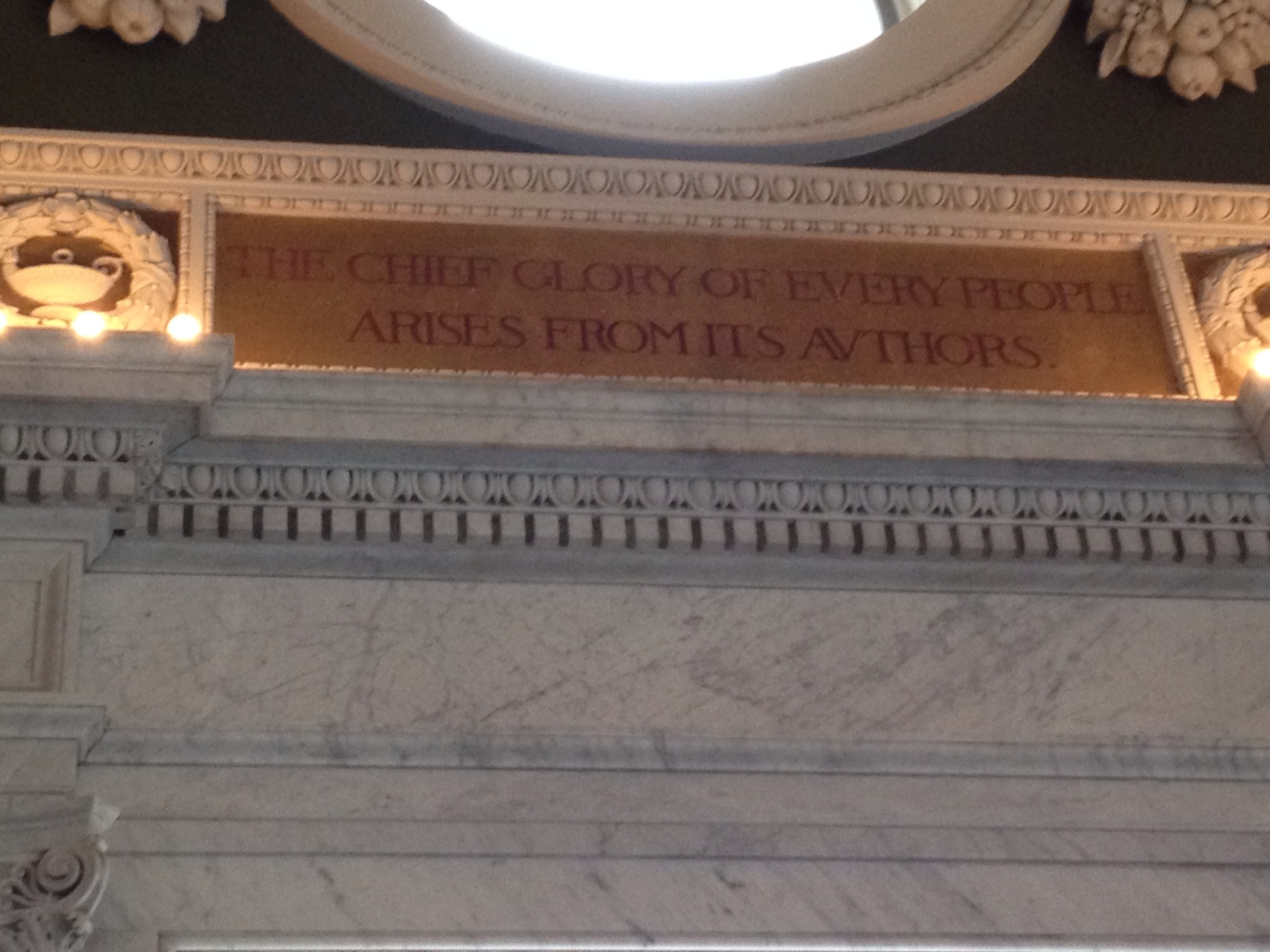 What a marvelous sentiment!
‘The chief glory of every people arises from its authors.’
I took this picture while visiting the Jefferson building of the Library of Congress with my better half’s father.
Is it true?
In a thousand years, will people remember George W. Bush? Steve Jobs?
Or will they remember Mark Twain?
The glory of Greece and Rome is as much in Homer, Cicero, Plato, and the idea of a Republic and Democracy as it in roads, aqueducts, and temples, however glorious.
It Could Have Been Different
Maybe if San Francisco had named their team after an American literary icon instead of an era of rampant greed and pillaging of the land, things might have gone differently.
The San Francisco Beats, perhaps?
Crossroads Of Twilight (New Year’s Resolution, Book Five)
 They’re getting longer. Book ten clocks in at almost forty pages longer than book nine. If I was reading this in hardback, I could kill man or stop a bullet. As it is, the paperback barely fits in my copious coat pocket, and a genre novel that were incapable of so fitting would seem like a betrayal of the trust between the reader and the author/publisher/editor.
As you may recall, after finishing the last book in the series, I was so excited that the taint had been cleansed from saidin (I don’t have time to explain all this to you; read about it on wikipedia). And while Rand may have become less of a whiny little punk, he’s also kind of absent. He gets a girl pregnant and not much else.
Crossroads of Twilight also reminded one of how Jordan loves to drag things out. In particular, I was reminded of the terrible absence of communication between people who, if they could have just spoken, would have solved a number longstanding, thorny issues in good order and moved on with saving the world from evil. To make matters worse, many of these people actually grew up together and have known each other their whole lives. Others actually meet and talk, yet somehow manage not to share the key data points that would illuminate things for each other. I know that this is medieval fantasy and there are no telephones, but I think that making a greater effort to explain things to your friend since infancy who also happens to be the prophesied savior of the world… well, it just makes sense.
Following that long rant, I’m going to give some credit to this book, the penultimate novel by Robert Jordan.
He left us on a rip roaring cliffhanger. I could tell you what happened, but it wouldn’t sound special out of context (Egwene is captured, I think by supporters of Elaida in Tar Valon; see, I told you it wouldn’t sound special). For some reason, this particular cliffhanger really struck me. I thought to myself, this is exciting. I want to know what comes next and not just because sheer volume of pages and books has bludgeoned me into wanting to doggedly finish. But, instead, actually kind of wanting to know what the heck is going to happen.
I feel sure that the next book will ruin that for me.
While I will be finishing the Wheel of Time this year and more than that, probably before the end of April, I’m not going to be reading book eleven (The Knife of Dreams, if you must know) for next week. I’m leaning towards a happy medium between genre fiction and literary fiction: C.S. Lewis.
Why Did No One Tell Me?
It’s James Joyce’s birthday. Wouldn’t kill all my so-called friends to call me up and say, ‘Hey, dude, don’t forget – today is the b day of a modernist giant. Read a chapter of Finegans Wake in his memory, good friend.’
Instead, I got nothing.
 the coffee philosopher