2012 Shakespeare’s Birthday Bash At The Folger Shakespeare Library


Yesterday was the Folger Shakespeare Library‘s celebration of Shakespeare’s birthday, an event I had attended for five years in a row now. It’s kind of my thing.

Unfortunately, it was pouring down rain this year, so all the outdoor events were moved inside.

This year, I invited our neighbor’s daughter (she is, as she explained, “11 and a half years old”) to come with me. Normally, this is kind of a solitary event for – I browse the exhibit, listen to a lecture, listen to a lot of music, and check out the books for sale. But with a child, it’s a little different, of course. More drawing portraits of Shakespeare, more taking lessons in sixteenth and seventeenth century courtly dancing, etc.

And, she got up in front of an audience and read a line of Shakespeare from a speech by Benedict from Much Ado About Nothing. That was pretty cool, I have to say. She wanted me to stand next to her and help out, but then while in line, she started talking to another girl, maybe a year or two older and they seemed to make fast friends, as kids are wont to do, so I quietly slipped away.

While I missed my usual stuff (not much sitting and quietly reading and writing while listening to a string quartet), it was great to see a child get their first real introduction to Shakespeare and this language.

Oh, and unlike last year, their scholarly periodicals were set out in the magazine room for me to browse through. It really bugged me last year that they put those away.

Monday Morning Staff Meeting – New Urbanism Is Older Than You Think


The first sexual revolution(s).

The old new urbanism (before it was hip).

Staff Meeting – Poetry Reading At The Laundromat


Eileen Myles and CA Conrad entertain laundry washers with their verses.

The last days of Tony Judt.

Breathturn


Breathturn is the name of a collection by the poet Paul Celan.

Paul Celan was Romanian poet who survived the Holocaust and then went on to write poetry in German, primarily while living in France.

In 2004 or 2005, I picked up a copy of a selected poems (or perhaps collected poems) of Celan. I tried to read it, but nothing quite took hold. In short, I didn’t get it. I don’t know where that copy is now. Breathturn I bought at Bridgestreet Books in DC, on the edge of Georgetown, and this time something clicked. I got it.

Breathturn is the collection where the poet turned (pun intended) to the dense, brief, elliptical, neologism-heavy style for which is known. Short, broken lines, compound words split over two lines, and that constant elliptical and abstruse meaning.

The Holocaust hangs over everything, it seems – or maybe we, his readers, hang the Holocaust over all his work.

He committed suicide and one can’t help but attribute it to the survivor’s guilt that took the life of the great Italian writer, Primo Levi (who noted that no one in the camps survived, as he did, without, in effect, someone else dying in their place).

Anne Carson wrote a book about Celan called Economy of the Unlost. In part, it asks how some poets measured the value of the dead.

Celan’s poems always seem to hint at some broken past – a lost landscape, as well a body (the poet’s body) lost by virtue of the alteration of the body.

Others have noted the way that Cambridge poet J.H. Prynne drew on the work and tradition of Celan in his own poems that very directly force the reader to scramble for a meaning that is always just out of reach.

Below is an example of Celan’s work from Breathturn.

ERODED by
the beamwind of your speech
the gaudy chatter of the pseudo-
experienced-my hundred-
tongued perjury-
poem, the noem

Hollow-
whirled.
free
the path through the men-
shaped snow,
the penitent's snow, to
the hospitable
glacier-parlours and -tables

Deep
in the timecrevasse,
in the
honeycomb-ice
waits a breathcrystal,
your unalterable
testimony.

Ezra Pound: Canto LXX


Pound still hasn’t really gotten back into the swing of things, in terms of style. I’m just not a fan of most of these Cantos taking place in the early days of the United States or during the Revolutionary War.

Nonetheless, I very much enjoyed this little segment:

My compliments to Mrs Warren
                               as to the sea nymphs
Hyson, Congo, Bohea, and a few lesser divinities
Sirens shd/ be got into somehow.
                              Tories were never so affable
                              Tories were never so affable.
We shall oscillate like a pendulum.
slow starvation,  conclave, a divan,
                   what shall we do when we get there

Ezra Pound: Canto LXIX


This is a relatively short Canto compared to last few – less than five and a half pages. It mixes English with some tidbits in French and what I believe is Dutch.

Still addressing Pound’s obsession with finance, this Canto focuses on inflation as a means of depreciating debt and the consequences to the nation. The ‘time’ is  Revolutionary War period.

While there’s little poetic about it, some things were interesting.

Once again, what he writes seems relevant in the wake of the last economic crisis.

The depreciation, he writes

but by no means disables the people from carrying on the war
Merchants, farmers, tradesmen and labourers gain
                               they are the moneyed men,
The capitalists those who have money at interest
                                        or those on fixed salaries
                                                                                                     lose.

If you think of ‘war’ as standing in for the ‘real economy’ – the economy of real assets, like physical items or labor, as opposed to the shifting of financial instruments – then doesn’t this point to the current inequity between those who live and work in the ‘real economy’ (most of the 99%) and the 1% who so often are those ‘who have money at interest’ as Pound says. Pound suggests that, really, we could do quite well and shouldn’t worry about the latter.

Reverend Doctor King – Labor Organizer


In case you forgot, the Rev. Dr. King believed that justice was inextricably linked to the right of workers to organize. When he was shot on this day in Memphis, he was helping to organize public employees – just like the ones the right has been demonizing.

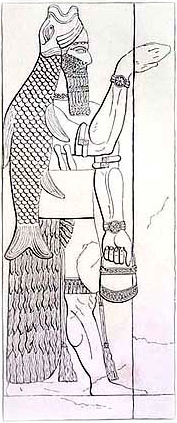
Tuesday Staff Meeting – I Said ‘Oannes’ Not ‘Onan;’ Very Different Things


Oannes, the founder of civilization.

‘Planet Patrol,’ one of the high points of western civilization.

The best philosophy journals.