‘Illuminating History: A Retrospective Of Seven Decades’ By Bernard Bailyn


I fear I’ll need to buy one of Bailyn’s seminal books, because the two available from the local library system are not giving me a good view of his value as a historian, but are giving me a good view of his limitations as a writer. He’s not bad, but when I started reading him, I was in the mood for a great stylist.

This is really just a collection of essays on his work; some interesting, some dangerously paternalistic, and some quite touching.

My favorite part was the very end, his appendix, which isn’t an appendix, but a place to write brief biographies of two historians of early America who influenced him. Many historians are forgotten after death and I credit him for wanting to immortalize Morison and Handlin, just a little, is admirable.

Nature’s God: The Heretical Origins Of The American Republic


This wonderful, if sometimes clunkily written, book is a series of long digressions on figures of deep influence to the intellectual leadership of the American Revolution and America’s founding. He begins with a discussion of two lesser known Revolutionary figures, Ethan Allen and Thomas Young, who wrote stridently ‘Deist’ (really, atheist) works. Theoretically, it is about the influence of Deism on the founders, but really, it’s about making sometimes tendentious, but always interesting arguments for another layer of philosophical forebears beneath accepted intellectual forefathers like John Locke.

So how does that work in practice? A long discussion of Epicurean cosmology and how it (supposedly) informed the intellectual climate that directly influenced Revolution figures (mostly Jefferson and Franklin; though this also undercuts the idea that these were foundational, since in their learning and interests, they were sui generis). Spinoza is brought up early and often and is taken to be a key figure whose ideas were behind all the most influential ideas of those most directly connected to the ideas of the Revolution.

I’m not sure that Stewart was all that deeply interested in writing a book about the intellectual history of the American Revolution, but rather that it made an easier sell on his actual book, a fascinating look at two marginal figures of the American Revolution combined with an expansive view of the influence of Epicurean physics and places Spinoza at the center of the Enlightenment (yes, he makes a point towards the end that Spinoza is an ‘early modern,’ but in context of the whole book, he is clearly shifting the Enlightenment backwards a good bit, moving it’s beginning to Spinoza and Hobbes).

Stewart is himself a materialist of the Spinozan variety (he wrote an earlier book about the Dutch-Iberian philosopher), I would hazard by his good natured glee when writing about it. I don’t mind a position, in that respect, especially when it is joyful in its advocacy, rather than disrespectful in it.

I enjoy listening to (and usually disagreeing with) some of the podcasts and YouTube videos put out by the gloriously titled “James Wilson Institute on Natural Rights and the American Founding.” I will give them credit for introducing me to the philosopher Daniel N. Robinson and also for aiming to influence the legal community in a specific conservative direction. Unlike the Federalist Society, which is really just a political organization dressed up in judicial clothes, the James Wilson Institute has a very specific legal philosophy around natural rights, which also puts it in opposition to the current trend of pretending to be originalist (natural right theory is not orginalism).

I bring this up because Steward waits until the book is nearly done to bring James Wilson (a Founding Father who is not obscure, but, let’s just say, sits in the second tier) up and goes on to describe him as: avaricious, socially ambitious, lavishly educated

Ha.

‘Sometimes An Art: Nine Essays On History’ By Bernard Bailyn


Bailyn was an influential scholar of American history who died recently. He was old school and, while the first essay in this collection is, in part about the horrors and evils of the slave trade, it’s safe to say he was more of the great man school of history, which, in practice, leads to more discussions of dead white men, than not. This is only a slight criticism, so long as others are taking up the slack.

However, it was disturbing to read his essay on the late nineteenth and early twentieth century historians who reinvigorated study of colonial loyalists during the Revolutionary War and missing the strong strand of racism which united them.

His cause isn’t helped by a congratulatory prose style that is both flavorless and slightly condescending. Don’t get me wrong, I will be breaking down and buying on his full length histories, but this, the only volume by him in the DC Public Library system, is a poor argument for his importance as an historian of America.

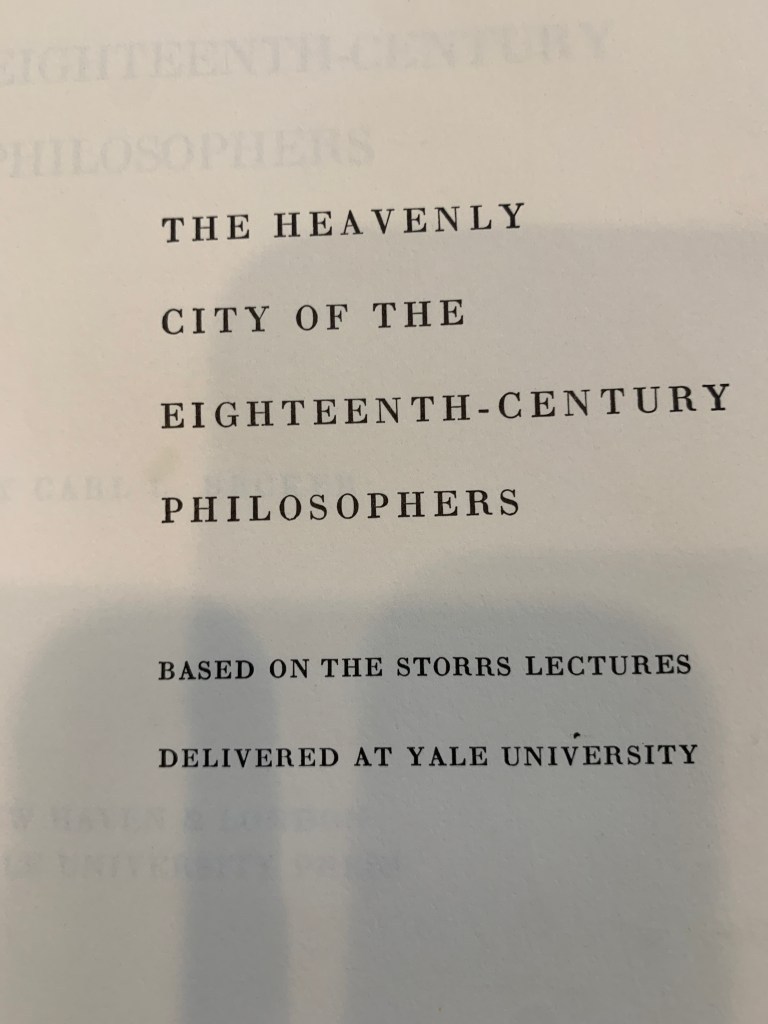
‘The Heavenly City Of The Eighteenth-Century Philosophers’ By Carl L. Becker


How did have I not read Becker before? He has the classic style of the great, witty, learned, essayists of the nineteenth century. This book reads like a sequence of connected essays, which, effectively, they are, being based on a series of lectures he gave. Becker’s name appeared before me while reading Garry Wills’ Inventing America; while arguing against Locke’s influence and for that of the figures of the Scottish Enlightenment, mainly Reid and Hutcheson (I hadn’t realized this was controversial).

Primarily about the francophone philosophes (francophone rather than French, so as to include Rousseau), with frequent attempts to loop in the Enlightenment figures of the American founding and into the Scottish Enlightenment, it makes eighteenth century philosophy a fascinating, discursive read, which is an apt metaphor for it.

Sadly, for me, he fails to stick the landing. First published in 1932, he waxes unhappily about Bolshevism and the socio-political tumult of nineteenth century Europe. While I don’t necessarily mind (if also don’t necessarily agree) with his grumpy reactionary-ism, he doesn’t connect it to his lyrical discourse on the eighteenth century philosophers, except perhaps to say, that was good and these are bad.

Inventing America


I loved this book, but mostly because it made me want to read other books. I’ve started reading Carl Becker, because Wills mentions him. I definitely need to read more Scottish Enlightenment (Hume, Home, Hutcheson, etc).

However, the argument itself seems… unnecessary today. That the Scottish Enlightenment was the critical intellectual yeast of the Founding documents does not seem controversial today, nor does relegating Locke slightly (though not so much as Wills does; he tries to dispel any idea of Locke’s political writings being an influence on Jefferson’s Declaration, which smacks of a lady protesting overly vigorously). He also leans heavily on finding references to Francis Hutcheson (followed by Kames, Hume, Smith, and only rarely Reid).

Wills writes that Lord Kames was Jefferson’s intellectual hero. Of course, Kames, Christian name, Henry Home, was David Hume’s uncle (Hume changed his name so that the spelling matched the phonetics) and Jefferson notably raged against Hume.

He spends as much time emphasizing the Declaration was not seen as a momentous documents at the time it was signed, only later becoming so (in part, through Jefferson’s own efforts to elevate it), as he does on the specific influences that this book is supposed to address. C’est malls vie, I guess.

I did learn things, though, or at least gain new perspectives. He provides new lenses through which to view Jefferson’s famed Head and Heart letter, provided by Scottish sentimental (which doesn’t mean what you think it means) moralism and Laurence Sterne. Incidentally, though I mostly fall into the camp of those who feel that the recipient of that letter and Jefferson did have a sexual relationship, though the letter suggests to me that our third president was an awkward lover.

Agony and Eloquence: John Adams, Thomas Jefferson, And A World Of Revolution


Another book about the relationship between Jefferson and Adams; less formally innovative than the other, but a nice, brisk read, nonetheless. Some odd choices though. It focused less on than the bitter divide that kept them apart for over a decade and more on the things that connected them. For about half the book, it seemed to be using their differing views of the French Revolution as the lens through which to view these two men, but then it seemed to forget about it. Which was weird, because it spent at least fifty pages discussing important figures within the French Revolution. Was that just padding?

Also, kind of amazed how historians (mostly white, male historians) are still tip toeing around Sally Hemings. It was a terrible, terrible thing he did, because her age and lack of freedom meant she could not consent and wildly hypocritical. But he did good, too, and it need not be interred with his bones, and Antony might say, it we acknowledge his deep sins.

The Rise And Fall Of Classical Greece


Despite the Gibbonesque title, this is a not traditional history of classical Greece. It aspires to be more data driven, though spiced with classical learning. Sort of like a Jared Diamond who didn’t reach for tendentious assumptions with uncomfortable racial overtones.

An early example was identifying that, even though ‘Greece’ expanded to many places in the Mediterranean beyond Greece, the distinctly Greek city states (did you know that plural of polis is poleis, because I didn’t) were located in a narrow climate band that featured relatively mild winters and not too much rainfall. While the first seems natural, the latter is counterintuitive, but it seems the liked dry summers, despite the potential benefits to agriculture.

So, I was enjoying this right?

Well, kind of. I actually didn’t finish it. I don’t have limitless reading time and, frankly, I decided to allocate it elsewhere after getting about 100 pages into it. I prefer cultural history to economic history. If I read about classical Greece, I want more Empedocles and Pericles and less olive oil output. Just a personal preference, but that doesn’t mean I don’t think this book is worth your time, though, should you be so inclined.

Cyril Mango


I got this because it was the only thing in the library by Cyril Mango. I only heard about him an article mourning his passing, as a preeminent Byzantine scholar.

Ironically, his contribution is a remembrance of another deceased Byzantine scholar.

Look, obviously there were a bunch of other articles, but I just wasn’t feeling all those specialized pieces about Byzantine history.

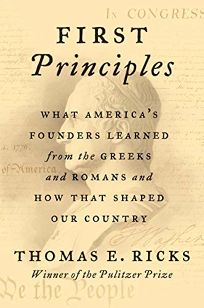
First Principles: What America’s Founders Learned From The Greeks And Romans And How That Shaped Our Country


I loved this book, because it’s all about the stuff that fascinates me about the Founders, particularly Jefferson. Does not necessarily make it for everyone. But if you wish you read Latin (or if you do and wish that everyone else did, too).

One of the central claims is that the early period examined – sort of late late colonial to the early 1800s – was heavily influenced by Roman and Latin history and philosophy. Later, as ideas of classical virtue declined, Greek to precedence.

He closes with an epilogue that addresses contemporary issues, including Trump, and how classical learning, especially Latin, can help.

While I don’t disagree, he never properly made that case in the previous two hundred odd pages. Too bad.

Brutus: The Noble Conspirator


Equal parts fascinating and maddening book which readily admits it is weaving a whole cloth out of not much thread. It asks an interesting question: Brutus is given a certain amount of respect, relative to his co-conspirators in the assassination of Julius Caesar, but why?

He is typically depicted as being rather more high minded than the ‘lean and hungry’ looking Cassius.

What does Ms. Tempest conclude? That he had a bit of a reputation as being a high minded person while alive and that he also actively sought to promote that image, even if it wasn’t always warranted (because there is, apparently, evidence that he was also greedy, rapacious, and rather petulant).

The primary sources appear limited and she relies heavily on the letter of Cicero, including his letters to Brutus (also, Plutarch’s biography of him).

It was a maddening read, the lack of certainty (which sometimes felt compensated for by a bit of padding). But also because he seemed like such a bright fellow. He was a well known orator (even if Cicero didn’t like his rhetorical style) and writer of philosophical texts, though no copies of his orations nor his treatises appear to have survived.

What I hadn’t really known was how long Brutus and the other conspirators were allowed to basically continue on after the assassination and how long it took for things to devolve into a(nother) civil war.

So having finished it, I picked up some Cicero I’d started but never completed, so that’s an accomplishment that book achieved.