‘Burr’ By Gore Vidal


Vidal signed my copy of his early novel, The Judgment of Paris, at the West Hollywood Book Festival some ten years ago. I read it, enjoyed it, but did not give him much more thought.

When The Best of Enemies, about the 1968 Buckley-Vidal debatescame out, I rushed to see it with a friend at the E Street Theater downtown and, for the first time, saw Vidal as a monumental figure.

But, in a way like Christopher Hitchens (who had a fraught relationship with Vidal), you wonder whether there will be any cultural memory of him twenty years after his death. Will his books and essays be read?

So, I decided to read one of his most famous (and best reviewed) novels, Burr.

Will Burr last?

Maybe. Yes. No.

A little, is probably the best answer. Much better than middlebrow (midcult?), but a shade below masterpiece or classic. It’s far, far, far, far, far, far better than Gone With the Wind, but I can see it having a similar lifespan. Mitchell’s novel has maintained an incredible cultural cachet and readership over the years, but is, I think, finally fading (mainly because it is unreconstructed claptrap).

But the real novel in question.

The character of Aaron Burr himself is a fantastic creation and the novel acts as a fantastic apology/redemption for the figure. For those who don’t the story of the novel, a man named Charles Schuyler finds himself becoming the biographer – or, really, the scribe for a memoir – of Burr. The novel jumps between first person sections from Schuyler’s perspective on his own life in New York City in the 1830s and then first person sections from Burr’s perspective, narrating major parts of his history (and, necessarily, the founding of America).

Based on my own (admittedly slight) readings of original texts from the eighteenth and early nineteenth century, Vidal has a nice sense of an earthy, pre-Victorian mindset for Burr (though it’s still a modern novel; also, thankfully, with regular and recognizable spelling) – less so for Schuyler. His Burr’s depiction of a craven, political Thomas Jefferson is as frighteningly hilarious as his thin-skinned, conniving, and barely competent George Washington.

American history during this period is not really my forte and I’m not going to act as judge on much of the accuracy of this – I just don’t know enough of Revolutionary and early post-Revolutionary American history to stand in judgment – and I know enough about Vidal to believe that, even if he would fudge for literary reasons, he did voluminous research. It’s certainly not news to say that Vidal is deliberately revisionist, in the sense of changing how we view the sacred icons of our founding fathers.

I have read that Vidal’s so-called ‘Narratives of Empire’ (of which this was the first book) is intended to show the evolution of America into an empire, but Burr ultimately feels elegiac. You could say an elegy for a dream lost to dreams of empire, but that’s not what it feels like to me. Schuyler missed the Revolutionary War and is somewhat in between epochs. Around long enough to hear the myths and truths of a great age, but not old enough to have experienced it.

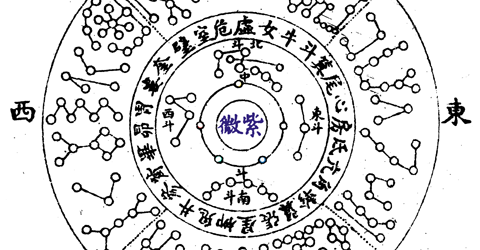
 

‘A Short History Of Chinese Philosophy’ By Fung Yu-Lan


9780684836348I was really enjoying this and what I was learning, until I stopped to think about it. Fung is very good on the history, but how much had I actually learned about Chinese philosophy from my reading?

Plenty, certainly, but it seemed like it was more about a more or less chronological succession of figures and their relationship to political-historical milieus than actual philosophy. And he allows various major currents, particularly Taoism and Confucianism, to seem surprisingly philosophically undifferentiated, as if the the major differences between them were in the historical place of major thinkers within the traditions, rather than the philosophical traditions themselves.

Now, he does lay out some wonderful categories of major schools in Chinese philosophy and, while acknowledging their limitations, uses them as a wonderful framework for helping the reader keep up. And I don’t want to suggest that I didn’t learn anything from this book, only that I had hoped to learn – or to feel like I had learned – a bit more about philosophy.

His account of more contemporary philosophy feels incomplete and mostly focused on the influences of and correspondences with western thought. There is an account of ‘intuitive mind’ in later neo-Confucianism, which resembles Socrates’ helping a slave to ‘remember’ a priori knowledge in The Meno.

It was also interesting to learn that the first western philosophy to be introduced to China was primarily non- or anti-metaphysical: Betrand Russell, John Dewey, JS Mill, and William Jevons. He says that the introduction of formal logic was the biggest influence from the west, but that it was more of a coincidence that it was analytic texts that first arrived than  any particular affinity.

The Sunday Paper – Shuffling The Tarot Deck


Economic model or astrological tool?

Economists use ‘mathiness’ to disguise their astrologies.

Old fashioned literary hate mail is the best literary hate mail. Today’s internet trolls just can’t compare to the greats of the genre.

We just don’t make good polymaths anymore.

Midweek Staff Meeting – Irreplaceable


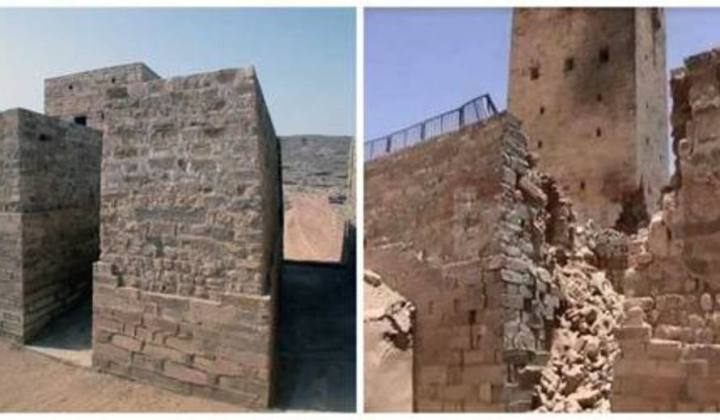
Saudi bombs are destroying the records of humanity’s earliest civilizations, one of the most important routes out of Africa for early human, evidence of neolithic trading empires and more. And we will never, ever get it back.

The correspondence between Mary McCarthy, the novelist that not many people seem to read anymore (Remember The Group?) and Hannah Arendt, the philosopher people can’t seem to stop talking about these days.

How chili peppers migrated from South and Central America to China’s Sichuan province in the seventeenth century and whether the fact that I love spicy food makes me a revolutionary, or, rather, more like to be one.

The oddly important place of philosophy in Wikipedia (but please note: do not actually use Wikipedia to learn about philosophy).

news_1291-890-520-20150611112036

The Sunday Paper – Kung Fu!


14.-D.A.-Jasper_Two-Champions-of-Death-652x1024Did you know that there was a tradition in Africa of hand painted posters for martial arts movies? Me neither. But now I want one.

Reinventing Shakespeare(‘s book covers).

The Etruscan language is nearly lost and much of their culture a mystery, so, while this stele is not a Rosetta Stone, it is something rather big.

On a related noted (in that it’s also a question of archaeology), some folks were tipped off on the location of a second Viking settlement in the New World by some photographs taken from outer space. Actually, I hadn’t realized we’d only found one Viking settlement. Honestly, because their presence in North America has been known for so long, I’d just assumed it was more widespread. And it might have been widespread, but this is the first evidence that were was more than one (semi-)permanent settlement.

The fine folks at DCist have compiled a list of the best used and independent bookstores in the District. Of course, with the closure of the downtown Barnes & Noble, there are only used and indie bookstores in DC: not a chain in sight. And I appreciate this list acknowledging the truly magnificent poetry selection at Bridge Street Books.


Power & Pathos & Trios


Next weekend, I’ll start working for my better half for the foreseeable future, which made using Sunday well more than usually important. At the National Gallery of Art, an exhibit called Power and Pathos: Bronze Sculpture of the Hellenistic World was going to be winding down and having blithely ignored numerous opportunities to see it, today (or, rather, that day) needed to be the day.

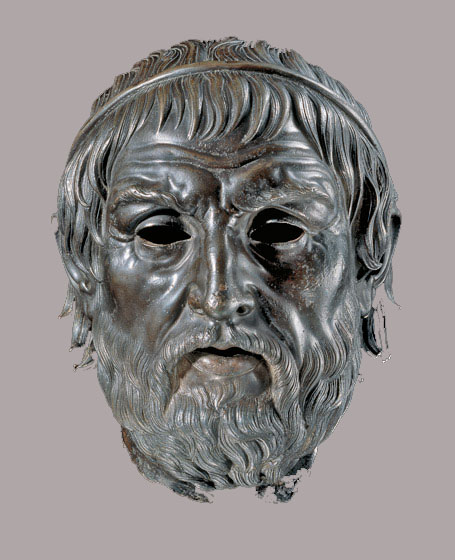
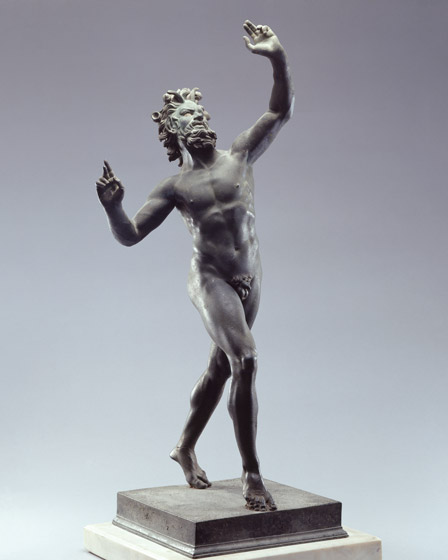
00309897001_HI’m sorry, but I was disappointed. There were some wonderful pieces (a weary Herakles leaning on his club and the head of a poet), but only one that was truly powerful (a statue of the god Pan) and more than a few ‘meh’ pieces and, certainly, I didn’t feel much power nor pathos (besides alliteration, what was the ‘pathos’ supposed to be?).

You still try to get a nugget of something interesting from any exhibit and for me, that was the head of a poet. It was labelled a poet because his hair was longish and his beard full and those were the signs of a poet. philosopher, or intellectual (and, in the late ancient world covered by this period, an intellectual would frequently also be a philosopher and poet; there wasn’t so much parsingDancing-Faun of the difference back then). The idea was that they were less influenced by vanities, so let their hairs grow out. So, the idea of the shaggy poet or thinker wasn’t an invention of Parisian bohemians, nor Greenwich Village poets, nor any other group from the last two thousand years, but dates all the way back to ancient Greece.

After finishing the exhibit, I kept wandering around the museum, stopping in some galleries to look at some nineteenth century landscapes. I walked towards one of the atriums when a woman walked in front of me, handed me a program and asked me if I was here for the concert.

Naturally, I said, yes.

Apparently, the National Gallery of Art had spent the previous two days doing several concerts a day in order to complete a cycle, as it were, of Beethoven’s trios. This particular concert would be his final string trios (which were actually early works; he moved on to string quartets after composing these).

The first one was a string trio in G Major and the players ended the trio so abruptly that we (the audience) was stunned into sudden and sustained applause. It was a very odd moment, as if a long silence had been ended by an invisible man suddenly clapping in our ear. We kept to our feet not because the performance was good (though it was), but because shock impelled us.

The second trio, in D Major, had a menuetto as its penultimate movement and I just loved it. Beethoven should have done more dances.
The third, in his famed C Minor key, was surprisingly upbeat for a chamber piece in a minor key.

The acoustics felt good, which is not always the case in there. The sound was clear and very, very bright, with the inevitable echo being an inconsequential factor.

Just an awesome coincidence that I walked in on it.
Staged Reading Of A New Play At The Capitol Hill Arts Workshop


I’d had a ticket for this, but then the blizzard came and it was rescheduled. It wasn’t a full on production but a staged reading of a new play titled First Citizen, presenting the little performed Shakespeare play, Coriolanus, from (mostly) the point of view of four ‘citizens’ who more or less represented different classes and different political viewpoints. Rather like Stoppard’s Rosencrantz and Guildenstern Are Dead, the play interspersed actual dialogue from Shakespeare with the new dialogue of First Citizen. Afterwards, was a talk back session; I had been expecting it to be more question and answer, but it was more like an open critique.

Some of the critiques I disagreed with, especially since most centered around historicity. Whether characters accurately reflected socio-economic realities of that time (late Republic) of Roman history. Whether we needed more background on Roman politics (what are the roles of the Consul and Tribunes?).

My personal response was different. As to historicity, first of all, it’s in dialogue with Shakepeare who, despite writing plays known as ‘history plays,’ should not be considered a historical source, so let’s not ask it to be historically accurate (but let’s do ask it to be presently relevant). Secondly, knowing some of the basics of the political system of one of the founding civilizations of what we know as western civilization is not, actually, too much to ask. I don’t want to get into (relevant) questions of euro-centrism in education, but knowing the barest minimum about the Roman Republic is pretty basic stuff (and does not preclude nor exclude also having a basic knowledge about Imperial China’s bureaucratic system).

On the positive side, the play handled political questions well. It was a political play about the best path for change that benefits the mass of people and it did an excellent job of not reaching conclusions, by which I mean, every point of view was challenged, so that the audience was denied a pat, self-satisfied answer and was instead given more questions.

On the negative, and it’s a small point, I thought that the non-‘direct from Coriolanus‘ dialogue was too much in the middle. It bounced a bit between colloquial and vaguely Shakespearean. Don’t try to compete, I say. I would have liked the original dialogue to be more colloquial and more modern in tone.

But really good and if it is put on around here, I would go see it.

Asian Civilizations Museum – Singapore


This museum really should be a ‘must visit,’ if you should be visiting Singapore. I’m not saying: ‘go to Singapore right, solely because of the presence of this museum.’ No, I’m just saying that if you happen to be in Singapore and you don’t stop by, you are probably a horrible human being. That’s all.

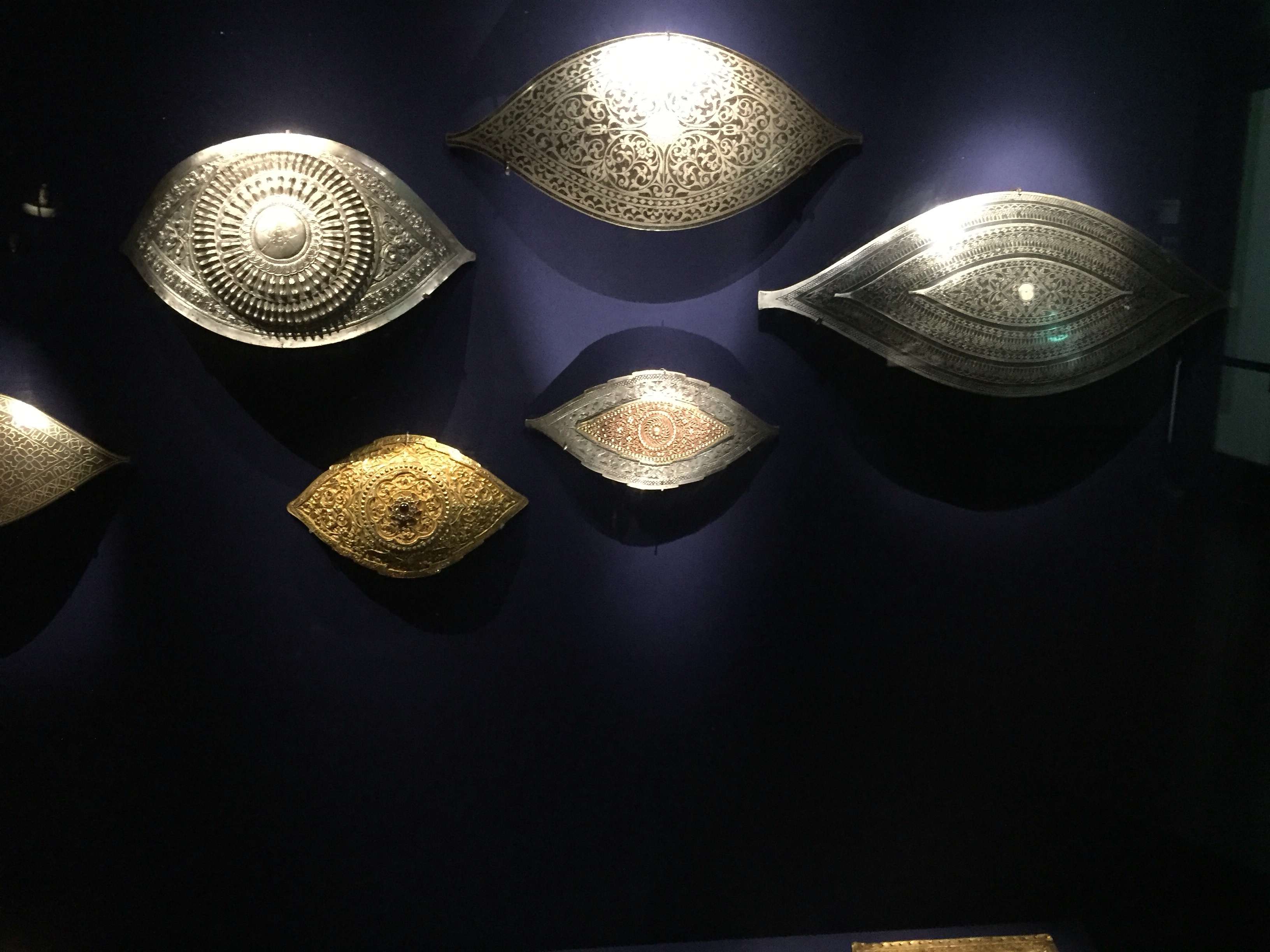
The collection is wide and varied and while not every single culture in Southeast Asian can be represented, nor every culture represented equally (in terms of space and available collection), but I can’t think of single, culture (or civilization) specific exhibit that gave its subject short shrift. As you might expect from an island nation, island and sea-going cultures were widely represented, as was the influence of ever present Buddhism.

They also had the most wonderful exhibit on a medieval, Middle Eastern trading ship. It had carried a cargo of goods from the Mediterranean to China and then loaded up on Chinese porcelain to take back, but had sunk on that return voyage.


Sukhothai


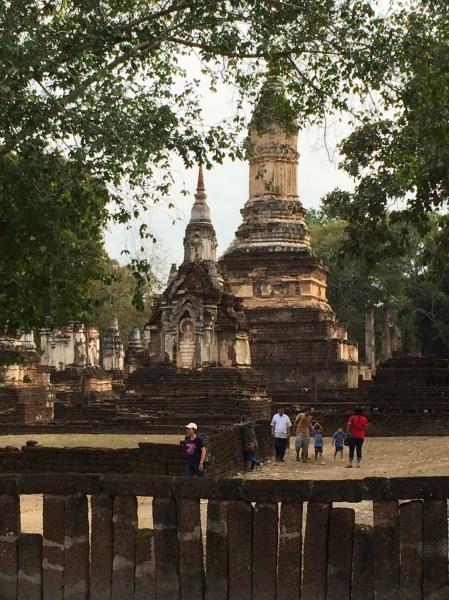
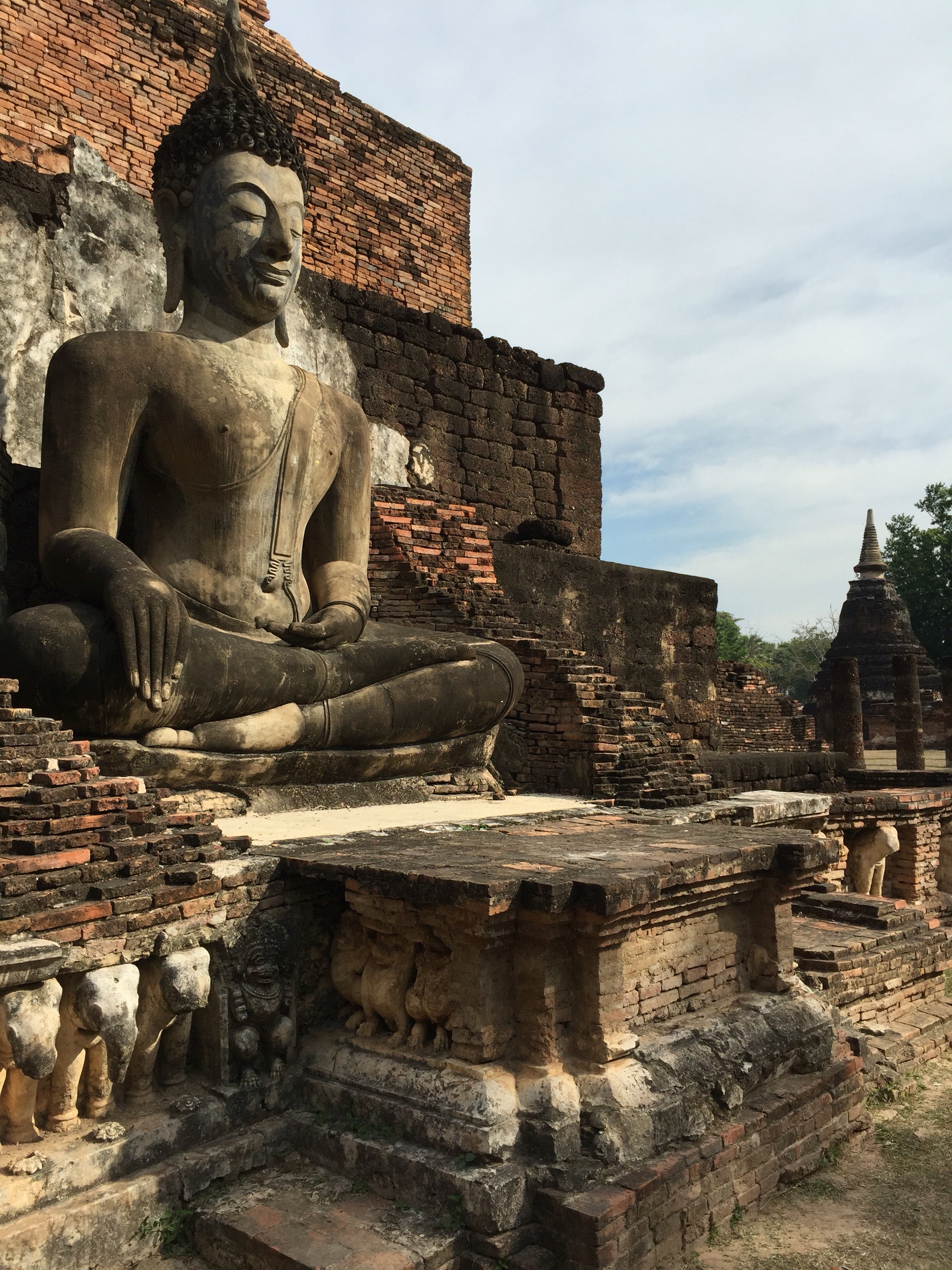
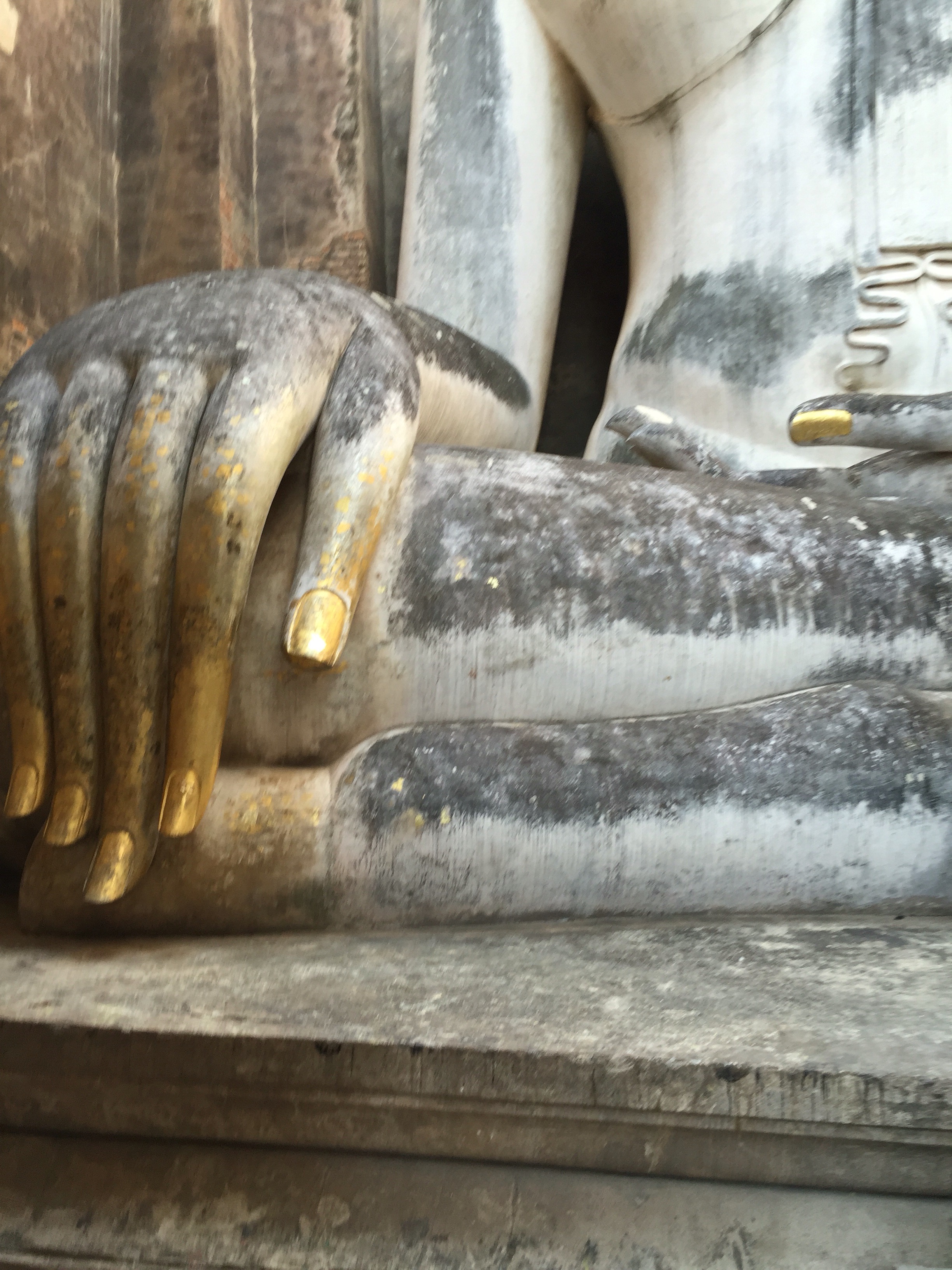
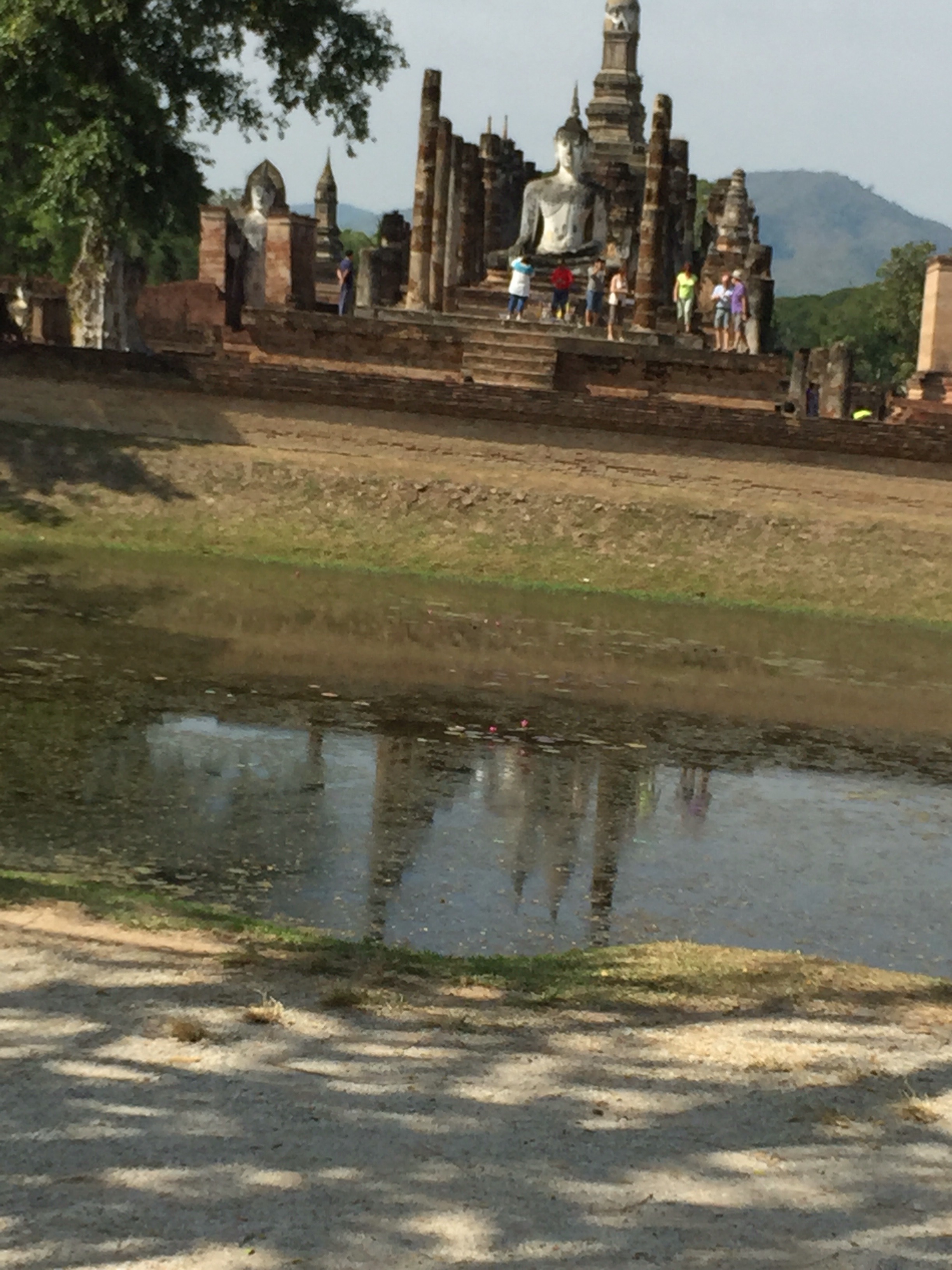
First, let me say that my adoptive family (my better half’s sisters, parents, and extended family) take wonderful care of me. As a history buff (and holder of a BA in history, if you must know), they took me to Sukhothai, the capital of the first Kingdom of Siam (back in the 1200s).

When people talk about Sukhothai, they are actually (most likely) referring to three nearby medieval site: Sukhothai, Si Satchanalai, and Kamphaeng Phet. We checked the first two (Si Satchanalai is about 40 minutes drive from the actual site of Sukhothai.

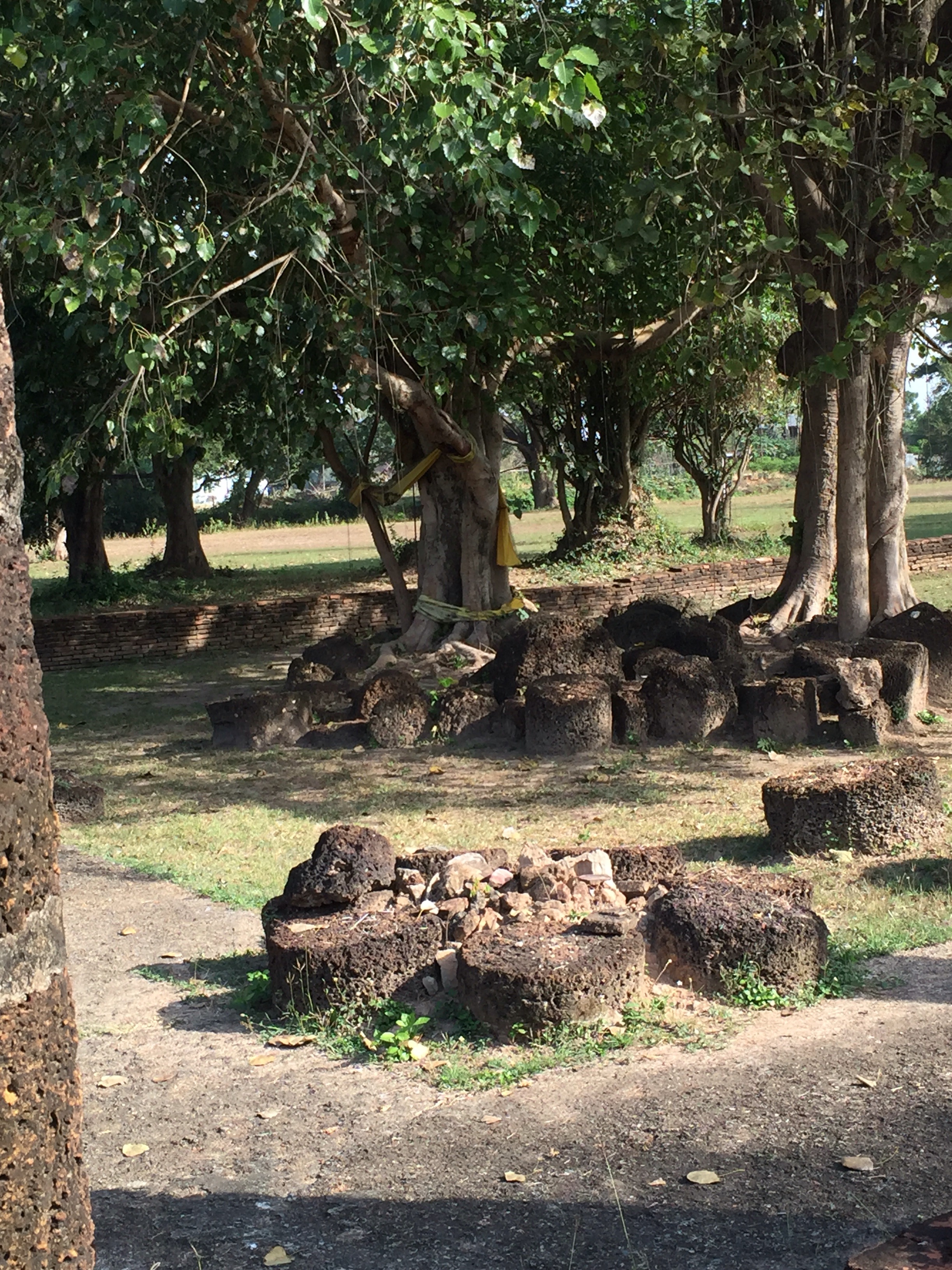
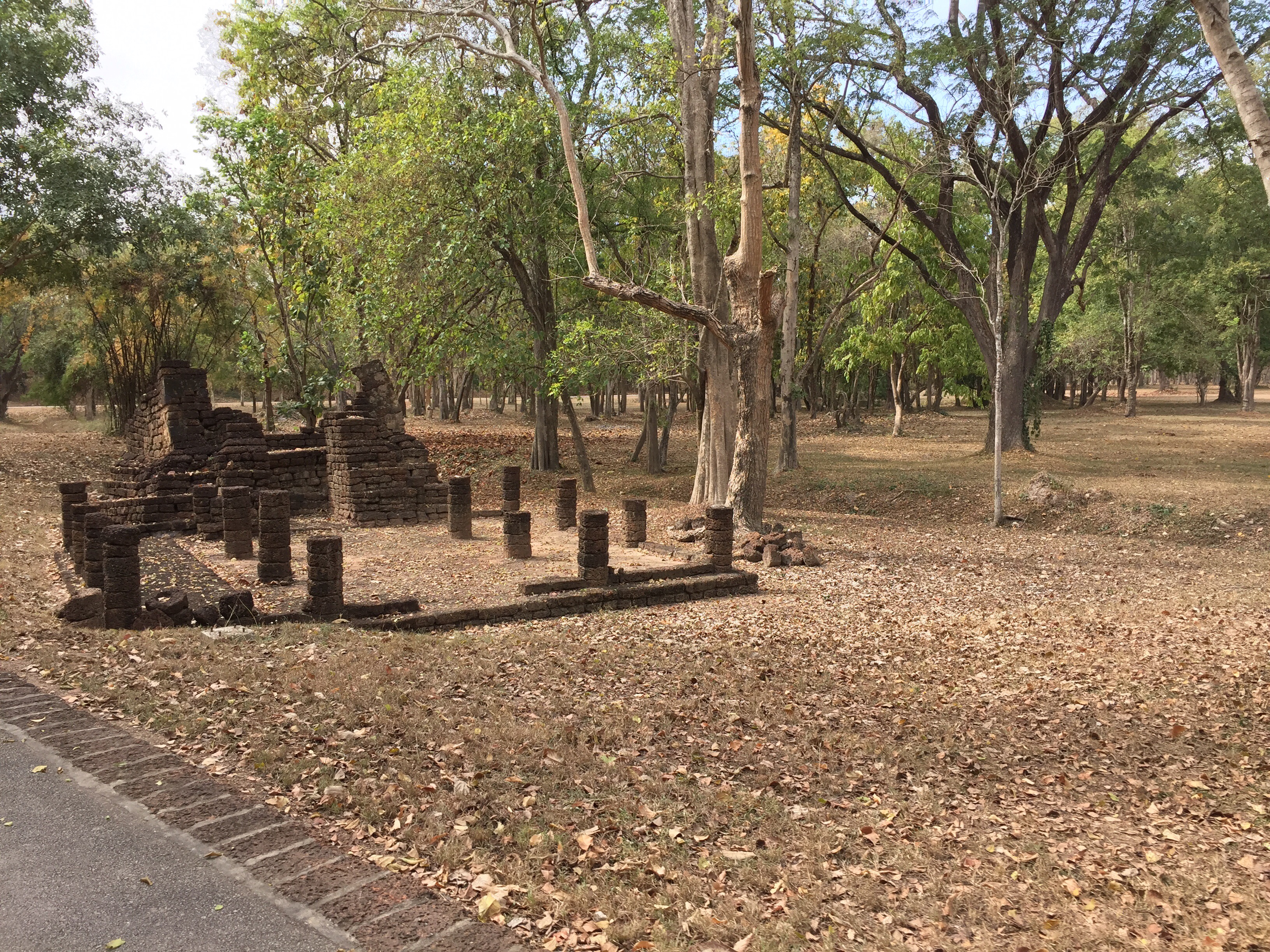
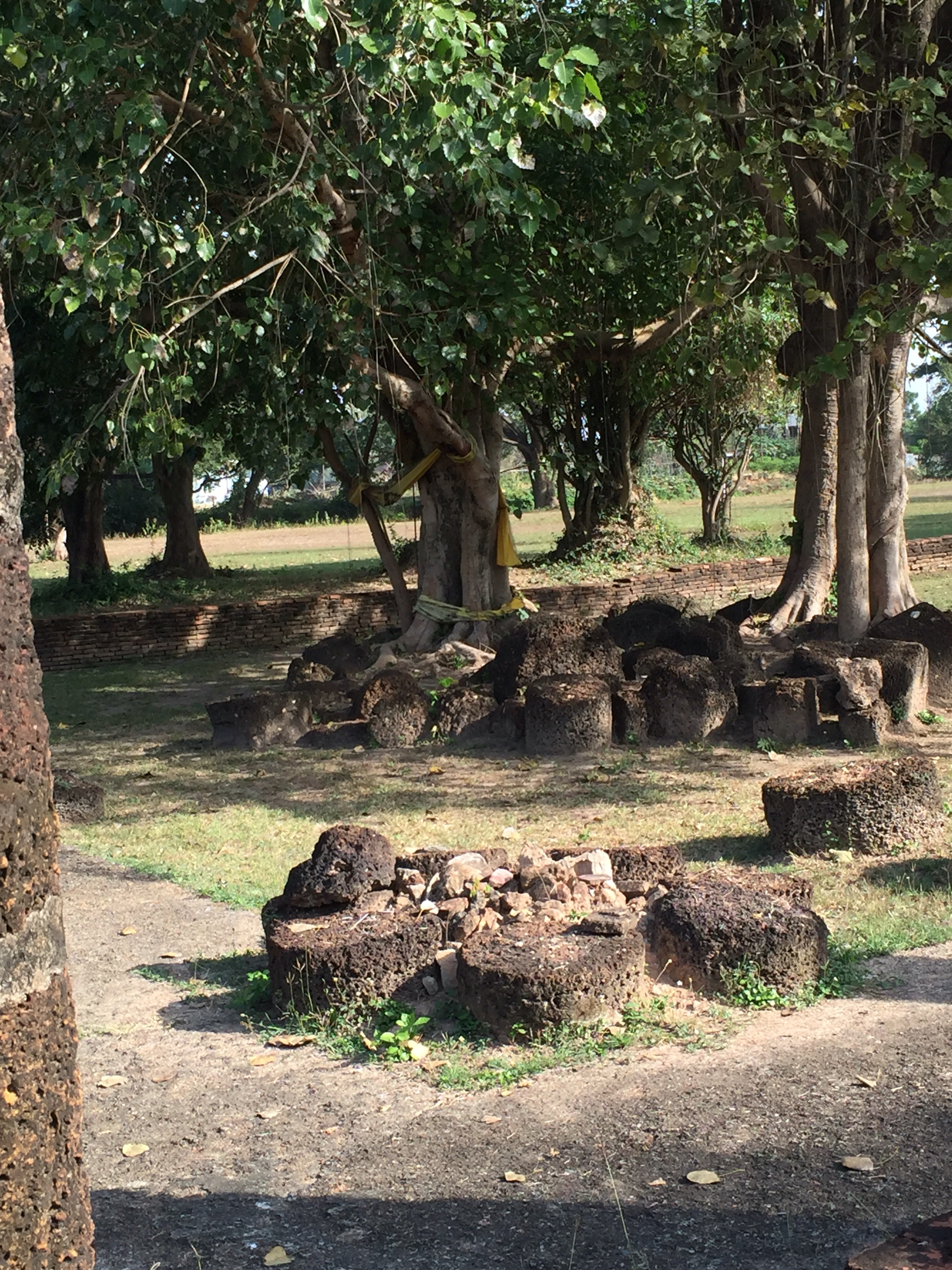
While many of the important sites are in large, park-like areas, where it is traditional to rent a bicycle and pedal around the area (I did), sites are also somewhat randomly scattered about. There was a wat (temple) by the side of the road, some walls in a highway median, and a good sized wat and associated temple grounds directly behind our hotel.


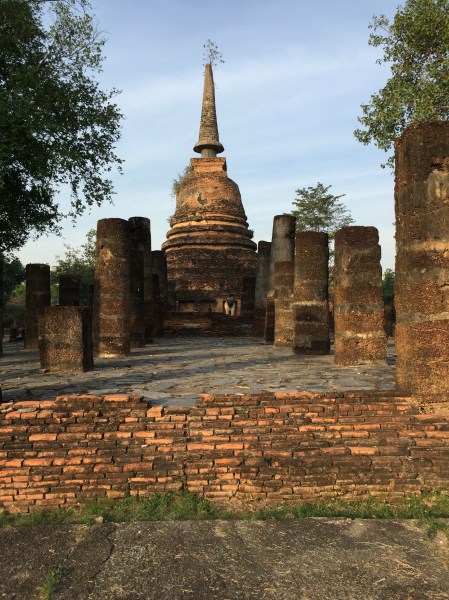
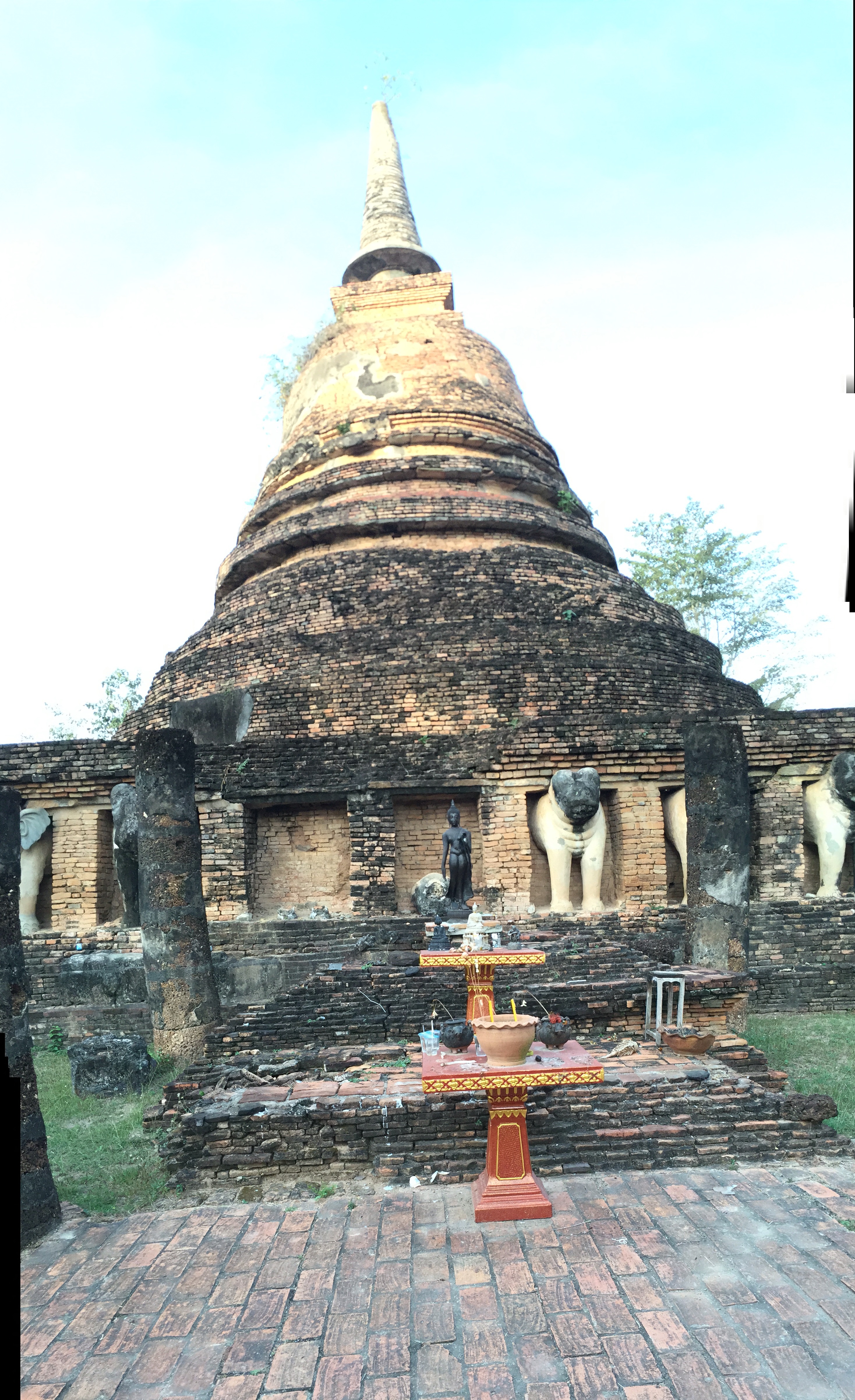
Wat Chang Lom


    Or Wat Changlom. I’ve seen it both ways. In either case, it is behind our hotel, the Legendha, through an unlocked gate and past a few mildly informative markers. But mostly, it is just there. I got up a little early to walk across and spent some quality alone time with history.

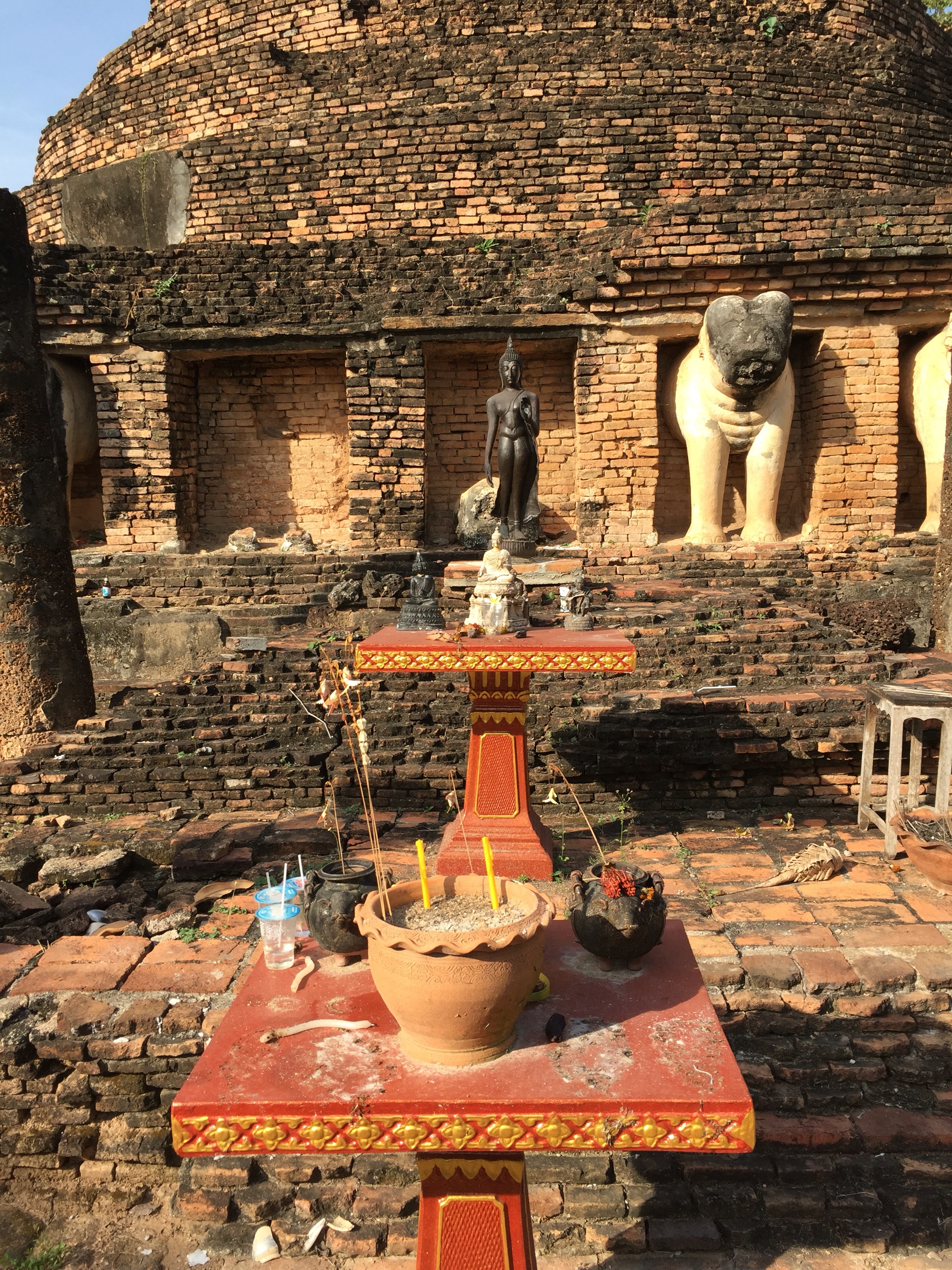
I walked a little further and found a homemade shrine, guarded by some frightened dogs.