The Coffee Philosopher


I first started using the term “coffee philosopher” back in high school. I even created a little Platonic-Marxist (I was a confused young man) constitution for a government by the three most qualified groups – the coffee philosophers, proletariat poets, and the philosopher kind.

My friends and I were consumed with various fantasies of intellectual mandarins from times past – Allen Ginsberg drinking coffee in a Greenwich Village coffeehouse; Hemingway writing his “one true sentence” with a pencil in a Montparnasse cafe; Jean-Paul Sartre holding court at Cafe Deux Magots in Paris; Sigmund Freud and Carl Jung playing chess at the Cafe Central in Vienna; even Samuel Pepys visiting London coffeehouses for the latest political news.

Of course, in suburban Florida, we had no such place.

Typically, we congregated at Denny’s, drinking cup after cup of coffee; Matt, Damian, Scott and my other friends also smoked Camel cigarettes.

Later on, our we found places like CAMS (Consortium for Art and Media Studies) in Pinellas Park and Clearwater. Mother’s Milk, inside an old house on the edges of  the then decrepit downtown Clearwater. Later, there was Insomnia (tag line: “Because there’s nothing else to do in Palm Harbor.

Sometimes, an older person would be there (older is a relative term – by the standards of my teenage self, I would be older, too). In the sometimes unsubtle but also unrecognized (at the time) sexism of our culture, we would be especially drawn to these people if he were a man. For at least an evening, his greater wisdom and deep thoughts would be admired, as if he were Sartre and we his willing disciples.

I have never found that place that would truly recreate those images from past periods. In the past, I looked for this place in New York City, San Francisco, Los Angeles, Atlanta, London, Dublin, Madrid – even in Paris.

Now, in truth, I most often buy my coffee from a place down the street called Peregrine Espresso. They serve the best coffee in DC (for me – this is a fact a not even in question – the coffee is indisputably delicious). But they are not a good place for would-be mandarins or would-be disciples to hold court.

As an adolescent, sitting in Denny’s, I used to pose the question to my friends – what if this is what it was like in Paris in the 1920s? Sitting around a dirty coffee shop, complaining about how people were petty and there was nothing to do? Fifty years down the road, will there by graduate theses about the “scene” in Dunedin back in the late 1980s and early 1990s? Are these moments recognizable, palpable as they are being experienced?

E-Books


I remember watching local news in Minneapolis back in 1995. The anchor was talking about early versions and ideas about e-books (though that term wasn’t in use back then). He referred to paper as being a three dimensional object and this as being one the major changes. As you can tell, that comment stuck with me. Even though e-books still exist in a piece of hardware that exists “somewhere” (whether on a server somewhere or on your e-reader or personal computer), the distinction always feels like that difference between something exists out there in the “ether” versus a physical book on my shelf.

I should probably admit that I don’t have an e-reader, though I suspect that a present for my upcoming birthday will include a Nook.

I expressly indicated that I would prefer Barnes & Noble’s Nook over the more prevalent Amazon Kindle. My reasoning being that I want to support Barnes & Noble over Amazon. While neither is anything close to an independent bookstore, B&N at least keeps physical bookstores and surely that is worth supporting. In addition, the Kindle uses proprietary technology that essentially locks you into Amazon’s Kindle store. With a Nook, I have hope that I could take advantage, for example, of independent bookstores that are talking about banding together the sell e-books.

Peter Meinke


Peter Meinke, the official Poet Laureate of St. Petersburg, is the undisputed dean of Tampa Bay poets.

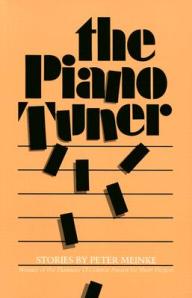
I first met Peter Meinke some time in the late eighties. I was in junior high school and he was signing books at some book festival in Tampa Bay. My mother bought his short story collection The Piano Tuner for myself and his book of poetry, Night Watch on the Chesapeake for my father. I grew up on the Chesapeake Bay, in the naval town of Norfolk, Virginia, so the title seemed appropriate.

Being someone who regularly attended open mics, book festivals, and poetry reading across Tampa Bay, I saw Meinke and his work frequently.

When I lived in a bookstore in Paris, I even found his collection of poems from the late sixties, Liquid Paper on Shakespeare & Co‘s shelves.

Meinke’s style has not been a big influence on my own writing. He comes from the Billy Collins school of poetry – and I have deep reservations about Billy Collins.

That’s not exactly true. Actually, I can’t stand Collins, but that’s a subject for a future post.

But I have nothing but love for Meinke.

He has found a home in the prestigious Pitt Poetry Series, which regularly publishes his collections. But mostly, he has found a home in St. Petersburg, even though he often takes positions at universities across the country, having retired from Eckerd College many years ago.

I probably haven’t done a good job of explaining why you should read Peter Meinke if you are not from the Tampa Bay area. And that’s a failing on my part. So let me just suggest that you read his signature poem (for those who followed him across various reading in the early nineties) – Supermarket.

Yevgeny Yevtushenko


I met Yevgeny Yevtushenko in the spring in 1993. A local poet (this was in Saint Petersburg, Florida) with a Hemingway beard called Guy (whose last name escapes me) had some how managed to bring him to the University of South Florida for a reading.

Yevtushenko legendarily used to fill football (read:soccer) stadiums in the former Soviet Union for his readings of poems that spread across the nation, passed around in samizdats (according to the Cape Cod Times, he brought in 42,000 at a reading in Russia last week – but I have also read that the days of Russian poets as rock stars may be at or, at least, nearing an end).

His poem, Babi Yar, is also the text for the vocals of Dmitry Shostakovich’s 13th Symphony.

I got to read some of my poems to the crowd (which was embarrassingly small – perhaps 50 people – for an appearance by a such a renowned figure of world literature). I won’t say that I was very well received – but, give me a break – I was eighteen. Unless your last name is Keats, chances are, you weren’t writing much poetry that was any good before you were twenty-five and your best stuff probably didn’t come until you were at least thirty-five.

Despite my personal failings, Yevtushenko himself was unfailingly polite and enthusiastic, reading and speaking with great gusto. I think he was even hitting on another poet of my acquaintance, named April (again – I can’t remember her last name).

A little older now, I understand that Yevtushenko’s name is not universally beloved and that maybe he was not always the rebel he made himself out to be in the eyes of the state. But I also understand that I once stood next to one of the last poet-rock stars.

The Waiting Is the Hardest Part


Tom Petty was right on the money when he said “that waiting is the hardest part.” Of course, I’m pretty sure he was talking about a woman, but I feel that most things in life can be succinctly explained using a Tom Petty song (I will argue incessantly for the stance that Petty is one of the great songwriters of last half of the twentieth century – and is still going strong, I might add).

I am not talking about women or men, of course. Or least, not in their capacity as objects of sexual desire.

We are still talking about my recent submissions to Saw Palm.

They are now evaluating another poem – The Creatures of Prometheus in Gulfport, Florida.

Percy Bysshe Shelley’s poem/lyric drama, Prometheus Unbound, is a personal favorite, as is Ludvig von Beethoven’s ballet score for The Creatures of Prometheus (interestingly, he cannibalized part of the score for his Eroica Symphony – which I also love, but because of an adolescent misreading, I always think of it as the “Erotica” not “Eroica” Symphony, and so find the piece to by inextricably wound up with thoughts of passionate, Romantic-era sex).

In any case… hoping that Winnona Pasquini is move amenable to Creatures than she was to Coffeeshop.

Sadly, It Was Not to Be


I have gotten my first rejection of a poem submitted via a content management system.

Yes, A coffeeshop overlooking the intercoastal in Gulfport, Florida has been rejected by Saw Palm.

They wrote:

Thank you for sending us “A coffeeshop overlooking the intercoastal in Gulfport, Florida.” We appreciate the chance to read it. Unfortunately, the piece is not for us.

Thanks again. Best of luck with your work.


Sincerely,
Winnona Pasquini
Saw Palm
sawpalm@cas.usf.edu

I am supposing this bodes poorly for the other three poems they have in their possession.

We can also see another downside of the short form encouraged by the online process – it positively encourages the editor to be dismissive of one’s efforts.

I don’t mean that they are more inclined to reject – but I feel that absence of real critique (“the piece is not for us”) is, perhaps, something endemic to the medium. Online, one feels encouraged to move quickly – knowing that the results will be apparent immediately to both parties. Does this, perhaps, discourage the deeper criticism, suggestions and even encouragement that keep the budding writer from becoming plainly suicidal?

Or maybe my work simply did not merit more comment.

It might not have been that good. Who knows?

* * * * *

A little post-script to this blog posting:

Well, this particular effort has come to a close – the remaining three poems that Saw Palm was holding onto were finally rejected. Even worse, I appear to have deeply offended an editorial assistant with this posting you are now reading, such that she wrote on Facebook (sarcastically, of course), in response to my blog that “[I/she] must be a real bitch.” (Apparently, this person did a search on their name and came up with my blog – but who among us hasn’t googled ourselves these days? I freely admit to doing it, myself).

Fortunately, there was at least one friend ready to defend the poor, beleaguered editorial assistant, commenting: Based on the rest of the blog, I’m guessing it just wasn’t that good. I doubt it has anything to do with the medium in which it was submitted. Just a guess though. Maybe their poetry editor is an ego-maniacal monster out to crush other poets beneath her feet.

The editorial assistant laughed it off and responded: absolutely. i want to crush other poets. especially guys who write about menstrual blood.

(And yes – one of my poems did reference having sex with a woman during her period. Not graphically, to be sure – I won’t say it was done tastefully, because surely that’s in the eye of the beholder, and also, clearly she did not find it so.)

I do feel bad that I touched a nerve. So let me say that my point was not that you, personally are a “bitch” – nor that publications (nor their editorial assistants) that rely on electronic transmission are inherently flawed. It was intended to be more of a question of how the medium affects the message (without going all Marshall McLuhan on everyone). Without getting into the post-structuralist weeds, I think we can all agree that writing done for instantaneous, electronic formats (instant messaging, email, blogs, etc) tends to be shorter. The burden of proof for a point made tends to be less than in traditional, print formats (is this posting itself an example of that? poorly argued and using the medium’s lower standards of evidence to coast by?).

Also, I am old enough to remember when we still wrote letters to people. Now, letter writing has become a self-conscious anachronism. Be honest – who out there really writes many letters anymore? Even thank you letters are more often done via a phone call now or even an email or text.

As a final note, the editor did email that I shouldn’t  “let the rejections keep [me] from continuing to write and study the craft.” She even wrote this before calling me out on Facebook, for what it’s worth.

But I can still remember when rejections (and even acceptances) came in the mail. Sometimes with fairly personalized letters, but more often with a form letter, but with note (often hand written in the margins) explaining what they did and did not like about the work, in what direction they would recommend taking the work. In some cases, even what they would require to get them to reconsider it in a revised form.

But maybe my poems did not deserve such treatment. As the editor assistant’s friend suggested, maybe “it just wasn’t that good.” If that’s the case, so be it. I was talking to a friend a mine who teaches at a local university and spoke in favor of the traditional gatekeepers whose job it used to be to tell us what is good and worthwhile and what is not. I did not speak in an unqualified fashion, but the decline of these traditional gatekeepers makes it more difficult to sort through the vast quantity of chaff produced out there in the ether (including my work? how sad to think that!) and show us what the true wheat looks like.

Somewhat ironically, this self same editorial assistant wrote in her personal blog about the struggle of trying decipher short and occasionally cryptic remarks that make up 90% of modern day rejection letters (not that acceptance letters tend to be more enlightening – the one time I got a very detailed letter back, it turned out to be paperwork I was expected to sign, affirming that I would not put these poems online in any way between now and their official publication). It would appear that she came across my little post not long after receiving some bad news from some literary magazine and, unsurprisingly, in no mood to be trifled with.

On the plus side, after all this, my little blog, which generally gets ignored (I haven’t even promoted it to family and friends) got a nice little spike in visits after the little Facebook/blog flame war sparked for a few hours.

Perhaps I should just close by saying, I wish us both luck and recommend that neither of us take rejections too seriously.
The Dangers of Online Submissions


The real danger in online submissions comes from the desire for a response and ability to constantly seek for one.

Since submitting four poems to Saw Palm, I have been checking their content management system every other day, at least, searching for signs of life.

Today, I found my first glimmerings.

My poem, A coffeeshop overlooking the intercoastal in Gulfport, Florida was gifted a new status – “in progress.”

How often do you think I’ll check back to see if others emerge into the state of “in progress?” To see if they move from “in progress” to “accepted/rejected?”

Places That Made Me Want to Write


Certain places just make you feel like pulling out a pen, laptop, or even a manual typewriter (assuming no one objects to the noise) and taking a wild, boyish stab at writing, as  Paul Varjack, from the movie version of Breakfast at Tiffany’s might say.

For me, those spots included the Gulfport, Florida coffeehouse Kool Beanz. Sort of the beating heart of the Gulfport Arts Village, it was exactly what a coffeehouse in a beach town ought to be.

Skylight Books in the Los Feliz neighborhood of Los Angeles, California is another place. Though it doesn’t serve coffee and its resident cat sadly passed away, not many other bookstores were as committed to the idea and production of literature – amply shown by their stunning selection of and support for small press books, hand printed ‘zines, and other literary labors of love.

Revelations Cafe and Book Store in the quirky, artsy town of Fairfield, Iowa. I picked up a used copy of A Sourcebook in Indian Philosophy here, as well as cassette tape (for my car stereo) copy of the Violent Femmes self-titled first album. Also, they have very good pizzas. Just saying.

The West Gallery of the National Gallery of Art in Washington, DC has two wonderful little courtyards that are perfect for sitting down with a notebook or a newspaper and indulging in some quiet literary introspection.

Also, perhaps I should put in a little something for those places we have lost – in my past, I remember C.A.M.S. (Consortium for Art and Media Studies), a coffeehouse/performance space in Pinellas Park managed by Billie Noakes, Mother’s Milk coffeehouse in Clearwater, and – the grand daddy of all Tampa Bay venues – Beaux Arts on Central Avenue in St. Petersburg and the irreplaceable and irascible Tom Reese. To my great loss, I did not know him well nor take sufficient advantage of Beaux Arts.

Online Submissions


I submitted some poems to Saw Palm, the lit mag of the University of South Florida, the other day.

Over the last few years, as I have dutifully picked up my annual copy of the Poet’s Market, I have watched as publications, big and small, started accepting electronic submissions. Then more and more started indicating that they preferred email to hard copies or, at least, that they made no distinction.

Saw Palm has gone one step further and uses a content management system from Submishmash to handle submissions.

It makes perfect sense and I’m sure if I drilled down far enough, I’d see a lot more publications using this or similar systems.

I can now log onto Saw Palm watch the water boil, which is to say, obsessively check and see if my work has been accepted or not (I’ve got no reason to think I’ll get any sort of answer in less than two months, but that hasn’t stopped me from checking once today already).

As a writer, I am deeply tied to the paper and to the work’s appearance on paper (this blog notwithstanding), but I am very happy to have this new way to send in my work. The last four poems that were accepted for publication were all submitted electronically and my day job basically consists of sitting at  a computer all day (with brief interludes on the phone and the infrequent road trip), so I am no luddite – my occasional anachronisms notwithstanding.

Frankly, it makes it easier for me to send my stuff out to do it this way (and I can do it from the office). Certainly, if the good folks at Saw Palm give me the slightest encouragement, I’ll be sure to send them new material next year.

The Coffee Philosopher Has a Poem “Published” in Poets for Living Waters


Poets for Living Waters posted  my poem, A Full Page Ad in the Des Moines Register’s Sunday Travel Section Praising the Fine Climate for Poets in Florida: Paid for by a Generous Donation from BP That in No Way Represents an Admission of Liability.

Sadly, it was not published in the “Featured Poems” section, but merely in an “Open Mic” section.

One suspects that this means I was merely part of the slushpile.

The only indication I have that any consideration went into choosing my work was that they picked neither the first poem I included nor the shortest poem – suggesting that maybe they actually read and enjoyed some small part of it.

Or I’m just clutching at straws.

In any event, please check out Poets for Living Waters and please check out my particular poem. It’s not a bad piece. Though, I admit to having edited it slightly before submitting it (the original title was merely A Full Page Ad in the Des Moines Register’s Sunday Travel Section Praising the Fine Climate for Poets in Florida – yes, a shameless move, I’m sure, and only slightly rewarded), but it’s still a fine piece, I think, and might some day be worthy of a future, second publication. Or not.