Obama, Aquinas, and Augustine.
University of Missouri President Tim Wolfe: reading less than important paying for football coaches.
We should keep trying this failed economic austerity program until it works.
 Sandra Beasley is a local (DC) poet, so I felt I was doing a good deed for the area by buying her poetry collection, I Was the Jukebox. Right now, she’s more famous for her memoir, Don’t Kill the Birthday Girl, but I just don’t have much interest in contemporary memoir.
I do admire her for putting together a living via readings, grants (usually, insofar as I can tell, to do poetry and writing programs in schools), and honorariums.
I also like her poetry.
Unlike a lot of poets who come out of the contemporary MFA scene, she avoids some of the surface ‘craftiness’ (and I don’t mean ‘craftiness’ as a synonym for ‘cunning’). She combines amusing surfaces with some lovely, deeper, revelatory stuff beneath it – including opening up on personal insecurities and vulnerabilities (particularly romantic and sexual ones).
I like it. But I don’t love it.
She’s a safer version of Kim Addonizio.
Addonizio seems to me to be a very similar poet, but, frankly, much better. She doesn’t stop at thought provoking, but goes all the way to heart and brain wrenching. She’s funnier, sexier, and more original.
But Addonizio is (at the risk of giving a woman’s age) also twenty-odd years older. Beasley has plenty of time to surpass her.
 I am sympathetic of the criticism’s Leon Wieseltier voices in his review of the translation, New American Haggadah.
He laments the declining literacy in Hebrew among American Jews and how that necessitates translations of holy texts that, like the Qu’ran, are inextricably and spiritually tied to their original language.
Latin does not have quite the same importance in Catholicism. Though it is deeply bound up with the liturgy, it does not have the same ‘originalist’ aspect that Arabic and Hebrew have in the faith traditions of Islam and Judaism. That said, ‘Logos’ (ironically, a Greek work) is a crucial concept.
Also, the critic’s broader critique of the translation brings to mind my own mixed feelings of the newly released English language liturgy. It’s not exactly a new ‘translation’ – translation not being the right word. It is part of a continuous process of incorporation of theological understandings into the liturgy.
One thing that paved the way for a, not easy, but less us say ‘less difficult,’ transition to the Catholic church was my childhood in the Episcopal Church. Many of the wordings were similar or the same. While the Catholic Church, naturally, does not use the King James Bible, neither does it use one of those stylistically abominable ‘modern’ translations.
But now, the wording is moving further from my childhood memories and feeling less familiar and more alien.
On a much more personal level than even my childhood memories, the old phrase, spoken before communion, ‘I am not worthy to receive, but only say the word and I shall be healed,’ was infinitely comforting while I struggled with a life threatening and debilitating illness. While I understood that the promise was not that God would necessarily physically heal me – some live, some die, some suffer, some do not – but the words themselves were reassuring. The new wording ‘and my soul shall be healed,’ feels almost like a betrayal of that earlier comfort. Irrational, I know. And ‘soul’ betters reflect what the sacrament offers. But nonetheless…
 On this day in 1841, Ralph Waldo Emerson published his first book of essays.
While I know that we read a poem of his and probably a brief essay in high school, that was the extent of my contact with him until I moved to Atlanta in 2001. At Chapter 11 Books, I picked up a copy of The Essential Writings of Ralph Waldo Emerson for several weeks, simply devoured it.
That copy got lost in one of my moves and I recently picked up a nice hardback edition of his collected essays from a used bookstore (I also picked up a collection of his early poems, but he’s not a great poet, to be honest).
One thing that very much struck me, once I actually got around to systematically reading him, was how sophisticated he was. I had read some Kant a few years previously (most of the first Critique and the entirety of the second) and was, like many readers of Emerson, very aware of the great debt he owed to Kant.
In school, he was presented as a sort of homespun caricature of American pragmatism, so to see him in such correspondence with (arguably) the greatest philosophical mind since Aristotle was a revelation.
Sigh. Another reminder of the inadequacies of the American system of education (and no, the fix does not include breaking teachers’ unions or giving out vouchers, but yes, it probably does involve paying and treating teachers like respected professionals and also less testing).
I enjoy undersized old books. Hardbacks slightly larger than a trade paperback. That kind of thing.
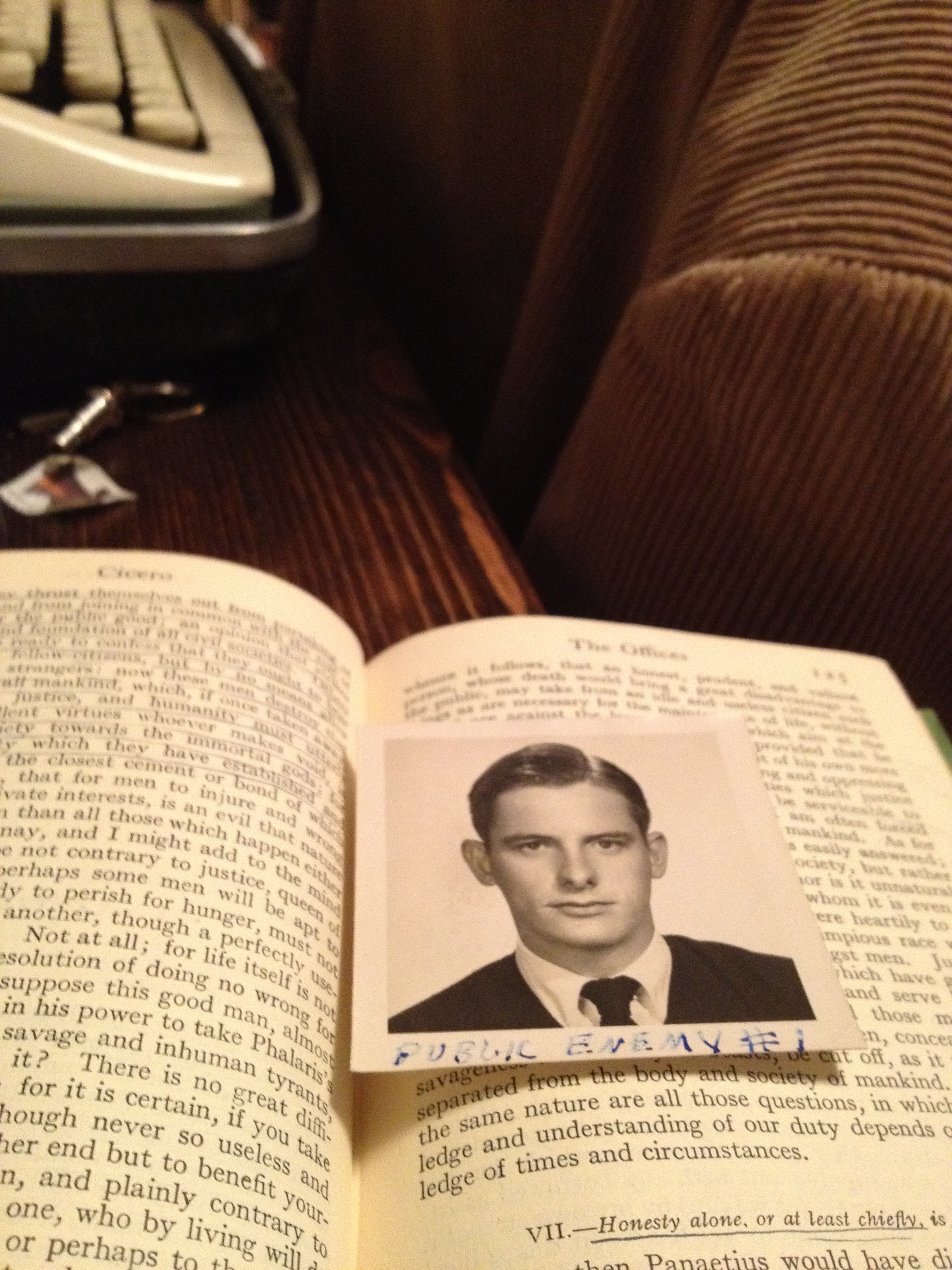 One of them is a copy of Cicero. In this translation, it is called The Offices, though it is more often called On Duties. This one is a particularly fortunate copy. Partly because the introduction is by the Romantic writer Thomas De Quincey, who famously wrote Confessions of an English Opium Eater (in the old days before the internet, I searched for months for a copy before finding a big old folio style one).
Secondly, within it was a small picture, like a school picture, on page 125. The young man, comicly identified as ‘PUBLIC ENEMY #1’ looks like an ordinary, handsome young man from the fifties (this edition was printed in 1949). The book is inscribed with the name ‘Katherine Laule’ (in truth, I am unsure about the last name). Was this young man her boyfriend? Her brother?
I will be saddened if children a generation or two don’t learn to write. I use a fairly expensive Cross fountain pen. I even have a quill and inkpot. So I will never cease to use handwriting, but even I struggle with cursive these days and I don’t know if any of my sisters’ children can use it at all, except to sign their name.
Also, as an argument for handwriting, there was this tidbit from the article:
Some research suggests that the conjunction of brain and writing hand is possibly more efficient.
 the coffee philosopher