Contemplation, No Contemplation


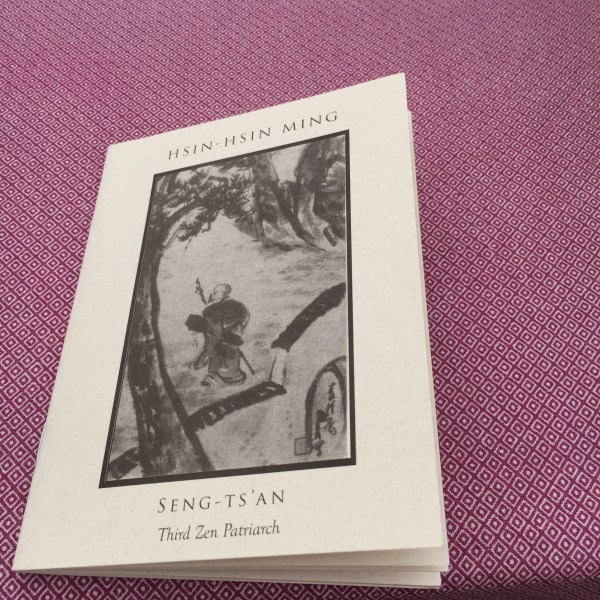
While working for my better half at Eastern Market, I read Tseng Ts’an’s The Hsin-Hsin Ming, a poem illustrating some principles of Zen Buddhism. At the same time, I’ve been doing some very casual, very unsystematic tasting of some ancient, classical philosophers: Aristotle (The Rhetoric), Marcus Aurelius (Meditations), Plato (Gorgias), Plotinus (glancing at, but by no means understanding The Enneads), Quintillan (Orator’s Education), and Cicero (On Duties). None of these particular works address the particular issue I was thinking of, though. However, in other works, all of them do express very clearly that, in some way, shape, or form, the best life (good life, virtuous life) is a life of contemplation and philosophy, through a combination of reading, study, and dialogue with others. Tseng Ts’an expressly forbids seeking ‘Englightenment.’ He expressly tells the reader not to meditate nor contemplate. He doesn’t want you studying, nor reading, not engaging in dialogue on things.

Ecce Homo


Re-reading Ecce Homo after reading Gros on Nietzsche has given me a new perspective. In my mind, Nietzsche was urban or housebound or almost an invalid. A cantankerous, mustachioed German. But Gros opened me up to Nietzsche the walker, the nature lover. And now, I can see his relationship with and affection for the natural world and he seems more like Thoreau than the Underground Man.

Also, as per Gros, rejects bookishness here, claiming he would travel with just a few books (this weekend, I refused to travel a mile to Eastern Market without three books). Later, when commenting on his earlier book, Human, All Too Human, he writes:

I was redeemed from the ‘book,’ for years at a time, I read nothing – the greatest favour I have ever done myself! – That deepest self, as it were buried and grown silent under a constant compulsion to listen to other selves (- and that is what reading means!) awoke slowly, timidly, doubtfully – but at length it spoke again.

Don’t know how I didn’t remember this, but he consistently rejects all things German and proclaims himself Polish and Poland his fatherland. He also constantly returns to Zarathustra, clearly rating it as his greatest work. While Birth of Tragedy does not get so much attention, Dionysos does, with the dionysian aspect being referenced again and again.

I’d been wanting to pick up the companion of my teens and twenties again, but Ecce Homo was probably not the best choice, especially since much of it is a commentary on earlier books by Nietzsche – books that I hadn’t read in a while (else a revisiting to him would be unnecessary).

Farewell To Old Siam/Nana Thai


A sad moment. I won’t say it was the best Thai restaurant, but it was good. Even when they changed the name to Nana Thai, it remained Old Siam to me. And so it shall in perpetuity, I reckon.

I didn’t even get one last meal in. By the time I had made up my mind to go, the furnishings were on the street and the staff were inside eating pizza.

This place was pleasantly close to my old apartment in DC, but after we moved to a house in the Atlas District, I apostasized and switched my loyalties to a Thai place called Imm on H.

The world keeps moving, I reckon.

‘District Merchants’ At The Folger


DistrictWIDE2Written by frequent Folger production director, Aaron Posner, District Merchants is new take on The Merchant of Venice which seeks to tackle to elephant in the room: Shakespeare’s unforgiving and cruel and anti-semitic take on Shylock, the titular merchant.

Posner keeps the names, but shifts the action to Washington, DC and the time to the months just before and just after the Panic of 1873. He mostly keeps the original names, or else uses something very close (which sometimes seems jarring – especially the continued use of ‘Shylock’), but plays with race and ethnicity, making the majority of the non-Jewish characters black. This does create a more nuanced view of discrimination and prejudice (especially in the form of a young mixed race man who ‘passes’ as white), as does the addition of topics like the pogroms in Russia and war profiteering during the Civil War. Muddies the waters, those last two, though I’m not always sure to what end. I mean, I know to what end, but I guess that I’m not sure if it really succeeded.

But the play does succeed, sometimes, in spite of itself. But The Merchant of Venice, when it succeeds, does so in spite of itself, does it not? And, as a DC resident, references to places like Eastern Market made me smile with pride/recognition.

The Ladder In The Sky


The Ladder in the Sky, one half of an Ace Double (the other half being The Darkness Before Tomorrow) is an oft told tale of an ordinary man given amazing intellectual, including mystical/psychic/super-science powers.


It does nothing very well, but nothing badly and I was entertained for an hour or so. If there was something, not exactly new, but different, was that it took place in ‘the future.’ Normally, the ordinary person lives in more or less modern times, but in this case, it was already a science fiction setting with interstellar travel and what not.

That day I’d brought two books with me to read while I was working for my better half at Eastern Market. Unfortunately, I’d misjudged the speed of my reading and found myself bookless by noon, so I ran to Capitol Hill Books during a lull and grabbed this Ace Double – mostly because it was an Ace Double and I just think the idea is cool – for four dollars twenty-four cents, including tax.

It’s A Mystery!


…was the corny name of a fun little event put on by WETA, one of our local public radio and television stations. Professor Rebecca Boylan from Georgetown spoke about (primarily) British mysteries and the distinction between truth and justice, insider and outsider, etc.

It wasn’t as academic as I would have liked, but she did talk about three philosophical ‘truth theories’ and how various detectives use them to reach the ‘truth.’

First was the correspondence theory, which is building relationships or correspondences between facts to arrive at the truth. She mentioned Wallander of the detective show (and books) of the same name, though the classic Sherlock Holmes would have been a more obvious one, I think.

Secondly was the coherence model, which is less observational and more introspective; more about building a internally consistent model for the truth, for which the models were Luther (love Luther!) and Poirot.

Finally, was the pragmatic model, which was less about absolute ‘truth,’ than what worked.

Also, a neat and counter intuitive comparison of Luther and Morse, with Luther posited as the urban Morse and both being primarily representatives of the detective as outsider.

And they gave me this cool mug!

East City Bookshop


While I missed its opening, fortuitously scheduled for April 30, also know as Indie Bookstore Day, because I was in Chicago or somewhere like that, I did eventually make my way over to East City Bookshop last Sunday.

It’s a little funky to get to, though it’s very near Eastern Market, and my first impression was a little off putting, it bears further exploration.

I was off put (or put off) because the first floor is small, with not many books. There were many shelves of books placed cover out, instead of spine out, which screams (to me), we have a small and poor selection!

Luckily, there were some stairs to a much larger downstairs which had a very nice and large children’s section and a well curated fiction and poetry section. The poetry section was not large, but I found Ocean Vuong’s much talked about debut (which I eventually bought), and Last Words from Montmartre by the late Taiwanese writer Qiu Miaojin (published by the awesomely reliable folks at NYRB; they had a number of books from that imprint and it’s a sure sign of quality).

While I didn’t partake, there was a big comfy couch and what looked like a play area for artsy activities for kids, though there also seemed to be a lot of wasted space.

In the end, it’s super close to an area where I spend a lot of time and someone clearly spent some time and attention to selection, even if there are some (to my mind) missteps in organization.

Happy Independent Bookstore Day!


Washington, DC is unique right now, in having a lively literary scene with plenty of bookstores, but exactly zero chain bookstores.

My own neighborhood has two longstanding used bookstores and, supposedly, today is the first day of a third bookstore on Capitol Hill – East City Bookshop.

I am out of town right now, but am looking forward to checking it out.

Staged Reading: ‘In The Belly Of The Whale’


This is the second, Taffety Punk sponsored, Capitol Hill Arts Workshop located, staged reading of a new play that I’ve seen. Like the first, it riffs on an existing (and canonical) work. In the first case, it was Shakespeare’s infrequently produced Coriolanus and in this case, it is the story of Jonah, from Genesis.

There’s no good way to say this, but I was disappointed. It’s a work in progress, but the flaws are so striking and, dare I say, intrinsic, that it’s hard to see it being a success.

It is a six person play: Jona (a woman, unlike her Old Testament namesake, and the protagonist), Astrid Overlander (a sculptor), Domino (a sort of frightened old man caricature who steals/collects junk that…), Jed (sells on the street; he’s also a caricature, but a more amusing one; a comic, street level entrepreneur who is alwasy optimistic about future business prospects), a parrot named Calliope, and the stage manager.

I assume the stage manager is a ‘character,’ because without her narration, the quantity of dialogue drops sharply and the quantity, elaborateness, and expense of the sets would become impractical for almost any theater (and it would turn the play into something more like a special effects extravaganza). But that ‘character’ also becomes a crutch and violation of the old writing adage, ‘show, don’t tell.’ She tells us what’s happening all through the play (and had, by far the most lines; more than the other combined, I wager).

The ideas picked up and dropped resemble a grab bag of late night, undergrad conversations. Jona writes to (explicitly stating so) fend off the coming (literal) end of the world. Astrid makes sculptures that are simultaneously cradles, cages, and arks. Domino collects the detritus of the world. They are Brooklyn bohemians and stereotypes, rescued, after a fashion, from a biblical flood by the surprisingly buoyancy of Astrid’s latest masterpiece. There’s a whale swallowing, there’s guilt overcoming (even though the origin of her guilt seems rather low stakes, especially for one apparently triggering both an apocalypse and a whale swallowing), there’s an ark, there’s that cradle metaphor, and that cage metaphor, and hypergraphia, and messages in a bottle, and on and on and the themes tangle and mix and never resolve and never cohere and I still don’t know what it was trying to say.

Shakespeare: Life Of An Icon


You have officially missed the chance to see the Shakespeare: Life of an Icon exhibit at the Folger Shakespeare Library. Sucks to be you, because it really was awesome.

I’d rushed through it once before, during intermission at a performance, but knew I needed to go back and give it a thorough look through.

A page containing what is believed (but not confirmed) to be the only example of Shakespeare’s handwriting, beyond merely his signature. The only preserved letter written to Shakespeare (a neighbor’s request for some money). Paper, paper, paper.

Paper is beautiful. Books are beautiful. One of the best things about the Folger is that its collection is paper. It’s research library that believes its printed and written collections are museum quality. That was the most wonderful thing about the exhibit. We are human because of our minds and the written word is Western humanity’s repository of the history of what makes us human.