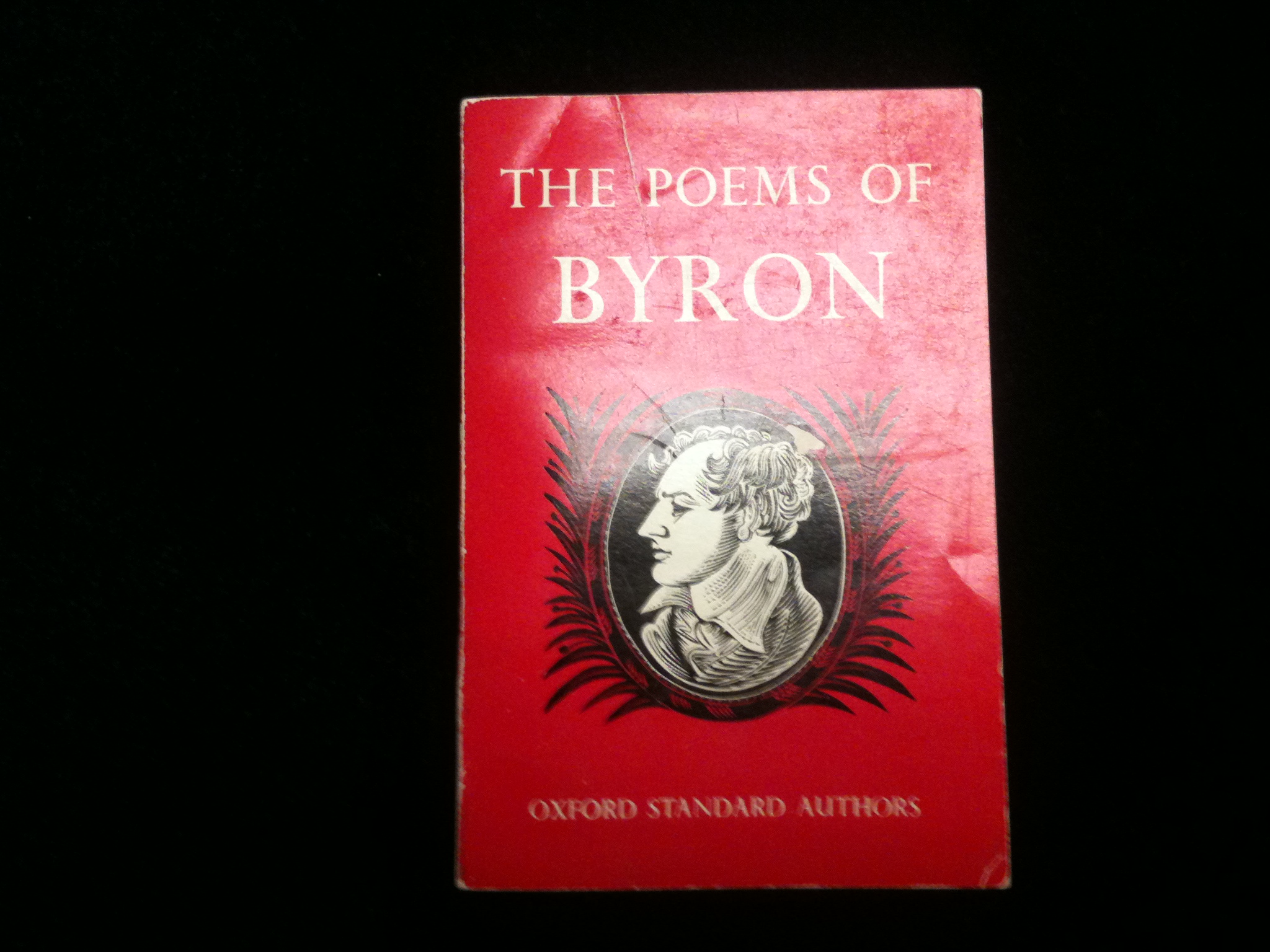
A Dignified Book


Even though I do my best to support living poets, I am not above a good read of the dead ones.

When I hunt through a used bookstore for poetry, I usually stick with the dead ones (if I’m going to pony up for a living poet, I’d like some of my hard dollars to reach the actual poet).

Part of a finding a good, used book of poetry is the actually book itself – the binding, the cover, the feel of it. Even the smell. A good old book has a scent that beats “new car” any day.

At Capitol Hill Books, I found this copy of Byron’s poems. It’s not absolutely, ideal (one day, I’ll show you my copy of Shelley, also bought at Capitol Hill Books – because that’s what a perfect used book of poetry look like!), but more than serviceable. It’s well read, but not disintegrating and though the cover is pinkish (I suspect that it was actually red when new, but has faded to something less masculine), it is generally what I would call a dignified book.

What has this to do with the contents? Nothing at all.

But for the record, I chose to dive into “Childe Harold” rather than “Don Juan.” All things in time.

Pulp Sci Fi: None But Man


On Saturday on I purchased and by Sunday I had finished reading Gordon Dickson’s None But Man, a science fiction novel from 1969 – towards the tale end of the silver age of pulp sci fi.

I had wandered into Capitol Hill Books‘ basement specifically looking for a good novel from the genre – preferably one from the late golden or silver ages of the pulps (roughly 1940-1970). I was inspired to dive into this preferred genre of my misspent youth by The Onion’s running feature, Box of Paperbacks, wherein Keith Phipps reads through a collection of 75 odd old science fiction novels.

While browsing at the bookstore, I was lucky enough to find None But Man, which had been recently featured in that very series.

When you pick up a book like this, you generally know what you are getting. Yes, writers like Ursula Le Guin have risen above the supposed limitations of genre to write Literature with a capital “L,” but even widely read and admired writers like Isaac Asimov (a clear influence on None But Man) are not, we should admit, ever likely to be confused with Leo Tolstoy.

But that’s not the point.

Taken for what it is, slipping into the pages of None But Man was like sliding into a warm bath for someone raised on used paperbacks from the period (though Keith Phipps was somewhat harder on the novel – dragged down by the sheer weight of reading some many similar novels).

The book itself is heavily influenced (I felt) by Isaac Asmiov – particularly Foundation. There is something of Asimov’s “psychohistory” in the way that the main character manipulates and manages the actions of large populations.

I also liked the way the author was clearly aware of some of the ways that the tropes of science fiction do not always line up with science. For example, the main character (Cully When) points out how fortunate they are, when hijacking an alien ship, that the aliens’ sensory range is roughly the same as their own, i.e., that they see roughly the same spectrum of colors. This would have been a problem if an important flashing light were only visible to a creature who could see in the infrared spectrum.

Giving the aliens (called the Moldaug) the same vision as us was a necessary part of keeping the novel flowing so as not to get bogged down in details, but the fact that Dickson addressed it suggests that he is aware that it is, in truth, unlikely to that the sensory capabilities of an alien species would be identical or even similar to our own senses.

He even has the plot of the novel revolve around the fact that he moral code of the aliens is radically different from our own (though not so different as Dickson suggests – I actually think he fails here to create a truly alien moral code).

Anyway… I’m looking forward to going back to Capitol Hill Books and picking up another bit ‘o pulp read later this week.

Places That Made Me Want to Write


Certain places just make you feel like pulling out a pen, laptop, or even a manual typewriter (assuming no one objects to the noise) and taking a wild, boyish stab at writing, as  Paul Varjack, from the movie version of Breakfast at Tiffany’s might say.

For me, those spots included the Gulfport, Florida coffeehouse Kool Beanz. Sort of the beating heart of the Gulfport Arts Village, it was exactly what a coffeehouse in a beach town ought to be.

Skylight Books in the Los Feliz neighborhood of Los Angeles, California is another place. Though it doesn’t serve coffee and its resident cat sadly passed away, not many other bookstores were as committed to the idea and production of literature – amply shown by their stunning selection of and support for small press books, hand printed ‘zines, and other literary labors of love.

Revelations Cafe and Book Store in the quirky, artsy town of Fairfield, Iowa. I picked up a used copy of A Sourcebook in Indian Philosophy here, as well as cassette tape (for my car stereo) copy of the Violent Femmes self-titled first album. Also, they have very good pizzas. Just saying.

The West Gallery of the National Gallery of Art in Washington, DC has two wonderful little courtyards that are perfect for sitting down with a notebook or a newspaper and indulging in some quiet literary introspection.

Also, perhaps I should put in a little something for those places we have lost – in my past, I remember C.A.M.S. (Consortium for Art and Media Studies), a coffeehouse/performance space in Pinellas Park managed by Billie Noakes, Mother’s Milk coffeehouse in Clearwater, and – the grand daddy of all Tampa Bay venues – Beaux Arts on Central Avenue in St. Petersburg and the irreplaceable and irascible Tom Reese. To my great loss, I did not know him well nor take sufficient advantage of Beaux Arts.

Every Month is Poetry Month


April is National Poetry Month, but it is important that we preserve protect the poets and poetry as part of our national and global cultural dialogue year ‘round.

On that note, allow me to offer my humble suggestions for how to “celebrate” National Poetry Month any time of the year.

1) Buy a book of poetry. It seems obvious, but not enough folks actually take the time to buy an actual book of poetry. I spend a lot of time in the poetry section of bookstores and believe me when I say that I am rarely mobbed by “Harry Potter”-like hordes of fellow shoppers when I browse for verse.

2) Buy a new book of poetry. I love used bookstores (I live down the street from one), but when you buy a new book, the publisher gets royalties, providing some economic incentives for publishers to print MORE poetry in the future.

3) Buy a new book of poetry by a living poet. I love Eliot, Keats, and Frost, but they are dead and don’t need our support – on the other hand, living poets do. As a corollary to #2, we want to provide economic incentives to publishing houses to print new books of poetry (including maybe one day, something by the coffee philosopher himself), rather than just putting out new editions of the Lord Byron’s Greatest Hits.

4) If possible, buy a new book of poetry by a local poet. I stopped in to visit Bridge Street Books in Washington, DC and picked up a book of poetry by local poet and Bridge Street manager, Rod Smith – Protective Immediacy. My feeling is that if we, the locals, do not support local poets, who will?

5) Buy a new book of poetry by a local poet from an independent bookstore.  Independent bookstores are such joys to browse in. Their collections are eclectic, many have specialize in particular titles (books associated with a certain region, genre or subject matter), but they are businesses and they need our  economic support to stay in business. Nothing against Barnes & Noble, but when I am in Tampa Bay, for example, I would much rather do my book buying at Inkwood Books. You should, too.

6) Finally, consider buying a literary magazine that specializes in poetry. I picked up a copy of Physical Poetry Vol. 2 while I was in Bridge Street Books. It’s a nice little chapbook style lit mag, stapled and with a handmade look (and who knows, perhaps it was stapled by hand) and it cost only $5 to encourage the bookstore to continue stocking little ‘zines like this and provide some small level of support to the publishers of poetry ‘zines. In fact, my last publication and my next publication were and will be in non-glossy publications that represent a labor of love by the publisher – Black Books Press and Atlantic Pacific Press, respectively.

So, in sum, as a personal favor to me and everyone out there who loves poetry and who wants to see it supported and published, go and put your money where your mouth is and drink tap water for a few days rather than bottled water or skip the lattes or walk to work one day a week or whatever it is you can do to put a few extra dollars into the poetical economy.

Yours in solidarity,
the coffee philosopher