Dungeons & Dragons


Did I mention that I’ve joined an every other weekend Dungeons & Dragons game just outside of the city? I found the game online and had never met any of the participants before the first Saturday we met to create characters. But it’s been great.

A friend of mine, Ryan, tried as well, up in Chicago. He had the disturbing experience of walking into a room filled with legally-fixated (as in an obsession with the official and formal rules of the game, rather than actually being law school students) twenty-two year olds.

Fortunately for me, my little group is roughly my age – the six of us range from barely thirty and mid-forties (I would guess), leaving me pleasantly in the middle. The dungeon master is even a part time opera singer at the WNO (I admit to having been a little googley-eyed and fawning when I found out – I do love watching the opera).

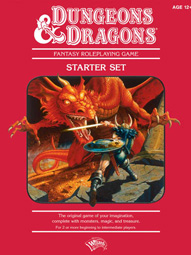
This is the first time I’ve played D&D in at least twenty years (and I actually played Advance Dungeons & Dragons, which is a fine distinction that doesn’t make a big different to the lay person) and I no longer have any of the books I used to assiduously collect (but I am pleased to see that the starter set, the picture shown to the right, is exactly the same cover design was it was twenty-five odd years ago). I’m already being mocked for having purchased the Dark Sun Campaign Setting book from Border’s. And hell if I’m not getting into it.

Every two weeks seems like an abominably long wait, except that, if it occurred more frequently, each of us would miss more games. Every other weekend is something one can set aside as reasonably inviolable in one’s schedule in a way that every weekend cannot.

So, for your information, I am currently playing a half-elf wizard named Cavafy, after the great Alexandrian poet.
Edward Said


I was with a friend watching the Cleveland Cavaliers get stomped by the Miami Heat (starring Cleveland apostate, LeBron James). It was not a pretty sight. My friends was not from Cleveland, but had spent a lot of time there as a fundraiser for Democratic candidates in Ohio last year. We crowded into a Dupont Circle sports bar and watched. Eventually, I gave up and made my way home via the metro while my friend joined some other Ohio expatriates at the Big Hunt.

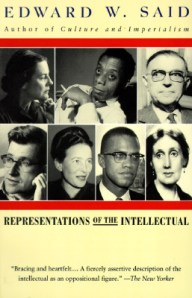
Before moseying home, I stopped at Kramerbooks to browse and to pick up something to read on the subway. I was bouncing back and forth between selection of poems by Paul Celan and a transcribed lecture from 1993 by Edward Said entitled Representations of the Intellectual.

As you have probably guessed, I went for Said. No disrespect to Celan, but Said was slightly less expensive and small enough to fit in my winter coat’s capacious pockets.

In the early stages, Said is simply juggling with what an intellectual actually is. He seems to be leaning towards a conclusion of the intellectual as someone who is outside the system in many ways – that, in fact, the classic French mandarin might not actually be an intellectual.

This struck me because of how it lined up with Tony Judt’s The Burden of Responsibility: Blum, Camus, Aron, and the French Twentieth Century. I just finished reading the middle section of that book (on my Nook, no less), the part about Albert Camus. He proposed that Camus was not truly a public intellectual, in the way that Jean-Paul Sartre and Simone de Beauvoir were. Instead, he places him in a slightly different tradition, that of the French tradition of les moralistes. Different from our moralists, which, in English, implies a hypocritical and conservative figure who speaks with ill-conceived religious certainty. Rather, une moraliste is someone who exists outside of the mainstream of thought and is constantly wracked by doubt and approaches the problems of the age from an abstracted, alienated perspective. The example he gives is Jean-Jacque Rousseau as le moraliste in contrast to public intellectuals like Diderot, Voltaire, and Montesquieu.

I was struck because Said’s definition of an intellectual appears to be similar or parallel to Judt’s les moralistes.

Of course, Said has the entire rest of the book to flesh out his definition and this similarity may not hold up until the very end. But it is certainly a new way to think about the role of the intellectual in society.

Take Your Child to a Bookstore Day


Saturday, December 4, 2010 will be the first annual “Take Your Child to a Bookstore Day.” Naturally, it has my full support.

If you have ever read my posts, you know that I feel very strongly that we, as lovers of culture, art, & literature, should support brick & mortar, independent bookstores.

If you live in the DC area, I would suggest two places for the child in your life – the first is Politics & Prose. A big bookstore, with lots of spaces for kids to run around a little, as well as a children’s section. The other is Capitol Hill Books, my local used bookstore. It is a classic kind of place, with an irascible owner and lots of nooks and crannies where book loving kids can curl up and hide.

Terrance Hayes


Terrance Hayes won the National Book Award this year for his poetry collection, Lighthead. Hayes has been a relatively frequent visitor to DC, based as he is, just a couple of hours away in Philadelphia.

I saw him at the Folger Shakespeare Library in 2008 and he signed my copy of an earlier collection, Hip Logic.

Keep an eye out and catch him the next time he’s in town.

Alice Coote


We saw mezzo-soprano Alice Coote, accompanied on piano by Bradley Moore, perform a recital of English poems set to music by English and American composers (Elgar featured prominently among the composers and the Romantics among the poets). We sat in the front row, which is awesome at a Grateful Dead show, but can feel a little awkward at a classical music event – but it was the first time to see a singer perform up close. The experience was a reminder of how little I really know and understand about music, watching the contortions of her face and body as she sang.

Unfortunately, Ms. Coote was suffering from a cold and was a little off, but it was still gorgeous. Not entirely my cup ‘o tea, though – the music, from twentieth century composers, sometimes seemed too close to the popular songbook and I have never been a big fan of musicals (except for, for some reason, The Fantasticks).

When she sang a series of “poems” – actually diary excerpts – by Virginia Woolf, I saw a bit of what we had been missing earlier. In many of the other poems, even such emotive pieces like Byron’s So We’ll Go No More A-Roving, she seemed content to simply perform the recital. But when she arrived at the Woolf pieces, her performance changed. She seemed to be personally and deeply moved by the sentiments. A reminder of how much, for me, a good operatic performance is as much a product of the acting as the singing.

Poetry in DC


I just wanted to give credit to Gina Sangster, who published a letter to the editor in the Washington Post pushing back against the perceived meme that the DC poetry scene is limited to unartful poetry slams.

She named dropped some of my favorite poetry events – from readings at Busboys and Poets to the poetry series at the Folger Shakespeare Library, to the readings at the Library of Congress.

I recently noted my own mixed feelings towards slams, but in addition to featuring to thriving slam scene (which it shares with Baltimore), Washington, DC also features a (relatively) well supported scene for all kinds of poetry.

My Library


My little library is nearly complete. It’s the smallest room in the apartment, save the bathroom, but now contains an office chair, my desk (made out of recycled wood by a local furniture maker), a stool, Smith-Corona typewriter, record player, and three pale wood bookshelves.

In other words, the whole get up is basically porn for poets.

During my first evening in my little nook, I sprawled out with a copy of Pedagogy of the Oppressed, a book long recommended to me by my pedagogically inclined friend, Steve. I still have a little room to mix and match books – giving away older copies of The Poet’s Market and switching out some of the trashier reads for the rest of my poetry collection. Plus, of course, all my many, many notebooks.

Full Moon on K Street


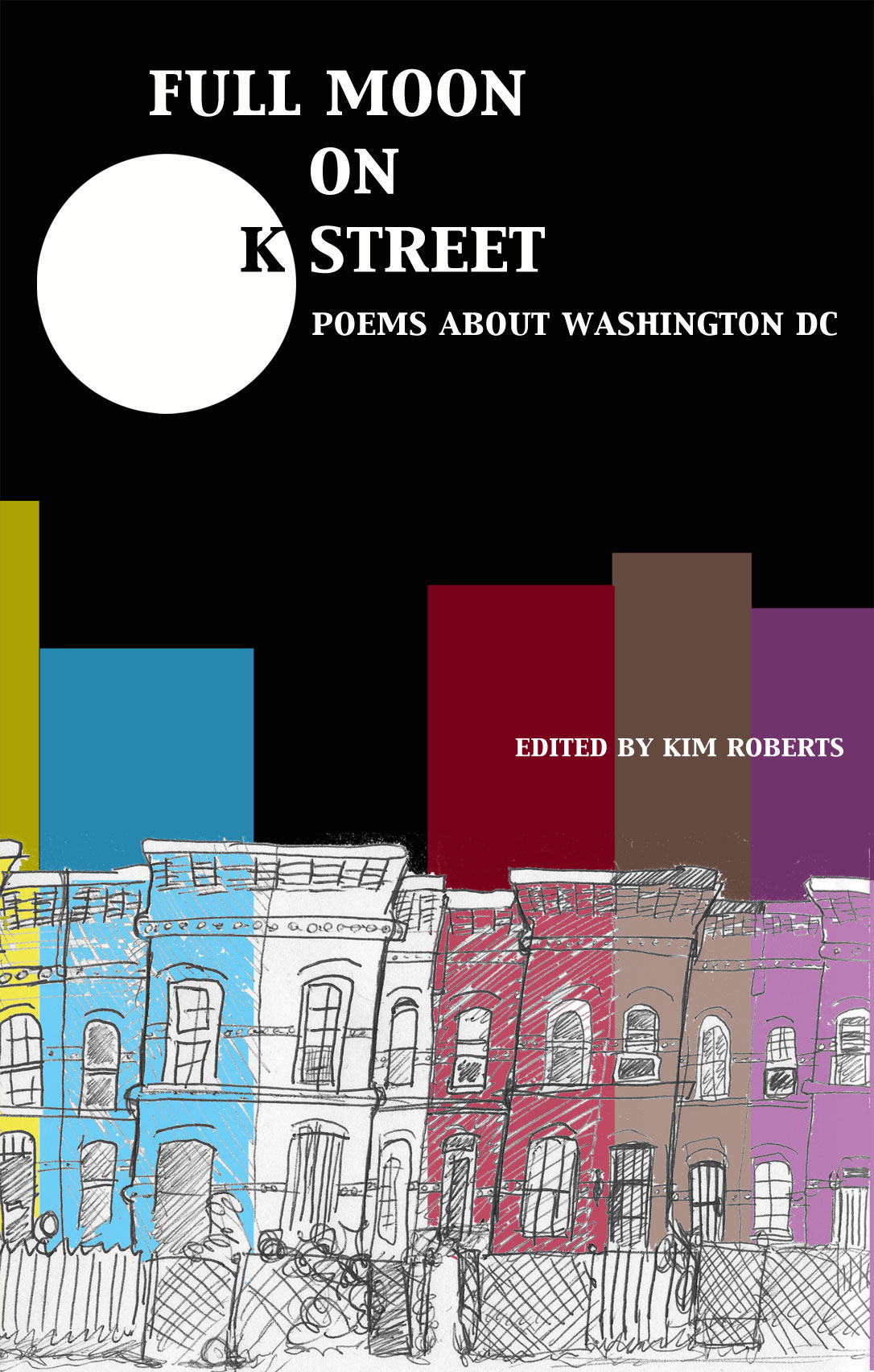
This book actually came out some time ago. I first heard some of the poems at a reading at the Folger Shakespeare Library, but did not buy the book at that time (I did buy a book of poetry – I always do at these things). I bought it more recently when Busboys & Poets featured the collection, its editor, publisher, and several of its contributors for a packed house a poetry reading on a recent weekend.

Full Moon on K Street is a collection of 101 poems that take place somewhere in Washington, DC by poets who have lived in the city. All the poems were written after 1950. The volume is a fine reminder that Washington, DC is a living, breathing cultural city. It is not just museums and monuments for the dead nor is it just a place where the federal employees goes to work. Washington is also a town filled with activists and organizers, who help create a wonderful bohemian vibe and support places like Busboys & Poets and contribute to a vibrant culture of art and poetry. Full Moon on K Street is partly a chronicle of the side of Washington you can’t see on C-SPAN.

Salome and Santa Teresa


I have tickets for the Washington National Opera‘s production of Salome with Deborah Voigt. It is also the day we remember Saint Theresa – Santa Teresa de Avila – the Spanish mystic.

Not entirely sure how these things are related. In fact, they are very nearly opposites. Salome is a… what? Dancer? Courtesan? Prostitute? Rather than mystical and spiritual, she is eminently a creature of the flesh. And Santa Teresa? Could we relate her ecstatic writings about spiritual unity with the Savior to Salome’s ecstatic “Dance of the Seven Veils” that overwhelmed Herod?

Last Night’s Concert


We saw the Arcanto Quartet play at the Coolidge Auditorium in the Jefferson Building of the Library of Congress. For those of you who live in or have visited Washington, DC – the Jefferson Building is the attractive looking one of the three main buildings of the Library of Congress (LOC for short).

I was painfully ignorant of the three works they played.

The first was the String Quartet in D minor, K. 421 by Mozart. Apparently, it is one of only two string quartets that Mozart wrote in a minor key. Despite the cliches about works in minor keys, it was not a particularly sad work. The second movement, the Andante, hardly sounded like Mozart at all to my untrained ears. The program said that much of this work was specifically written as a sort of homage to Haydn, so perhaps it was that influence coming through strongly.

The second piece was Ravel’s String Quartet in F Major. As you might expect from Ravel, it was unfailingly romantic. If I had any complaints, it might be that I detected what I thought were some sour notes from the second violin and viola. But since I don’t know this work at all, I can’t be certain.

The final piece was the String Quartet no. 5 by Bartok. As you might expect from him, it was occasionally lyrical, mixing Eastern European folk dances into the arrangement, but was more commonly a dangerous and traumatic piece (in the best of senses). The  fourth movement (out of five), the Andante, in particular, stood out for the me. At the movement’s completion, I turned to my companion and mouthed “wow” and saw that she was likewise stunned. I wish I could describe it. It ended with a sort of declining, high modernist sob from the first violin that drew out the history of the collapsed dreams of the Old World.