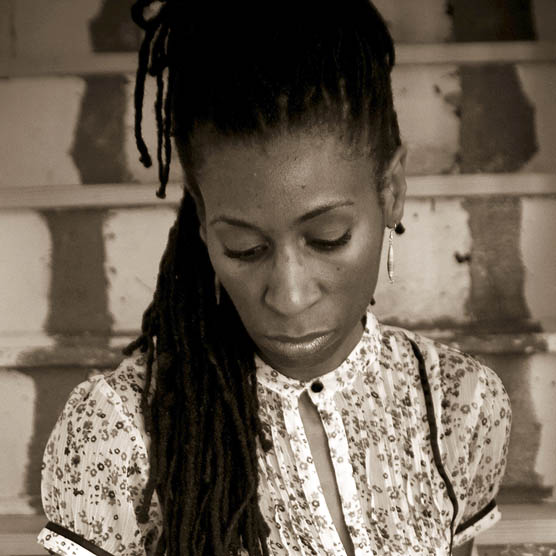
Mary Karr and Lyrae Van Clief-Stefanon


Memoirist and occasional poet Mary Karr joined poet Lyrae Van Clief-Stefanon on stage at the Folger Shakespeare Library this evening as part of the museum/theater/library’s O.B. Hardison Poetry Series. I vaguely remembered reading about Karr’s third memoir, Lit, but knew nothing about her poetry nor anything about Van Clief-Stefanon.

I would guess that Karr’s poetry is very similar to her autobiographical prose. Narrative and formally uninteresting. This was my opinion of her work while browsing through their books before the reading and Q&A session began.  Now, I would add “garrulously loud and asinine.” But that’s more of a personal description than an aesthetic statement.

I started dislike her when she kept hogging the spotlight from Van Clief-Stefanon (the visuals weren’t good either, with the white poet, Karr, hardly letting the black poet, Van Clief-Stefanon, get a word in edgewise when they shared the stage together). Then she made a comment about 90% of what Emily Dickinson wrote being “s–t.” I don’t necessarily disagree (Dickinson was incredibly prolific, but in practice we really just read a relatively small percentage of her work), but she started doing a version of the “I’m going to tell it like it is” (though her version was “someone has to say it”). Generally, when someone says, “I tell it like it is,” that person is about to be an enormous a–hole. Then Karr laid into the poet Rae Armantrout, calling her precious and saying that to like her poetry you have to “give a s–t” about the thoughts in her head “and I just don’t give a s–t.” Leaving aside the fact that I appreciate Armantrout’s work, the way Karr kept going about Armantrout was just irritating. And the purported impetus was a question about poets they liked. At least they agreed that they liked the Philadelphia versifier Terrence Hayes.

On the other hand, Van Clief-Stefanon was charming. Her work was formally inventive – and successfully used a variety of forms with amazing success, even introducing me to a new poetry form, the Bop. She also managed to write about the personal without seeming to vomit real life, unfiltered and unpoeticized onto the page. Van Clief-Stefanon is also a fellow Floridian and anybody who manages to become a relative success in a state that looks at people like Rick Scott, Mike Haridopolos, and Dean Cannon and says, “we should totally put those people in charge,” well, let’s just say that the person that overcomes that deserves some credit (I would include myself in that list, but I’m pretty sure that I’ve been traumatized by the sheer volume of stupidity and misbegotten garbage spewing out of Tallahassee).

Needless to say, I purchased and had autographed a book by only one of the poets.

]Open Interval[ was the book I chose. When I’m done reading it, I’ll tell you more.

On another note, the exhibit going on that the Folger is called Beyond Home Remedy: Women, Medicine, and Science. It’s great exhibit about early medicine and the curation (as the title suggests) gives it a strong feminist slant.


Anne Carson


I was reading Scarriet (a poetry blog) the other day and read about them crashing Anne Carson out of their little March Madness for poets.

Naturally, I disagreed with the result.

I have loved Anne Carson since 2001. I was browsing through books in a Books-a-Million (which once upon a time was not just crap that other bookstores only put on their bargain shelf, but actually stocked good books) on DuPont Circle back in 2001 when I stumbled on Men in the Off Hours. Just a few moments of flipping through the pages convinced me that this was something I had to purchase right then and there.

She has been one of my favorites ever since. The mixture of the arch, the classical, and the quotidian – I love it. Men in the Off Hours or Glass, Irony and God would be good places to start if you haven’t read her yet and were looking for a good intro to her style.


Postscript: Check out this Paris Review interview with Carson.

The Archaeology of the Last Days of Borders


This article lays out what those of us on Borders email list already know – the sad desperation of the decline (and fall?) of the second largest bookstore chain in America. Once or twice a week, Borders send me an email offering my 30% off or more on virtually anything I want. And despite my oft stated preference for indies, sometimes I acquiesce (mainly when my better half takes me on her shopping trips – she makes baby clothes, by trade, and often takes me to a Jo-Ann’s  a few stores down from a Borders in Columbia, Maryland).

I cannot be happy to see any bookstore go under. Not even a big, evil chain. Especially since I have such good memories of a particular Borders location.

Also, I once remember reading that they kept books on their shelves longer than Barnes and Noble. What that means is that newly published and less heavily promoted books had more time to be seen, perused, and bought by a passing patron. Which means that, if true, Borders was better for new and emerging writers and smaller publishers than Barnes and Noble.

Trading In; Trading Up


Sundays, Mondays, Thursdays, and Fridays from 4-6pm are when you can trade in your old books for cash or store credit at Capitol Hill Books.

The proprietor is comfortingly curmudgeonly and doesn’t brook argument nor negotiation in the process. I brought in six books and was given seven dollars store credit, which was noted and filed on an index card.

I brought in four volumes of the late Robert Jordan’s Wheel of Time series. Seeing as how the Wheel is twelve volumes (and counting – the series is being completed by Brandon Sanderson, based on notes left behind by Jordan, who was not caught unaware by his death and made plans for someone else to be able to finish the series, more or less as he had intended) and not particularly good, I can’t imagine going back later and re-reading them. Don’t get me wrong – I’m going to finish the damn series. I’m on the sixth book and have invested  (wasted?) too much of my time to give up now. But to cling to volumes I’ve finished, when the writing can best be described as “cluttered” and “lacking in humor” seems to be a gross misuse of bookshelf space, which is at a premium right now.

Another book I brought in was one of the Harry Potter novels. This may sound like heresy, but it seems to have escaped many people’s notice that the Harry Potter novels are crap. I’d bought this one for some young relatives and found it still in my possession because it turned out they already had that volume. I did read the first one and the strongest sensation it generated what the strong desire to read something better. If you enjoyed Harry Potter, may I suggest you pick up a copy of Ursula K. LeGuin’s A Wizard of Earthsea to find out how it’s really done.

Finally, I traded in a copy of Richard Wilbur’s Inner Voices. Normally, I would never get rid of a book of poetry, but Wilbur is an exception. I can’t stand him. I wish I could remember what misguided thoughts compelled me to purchase this book from the Hollywood Borders so that I would know to ignore them in the future.

This was the bounty for which I received seven dollars.

I browsed to crowded (with both books and patrons) aisles for something to spend my new riches on. Mostly, I was torn between a Modern Library edition of the selected writings of Saint Thomas Aquinas (a beautiful little volume, with a smooth, hard red cover and the smell of suitably aged tome) and something from Harvard’s Loeb Classical Library. In the end, I didn’t get anything. Partly because the Aquinas was $8.50 and the Loebs were $15 – which is to say, more than the value of my credit. Also, I wasn’t sure how my better half would respond if I brought home another book (she was working near the book store and would undoubtedly have seen me pass by, carrying my new used book. Maybe I’ll see if there is anything else I can stand to be rid of on my shelf to try and build up to either $8.50 (plus tax) or $15 (plus tax).

Coffee Addiction


I used to be addicted to coffee. A hardcore addiction. In high school, one of my teachers let me use his coffeemaker as long as I brought my own coffee and filters, so I started having that second cup (after my morning cup at home, before driving to school) in the afternoon everyday. But sometimes, we would run out supplies and I would forget to bring more. On those days, I would get the shakes and sweats, I would get terrible migraines (as if there’s any other kind), and would even vomit. Eventually, I made the connection between these two things. After that, I rarely missed my second cup.

This need became part of the image I projected both to myself and others and I had no desire to quit.

But quit I did, but entirely accidentally.

After my kidney transplant, I was on an IV for both nutrition (which is to say, a steady drip of sugar water) and pain. So, during the several days when I would normally be going through withdrawal hell, my doctor was keeping me on painkillers.

So here we are,  more than a month after my surgery, and I no longer need coffee or caffeine to get through the day. None at all.

The thing is, I kind of miss it. I was such a huge part of life. As I mentioned, it was part of my self-image, but it was also a structure to my day.

I am not so foolish as to deliberately get my addiction back, but I am starting to make an effort to drink more coffee (mostly from one of two coffeehouses near my apartment – Peregrine Espresso and Port City Java – the first one is where I go for the best coffee, the second for when I want to bring my laptop, a book, or a journal and relax in a comfy chair).

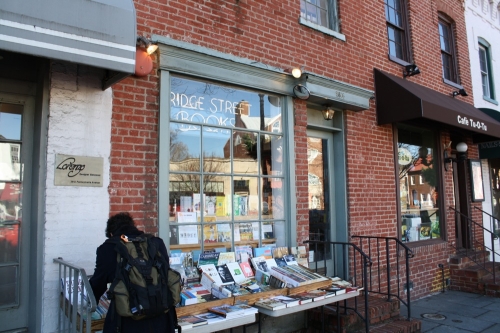
My Favorite Bookstores – Bridgestreet Books


Bridgestreet Books on the eastern edge of Georgetown is Washington, DC treasure. With a narrow, two story space, their collection is not large, but is rather impeccably curated. One of its employees is also the local poet Rod Smith (I purchased his 1999 collection, Protective Immediacy a while back).

Many, many years ago (actually, ten years ago) I lived in Georgetown. Somehow, I accomplished while also being poor. Part of my poverty was my insatiable habit of constantly buying books. I worked for a small non-profit situated just behind the Supreme Court building. Rather going home by way of the nearest metro stop, I would take the red line to Dupont Circle and make the long (ninety minutes or more) walk from there to my apartment near the Key Bridge. On my way home, I would pass so many bookstores that my mouth would water.

I got off the metro by Kramerbooks & Afterwords. Across the street from them was a now defunct used bookstore (I remember that I bought a copy of Kant’s Critique of Judgement from them). Around the corner was Second Story Books. On M Street, on my way home, was a Barnes & Noble.

And then there was Bridgestreet.

They would keep outside their store some racks filled with interesting (and cheap books) that were the immediate lure. And then there was the inside…

Such an enormous poetry section for such a small store! And filled with contemporary and avant-gards poets! Sections set aside for Cultural Theory! A bookshelf of just Greek and Roman classics! And so many small press lit mags (many locally published)!

It was my favorite bookstore among the ones I would pass. I recall that I bought a dozen of those inexpensive little Dover Publications books and a book of essays by Emma Goldman.

Nowadays, it is not so easy to get there from my home on the Hill, but I never visit Georgetown without stopping by.

Robert Hass Coming to the Folger in May


On May 21, former Poet Laureate Rober Hass is coming to the Folger Shakespeare Library!

Addendum to Borders


I must add a little post-script to my post about Borders. Last year, a Borders near Metro Center closed shop. That particular location was probably too close to its rival, Barnes & Noble. But now, the one near 18th and L, close to my old office, is apparently closing up. With that closure, there will be no Borders anywhere near my home in Capitol Hill.

The Social Function of the Coffeehouse


Firstly, let me apologize for my extended absence. Not that anyone really noticed. Except for a few family members, I don’t really have any regular readers and my single day record for unique visitors was 51 (and that was back in September). But still, we plug along, sending our thoughts out into the vacuum of (cyber)space.

I was inspired to write here again by this little bit o’ fluff from the New York Times about coffeehouses that don’t allow e-readers in their establishments.

Leaving aside the fact that it seems unfair single out e-readers, unless they are just hard core bibliophiles and this is an effort to protect traditional publishers and bookstores – but let’s be honest, this is just about getting us in and out as quickly as possible so they can maximize profits, it brings to mind the question of the true utility of the coffeehouse.

They are certainly well within their rights to try and maximize their profits, but I cannot help attaching a certain social responsibility for coffeehouses. This comes from my high school and college days, when coffeehouse, by and large, were not places where one found quality coffee, but rather primarily existed as social venues – a place to create gathering places from the sixties, places to read your poetry, play your music, talk politics and art, and play chess with strangers. Now that I’m older and a little more knowledgeable, I would say that the true model were the coffeehouses of 16th century England. Dispensing a bitter, burnt brew, but primarily hotbeds of debate and even relative egalitarianism.

This is not the only model for the coffeehouse, of course. Very near my apartment in Washington, DC is a place called Peregrine Coffee. It specializes in extremely well brewed coffee – and on that level, it succeeds. It has tables and seating and even free wi-fi, but the vibe is not to sit and socialize, but more to get your coffee and go. I have never gone there just to hang out, only to get coffee or to have meetings with people for a very specific purpose. The decor is very stripped down and functional (no big comfy chairs) and inspires an “all business” attitude.

Emily Dickinson Birthday Tribute/Revolt for a Cause


I will find myself in a quandary next Tuesday as I attempt to cram two events into one evening.

The first event is Revolt for a Cause, which is being put on at the swanky 18th Street Lounge, which represents pretty much the pinnacle of hipster cool in a town as uncool as Washington, DC. The event is a fundraiser for Wayne Kramer’s prison rehabilitation non-profit, Jail Guitar Doors. If you are a fan of classic punk, then to answer your question, yes, it is named after the Clash song, Jail Guitar Doors (incidentally, written in honor of Wayne, who was serving some time in jail when the song came out in the late seventies). I have mentioned before that I am a fan of Wayne, so I certainly don’t want to miss an opportunity to hear him to do an acoustic set for a small gathering – particularly since I’m getting comped on account of the work I have done as a subcontractor for the group throwing the fundraiser, Revolution Messaging.

But I said there was a conflict.

The Folger Shakespeare Library, a little later that evening, is having an Emily Dickinson Birthday Tribute, featuring the poet Lucia Perillo. I confess to knowing nothing about Perillo (I know a good deal about Dickinson – my mother loved her poetry and used to read them to me when I was a child). But before I saw them at the Folger, I knew nothing about Terrance Hayes or Rae Armantrout and had mixed feelings (at best) about Charles Wright. What I’m saying is, I trust their taste enough to take my chances.