Inscribed Books


While helping out at an craft fair, I moseyed on down to used bookstore down the street, Idle Time Books.

Idle Time tends to be on the expensive side for a used bookstore, but they also more hard to find and even rare books, so you’re paying more for quality often.

They also have a rack outside: paperbacks for a 50 cents and hardbacks for a dollar.

Not that I haven’t bought too many books lately, not that I’m not way behind on my reading (I just last night finished A Dance with Dragons, which predictably ended on a cliffhanger that won’t be resolved for another five years). It’s more that I have a deep, pathological problem.

So, for 50 cents, I bought The Seven Storey Mountain.

Inside the front cover, was an inscription covering the entire page:

Dearest Patti,
This may look like a plain old fashioned paperback book – but is so much more than that. 
   Merton has something very precious, something I can only hope to feel Someday, but something so wonderful that I want to share it with you. And that’s why today – Sept. 19, 1965 – has been so extra-special: being able to share so much with you and Claire – and I know that I am truly the luckiest person ever.
   Gosh – with you for a sister and Claire too –
                    well, I’ve reached the point where words don’t come out right at all.
   So what does come out is Thank you so much, just for being you.
                                                                                                                Much love,
                                                                                                                        Kathy 

Of course, the  forty-sixth anniversary of this inscription will be on Monday.

(Relatively) Recent Books of Poetry Worth Looking Up


Seth Abramson tends to divide opinion.

He’s sort of the anti-Anis Shivani.

If Shivani’s role in the intellectual ecology of poetry is to be a blowhard a–hole and bomb throwing provocateur, then Abramson is the ultimate defender of the status quo – the status quo, in this case, being the importance of MFA programs in the aforementioned intellectual ecology of poetry.

However, at least both write with some regularity about contemporary poetry in more or less prominent venues. God knows poetry needs people with the means and desire to do so.

God knows a blogger-cum-poet-cum-activist with a blog whose reach extends not far beyond his own family doesn’t meet that criteria.

But to get back on topic.

Abramson recently posted on the Huffington Post Ten Recent Books of Poetry You Should Read Right Now.

After all of that earlier discussion of provocateurs versus defenders of the established order and intellectual ecologies, this is all just a misbegotten excuse to post my own top ten.

I know. Ugh. But here it is (in no particular order):

Charles Wright, Sestets: Poems
I was not a Wright fan until I heard him read at the Folger Shakespeare Library and heard his recent work. To me, he was sort of a Merwin-lite, which is like Corona Light. Really – what’s the point? Is Corona such a heavy brew that we need a watered down equivalent? But what Wright is doing these days just impresses the heck out of me. Sestets: Poems keeps some of the rawer edge of his contemporary work while working within a single form (the sestet, naturally) for an entire collection.

Anne Carson, Autobiography of Red: A Novel in Verse
I think this was the second or third book by Carson that I read. I know that I bought it while I was living in Iowa. It’s verse novel retelling of the tale of Herakles and the monster Geryon (slain during the accomplishing of Herakles’ seven labors). Geryon, an ugly, monstrous child, teased at school, finds purpose as a gay bohemian artist – a photographer to be exact – whose earlier love affair with Herakles makes his death at his former friend and lover’s hand so much more heart rending. Good stuff. As always, the way the contemporary and the classical intersect in Carson’s work is amazing.

Charles Simic, The World Doesn’t End
This book was from 1990, so it’s beyond the fifteen year limit Abramson set himself, but I think that Simic gets short shrift these days. Yes, he’s tending to repeat himself, but his best work is very, very good. And this is one of his best. It’s also the first book by him I ever read. I was in Montgomery, Alabama and these surrealistic prose poems opened up contemporary poetry for me. The intersection of lightheartedness with undertones of barely held memories of war torn Eastern Europe is still worth appreciating.

Adrienne Rich, An Atlas of the Difficult World: Poems 1988-1991
Adrienne Rich’s style was a huge influence of my writing when I was younger (maybe it still is – certainly the echoes remain). An Atlas of the Difficult World: Poems 1988-1991 and Dark Fields of the Republic: Poems 1991-1995 deeply affected me. I was not necessarily “up” on things like feminist poetics and queer/LGBT poetics, but I could tell something was going on there that was important and that I needed to understand better. I picked Atlas over Dark Fields because the time period it covers was also important for me and my creative and intellectual development. Dark Fields has a cooler title though (it’s from The Great Gatsby – “And as I sat there, brooding on the old, unknown world, I thought of Gatsby’s wonder when he first picked out Daisy’s light at the end of his dock. He had come such a long way to this blue lawn, and his dream must have seemed so close he could hardly fail to grasp it. But what he did not know was that it was already behind him, somewhere in the vast obscurity beyond the city, where the dark fields of the republic rolled on under the night.”)

Kim Addonizio, Lucifer at the Starlite
Let’s get something out of the way first. Kim Addonizio is hot. She’s mid-fifties, but looks like mid-thirties. And she looks and talks like she’s living the bohemian dream of a twenty year old lit major dreaming of life as an artist-cum-shaman. And her poetry has that aura of college rebellion and youthful sexual transgression. There’s also a certain shamanistic quality to her writing (it is no surprise that she has also published two books on the creative process). But there is also a Bukowski-esque despairing darkness of the stories in her poems (a lot of narrative poetry in her oeuvre). Of two pack a day failure. She appears to be living the dream, but her poetry often tells of that dream’s failure. Oh, and she is originally from Washington, DC.

Bob McCann, Warehouse
You won’t find this chapbook, I expect. It was self-published by Bob in the early nineties. Frankly, he over edited the titular poem, Warehouse. But listening to him read its various iterations at the weekly poetry group we attended was incredible. It was filled with lines and images that blew away this young would be poet (or poet who was young then; funny to think that I am almost now the same age he was then). I haven’t seen hide nor hair of him in years. I don’t even know if he still lives in St Petersburg, Florida. You’ll find a brief reference to him and to the poem here.

Fanny Howe, Selected Poems
I am not very comfortable including “selected” or “collected” poems in here. It feels like cheating. But when I came across this book, I thought she was something special – someone I should have been reading for years. Howe hit a certain zeitgeist in my life and I’ve got to include it.

Anonymous, Beowulf (tr. by Seamus Heaney)
Heaney, of course, is a Nobel Prize winning Irish poet. Despite myself, I am a fan of his poetry. If I were to name a favorite, it would be his 1979 collection, Field Work. He has a certain hard empirical concreteness (in my mind) to his lilting (what a cliche – to call an Irishman’s literary voice ‘lilting’) lyrical voice. Makes the pastoral touches enjoyable. But his masterwork may not be any of his original works, but his translation of the Anglo-Saxon epic, Beowulf. I bought this book at Chapter 11 Books near the Kroger’s grocery store in midtown Atlanta.

Ted Joans, WOW
Ted Joans meant a lot to me, though I hardly knew him. For a young man in Paris for the first time, what massive figure to meet (I was both young and short [still am short], so it was pretty easy for folks to seem to tower over me). I have to include this, his last (to my knowledge) book. Chapbook really. Read more here.

Abdellatif Laabi, The World’s Embrace: Selected Poems
I was visiting my friend Mike in San Francisco (I was living in Los Angeles at the time) and insisted (of course) on visiting City Lights Bookstore. Upstairs, they have a lovely room devoted to poetry. By chance, I came across this book. Loved it. Had a couple of quibbles with the translation (the translator seemed to translate a particular line without realizing that it was a reference to Baudelaire, so the English didn’t reflect it), but the beauty of the poems comes through. Great way to integrate political sentiment into beautiful, lyrical pieces.
F. Scott Fitzgerald Conference October


Rockville, Maryland, a suburb of Washington, DC (and, incidentally, not far from my office), will be having a conference on the great F. Scott Fitzgerald.

Details here.

Belated Happy Birthday to Dvorak


I forgot to note Antonin Dvorak’s birthday yesterday!

If you live in the DC, the Czech embassy is sponsoring some concerts celebrating his work.

The Final Days of Borders


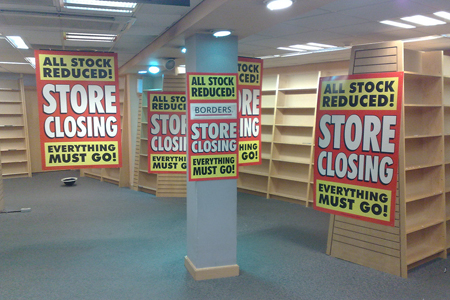
A litter after midnight, on Labor Day, I received an email from Borders announcing the last ten days of its existence were upon us. So I stopped in the one in the DC suburb of Columbia, Maryland that day while my better half visited a Jo-Ann’s Fabrics next door.

Lord, it was a sad sight. The cafe was closed in order to sell off the espresso machines and the like. A crowd of folks (little different from myself, of course) gathered to munch on the chain’s price reduced corpse.

For $22 I picked up John Ashberry’s Self-Portrait in a Convex Mirror, Charles Wright’s Sestets, and Claude Levi-Strauss’ The Savage Mind, and Elizabeth Moon’s Victory Conditions (I’d never heard of the book or the author, but it is clearly some kind of  space opera in the classic style of the Lensman or Lucky Starr).  Oh, and a book I bought for a Christmas present for one of the few people who read this blog.

Even Amazon should be a little saddened. After all, how many people have (and I don’t condone this) walked into a Borders or a Barnes & Noble or an independent bookstore, browsed through the selections to find something they liked, and then gone home and ordered it on Amazon.

Hell, Amazon should be subsidizing brick and mortar bookstores.

Publishers, too. After all, word of mouth from dedicated bookstore employees and shoppers is cheaper than paid advertising to promote a new book.

Of course, Amazon can afford to do a little subsidizing whereas the contemporary publishing industry really can’t. Not that I expect Amazon to do anything to roll back or at least hold back the bookstore apocalypse they were the cause of.

#Fridayreads


If you are on Twitter, I encourage you to participate in the #Fridayreads hashtag.

Basically, you use the hashtag (on a Friday, of course) and note what you are on reading on that Friday.

The act of doing so sharpens one’s focus on the act of reading and forces one to think about setting aside some time with a particular book over the weekend. I’ll be reading The Carrier of Ladders, of course, as well as finishing up another Canto. Those seem like good books to read during Washington’s impending hurricane, don’t they?

Library Book Sale


While wandering Eastern Market with my father on Saturday, I saw a sign taped to a trash can that spoke of a book sale at the Southeast Library, just across Pennsylvania Avenue.

When I was twelve years old, my mother took me to a sale at the Dunedin Library where we found a lovely three volume history of mathematics. It was actually a huge collection of essays by various folks, rather than a chronological history by a single author. Unfortunately, every other sale at that particular library was nothing but disappointing.

Fortunately, this one did not disappoint.

For the low, low price of four dollars, I picked up copies of the following:

Hestia, by C.J. Cherryh
Childhood’s End, by Arthur C. Clarke
Possession, by A.S. Byatt
Middlemarch, by George Eliot
Triton, by Samuel R. Delany
Spy in the House of Love, by Anais Nin

Middlemarch, in particular, excited me. For some reason, I had lately been struck by the desire to read it. Many years ago, I went through a nineteenth century novel phase, but someone, George Eliot’s oeuvre had escaped my attention (partly because I was a boy, so was much attracted to Dumas’ tales of derring do and partly because I was a moody boy, so also much attracted to Dostoyevsky’s architectural novels of philosophy leavened with hearty helpings of despair and Christian proto-existentialism).

And a funny little story about Anais Nin. My first introduction to her actual writing (I knew of her as person because of her association with Henry Miller) was from MTV. Yes. MTV.

In the early nineties, they used have actors and actresses read brief segments of famous novels and very alluring literary environments. Sherilyn Fenn read a brief segment from Nin’s Delta of Venus and I also remember Aidan Quinn reading from The Metamorphosis. Back when it seemed like MTV might actually be something cool and occasionally constructive. Sigh. Not anymore. Or maybe I’m just growing old.


Freddy Adu Not Going To Chivas


The Philadelphia Union have reached an agreement with the playmaker. I’m not sure how well that will go. Carlos Ruiz is no longer with the team and he was the kind of predatory striker who might have fed well on having a possession oriented #10 behind him. And Adu will be reunited with coach Piotr Nowak.

He was the young man’s coach with DC United, as well, but their relationship was famously contentious and you never felt like Nowak thought much of Adu. If that hasn’t changed, something’s going to break up in the city of brotherly love.

Freddy Adu Coming Back To America?


One of the rumors flying around is that Chivas USA will grab Freddy Adu before the European transfer window closes in August.

He’s currently ‘playing’ on for the Portuguese powerhouse Benfica. I say ‘playing’ because he’s hardly played for them at all. He’s ridden the pine and been loaned out, but he’s hardly played for them at all over the last few years. The only reason any is really talking about him again is because he went on loan to a second division team in the Turkish league, put in the work and made a real difference for them. Then, he got called up to play for the national team in the Gold Cup and when he was finally given his favored trequartista role, excelled in holding onto possession and played some excellent passes to open opposing defenses.

But he still looks unlikely to get any playing time for Benfica.

If he came back to Major Leage Soccer, Chivas would be my first choice for him. My hometown team right now is DC United, but his time here was only moderately successful and think maybe we should say that the moment for him here has come and gone.

I also lived in Los Angeles and Chivas USA was my team during that time (I’m not just a leaf on the wind – my true team were the Tampa Mutiny, but they are gone forever, I fear; everyone else is just a substitute for my true love). They could use some sparkle and pizzazz. If Adu were really given a chance to shine and given a central playmaking role with little defensive responsibilities (either in a 4-2-3-1 or at the top of a midfield diamond), then he could really make that team – known more for hard work and grit, than flair – shine.

That said, I’d like to see him stay in Europe. Portugal would, in theory, be perfect for him: a league heavy on offense with frankly weak and not very physical defenses. But that train has left the station. A mid-table team in the Netherlands looking for a possession oriented quarterback or even a team in France’s second division would suit him to a tee, but the transfer window is almost over and getting on the field for Chivas USA is better than sitting on a bench for Benfica.

Last Trip to Borders?


I went to Borders last night. I meant to go before they closed, as much to say good bye as anything else. But I hadn’t meant to go yesterday. But then unbearable traffic drove me in an alternate direction that took near it.

Nor had I meant to buy anything. Frankly 20% off most books didn’t seem like much. After all, Borders was sending us all 25-30% coupons twice a week not so long ago.

But periodicals were 40% and they were never covered by those old coupons, so I bought the most recent copy of Dissent, looked for a poetry or sci fi magazine, but couldn’t find one.

Then I left.

My idea, when going in, was to stay a little while. Grab a cup of coffee. Indulge in a little nostalgia.

But I couldn’t find any nostalgia.

Maybe if I’d gone to the one in Columbia, Maryland. When I was still recovering and unable to work much, I would go with my better half to shopping trips next a Borders. While she bought fabric and supplies, I would browse books.

Certainly if I’d gone to the one in Hollywood. That one meant something to me. It was a frequent excuse to get out of the house and look for something new and interesting. A place to browse for an hour or more, undisturbed. A place to get coffee before seeing a movie at the nearby Arc Light movies theater.

But this one didn’t mean much to me. It was just kind of sad. Especially because I may never go back. And soon, I won’t be able to go back.

Yikes. Too metaphorical.

But I get misty eyed over good bookstores. A mystery bookstore in Los Angeles where I took my mother, a fan of British mystery writers, to see a place devoted to her favorite genre, is now gone.

It’s not gone, but will I ever go back to Skylight Books in Los Feliz? Or Revelations in Fairfield, Iowa? Lemuria in Jackson, Mississippi? Probably not.

Conceivably, not even City Lights will be immune from my absence.

Ugh. Need more coffee.