The B Spot Jazz Trio; Or, Is Cornel West Drunk?


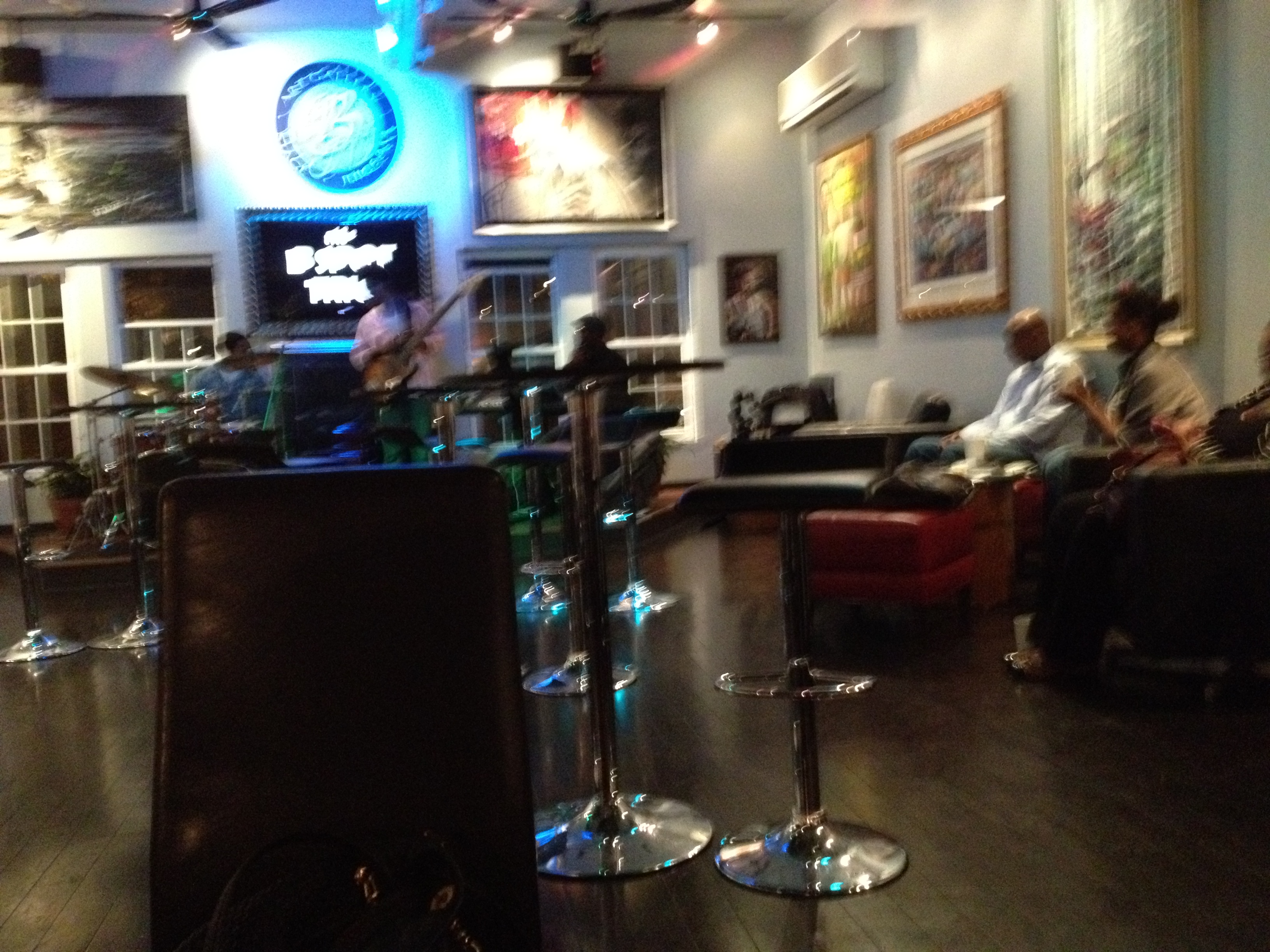
Last Saturday night, my better half I ambled over to the B-Spot, a teahouse on the second story a building on Pennsylvania, just above a pizza-by-the-slice shop.

I haven’t been there in a while, but I keep on meaning to go for their regular, Saturday night jazz sets, usually featuring the B Spot Trio, the teahouse’s aptly named house band.

The place serves quality tea (the owner takes his tea very seriously), is swankily decorated with modern looking furniture and paintings by local artists (the place also does brisk business in framing, which seems odd, but what the heck).

So I convinced her to come with me and listen to some tunes and drink some tea.

The Trio plays some good music and the crowd skews older – forties and up. With the more mature audience and the lack of alcohol, the vibe really was one of the coffeehouses I remember from my adolescence and early twenties, back when the main draw was not Starbucks latest attempt to serve a sixteen ounce cup of frothy milk, cut with a little coffee, nor even a place to bring one’s laptop, but rather music, poetry, and conversation.

And while my camera took a fuzzy picture, in the corner, next to the window, is a painting that looks for all the world like someone painted a portrait of Cornel West as if the philosopher was just coming off a two day bender and wearing a wife beater and drinking a warm bottle of beer.

Tuesday Morning Staff Meeting – The Book Of The Future


Is this the ballyhooed ‘future of the book?’

The making of an epic.

Van Gogh, Henry James and the art of being ignored.

Charles Murray – still an a–.

Mitt Romney Gazes At Paul Ryan With Such Love, Doesn’t He?


You can read the article this came from here.

Sunday Book Review: Vatta’s War


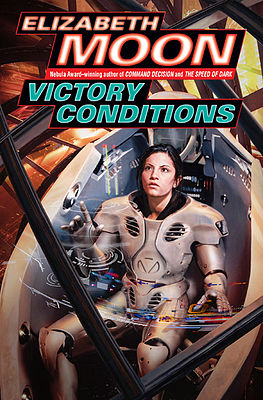
So. I bought this book called Victory Conditions during my last stop the Borders Books & Music near the Jo-Ann’s Fabrics in Columbia, Maryland. I would browse the books while my better half browsed fabrics for her business. Of course, during this visit, the shelves had become nearly barren (and everything hopelessly out of order, but you can hardly expect the inmates on death row to take a huge interest in keeping their cell neat with their execution day coming hard upon).

I had thought Elizabeth Moon’s Victory Conditions to be a likely space opera type of book. A quick glance did not necessarily prove it to be later book in a series – it could have been a stand alone novel beginning en media res.

Alas, it was not. In fact, Victory Conditions is the fifth (and final) book in Moon’s Vatta’s War series.

But should I really say ‘alas?’ After all, anything the encourages anyone in America (or the world) to read some more is surely a good thing? Even me, who believes himself to be a pretty prolific reader.

So not ‘alas.’ Merely ‘is the fifth (and final) book in Moon’s Vatta’s War series.’ As comics who make fun of Martha Stewart say, ‘it’s a good thing.’

Being obstinate and a sucker for diving into sci fi and fantasy series that will take me too long to finish by half, I did not resist to urge to finish this thing that, in all honesty, I hadn’t really started. It was more like an urge to turn a $3.00 investment into something closer to $35.00 (once I’d bought the first four books).

It’s finally over. I finished.

Was it worth it? Well, I won’t be reading them again, who reads a series of more than two or three books again? Except for Lewis’ beloved (by me, at least) The Chronicles of Narnia and the first four books of Martin’s Song of Fire and Ice (I was preparing for the long awaited fifth book, not realizing that it’s actually release would still be some two years then), not many (I would, of course, include the much read by me Lord of the Rings, if you add The Hobbit to make it a quartet – though I’ve only read The Silmarillion once). I’ll be taking them down to my neighborhood used bookstore (Capitol Hill Books) and exchanging them for store credit that I will use to buy more sci fi and fantasy.

But this was a solid series. Solid writing. The arc was unimaginative, in terms of the narrative structure within each book (the location of various set pieces within each book was pretty standard), though the twists and challenges Moon placed in front of her heroine and her assembled heroes was often surprising. The world building is well done and thorough, though also more workmanlike to truly original or inventive. The final book was disappointing in that the big finale – the epic last space battle against the pirates – was neither very tense nor vividly depicted. The earlier space battles in previous books were typically both, so this was a bit of an unfortunate aberration, especially unfortunate because it was the author’s last chance to reward her dedicated readers of this series.

I would recommend it to someone who enjoy old school science fiction with cool space battles, though I would not suggest it as an entry point into the genre (that would have to be either a short story by Asimov or Bradbury or a novel by LeGuin).

Mallarme & Cabernet Franc


My father and I took a trip out to the Shenandoah Mountains to (somewhat belatedly) celebrate his birthday.

Besides the mountain vistas, the main attractions were a fantastic (mostly) used bookstore called Royal Oak Bookshop and the Fox Meadow Winery, or rather the fantastic views of the mountains from its patio.

While sitting on that patio deck with my father, I sipped a solid (if unspectaculer) Cabernet Franc (though, in fairness, while the Cabernet Franc varietal seems particularly well suited to the terroir of the Shenandoah Valley, I can’t think of anyone who say it rises to spectacular heights with any frequency) and read Stephane Mallarme.

It seemed a perfect moment. A full, relaxing, and uncomplicated wine to go hand in hand with a full, relaxing, and very complicated poet.

Mallarme was one of those poets I had read a little of, but not deeply, but very much wished to.

In this particular collection (Selected Poems, purchased, naturally, at the above mentioned Royal Oak Bookshop) was a poem entitled L’après-midi d’un faune.

A month or two earlier, I attended a small concert where they played a Debussy piece entitled Prélude à l’après-midi d’un faune. The musicians described it as having been written for a dramatic presentation of a poem by a then famous poet. The poem and poet, I was assured, were little read and with good reason. It was typically bad and boring nineteenth century poem and we, the audience, need not worry ourselves, for the only thing left of value from that artistic moment was the music.

What absolute poppycock!

Now that I know it is by Mallarme, I rightly incensed. Mallarme and his poems are still rightly read and rightly respected and that poem is quite good.

In continued rambling, the Royal Oak is a fantastic bookstore. The owner takes care to keep a broad and good selection of books. Yes, he stocks some trash – including many of those old sci fi pulps I love so much – but also clearly works to keep good and interesting books in stock. You will find some treasures, if you care to look (and you won’t have to look that hard to find them, either).

Fox Meadow Winery is a typical Virginia winery. The vines are pretty young and the wines not very complex.

The tasting covered the following:

2010 FMV Le Renard Gris – This is the bottle I bought to bring back. Not my favorite, but my partner prefers sweeter wines and I really can’t stand them. This one seemed like a good value and sweet enough for her palate and still dry enough for mine – as you might expect from a blend of (among others) pinot grigio and chardonnay.

2010 FMW Barrel Fermented Chardonnay – I’ve got to say, this was not a very chardonnay-ish chardonnay. In fact, I couldn’t get any of the classic chardonnay mineral-ish flavor until the finish. Nothing in the middle at all. Interesting for all the wrong reasons.

2011 Riesling – If you love sweet rieslings, you’ll love this. I don’t love sweet rieslings, but my partner would have loved it. However, as noted, I opted for something she and I could (I hope) enjoy together.

2009 FMW Syrah – They offered a lot of descriptives for this one, but I swear, most of the time, I could barely taste a thing. There was no “there” there.

2009 FMW Cabernet Franc – This is what I enjoyed on the patio. A relaxing and enjoyable wine. I would have gotten it except it simply wasn’t worth $27 a bottle. But, I was very much tempted. It is a great full bodied, dry red that also manages works well in summer.

2009 Le Renard Rouge – My absolute favorite, but I just wasn’t prepared to spend $32 on it, especially since my better half would not have appreciated it. But it really was the best wine they had and I can recommend it.
E-Book Typography


James Felici’s piece, The State of E-Book Typography, brings into sharp relief some of the obstacles standing between e-books fully participating in literature at its highest and best level.

Essentially, reading on a screen – especially a computer (include tablet) screen, but also an e-reader – is always (using current technology) going to be less readable than even the cheapest printed dime store pulp.

Felici makes the distinction between readability and legibility. Legibility being the reason that most folks (including myself when I’m reading my Nook at Eastern Market or on the subway or on the National Mall) use the sort of font size on their e-readers that, in a traditionally printed book, would be associated with large print editions for the vision impaired. Just the other day, I had to increasee the font size I was using to read Melmoth the Wanderer, an earlier nineteenth gothic novel, on my Nook while riding the Metro here in DC.

But that doesn’t help, he says, the readability, which is limited by the pixelated technology used to create the words on the screen.

And though there some fonts that are better than others (Verdana, Tahoma, Georgia, Cambria) for use when reading on computers or screens, the limitations remain.

As a result we still read 25% more slowly on e-readers than on traditional books.

I also think of the writers, designers, and typographers who choose the font used in their books so carefully.

Especially poets, who are already crippled in their ability to transmit the true quality of their work in an e-reader because of how the devices lay out the lines. In a literary art form that is so much connected to its appearance on the page, the inability to even truly control the font size seems like salt in the wound, insult to injury, or whatever metaphor you prefer.

I’ll let Felici finish up this thought:

The problem today is that after 500 years of evolution, the “printed” word has taken a step backward in quality. According to “The New York Times,” electronic publishers are commissioning shorter books because their readers find it too tiring to take on longer works. Ever since I started writing for online magazines I’ve been obliged to write shorter pieces than in the past because editors tell me that online readers simply won’t finish longer articles. With today’s technologies, reading is simply more of a chore than it’s been in the past. Access to reading material is amazingly easy — a revolution, in fact — but reading is more than just taking in information, and the aesthetics of text presentation involves more than just making type pretty. It means making type functional as well.

2012 Shakespeare’s Birthday Bash At The Folger Shakespeare Library


Yesterday was the Folger Shakespeare Library‘s celebration of Shakespeare’s birthday, an event I had attended for five years in a row now. It’s kind of my thing.

Unfortunately, it was pouring down rain this year, so all the outdoor events were moved inside.

This year, I invited our neighbor’s daughter (she is, as she explained, “11 and a half years old”) to come with me. Normally, this is kind of a solitary event for – I browse the exhibit, listen to a lecture, listen to a lot of music, and check out the books for sale. But with a child, it’s a little different, of course. More drawing portraits of Shakespeare, more taking lessons in sixteenth and seventeenth century courtly dancing, etc.

And, she got up in front of an audience and read a line of Shakespeare from a speech by Benedict from Much Ado About Nothing. That was pretty cool, I have to say. She wanted me to stand next to her and help out, but then while in line, she started talking to another girl, maybe a year or two older and they seemed to make fast friends, as kids are wont to do, so I quietly slipped away.

While I missed my usual stuff (not much sitting and quietly reading and writing while listening to a string quartet), it was great to see a child get their first real introduction to Shakespeare and this language.

Oh, and unlike last year, their scholarly periodicals were set out in the magazine room for me to browse through. It really bugged me last year that they put those away.

Welcome, Interns


From Spotted: DC [Summer] Interns”

Welcome

Welcome to Washington, DC and congratulations on your summer internship on Capitol Hill, K Street, White House, or elsewhere. Over the next three months you have paper runs, coffee runs, and envelope licking to fill your days. As a consolation prize, you will be provided an intern badge, conveniently red, fashioned as your scarlet letter. This will identify your status to all of DC. A status that you interpret as “important” and we interpret as “tired” and “obnoxious.”
You will likely spend your days on the Hill and your evenings in Georgetown, U Street, and Adams Morgan. You will order “RBVs” – perhaps without knowing what they are – and hit on girls who are 9s to your 4s and 5s, trying to impress them with your intern badge. It will not work. You may be arrested for using your fake ID at McFadden’s on a Tuesday night for dollar beers, or simply turned away and stumble across the street to the already-overridden-with-interns 51st State. You will wait in line at Old Glory and Third Edition and complain about paying a cover, when there are a few dozen other bars in Georgetown you could frequent instead. You will not understand why the bartenders do not pay attention to you when you do not tip well, or when you treat them with contempt. You will go home drunk, wake up, go to work, and restart the cycle.Interns are a cause around which all DCers – Republicans, Democrats, Independents, and Militants alike – unite. It’s the one issue upon which the politically motivated and divided DC public truly feels the same – get out of our city and out of our way. Stand right, walk left.

We’ve all been there, we have all had an entry-level or intern position in DC – but we had it without your extreme sense of entitlement … and therein lies the difference. Interns are essential to the function of offices in DC; they are willing to complete tasks that permanent staff are not, and are usually eager to do so. For many interns, this blog will not apply to you. For those interns to whom it does apply, we hope that you use these anecdotes to change your behavior and, eventually, change the stigma attached to DC summer interns.

Be polite, know your place, and you will make it through unscathed. Drop your sense of entitlement and pompous attitude, and get the most out of your internship – in the role in which it is defined. So, our sincerest congratulations on your internship, we hope you enjoy your summer in DC; but, heed our warnings and follow our advice. Those of you who do not – we look forward to sharing stories of your drunken evenings, your conspicuously placed badge on your clothing on a non-work day, your obnoxious banter on the metro in the morning, and your inappropriate clothing choices. Cheers!

Poet Reed Whittempore Has Died


Reed Whittemore was former Maryland Poet Laureate and U.S. Poet Laureate.

DC Poetry Reading – April 15th


Next Sunday at 3pm, there will be a poetry reading at the DC Arts Center on2438 18th Street in Adams Morgan (south of Columbia Rd. on the west side of the street).

Admission is $5, free for DCAC members.

Gina Myers, Jim Goar, and Rod Smith are the poets.