One of the geniuses at the Washington Times spent an entire column explaining a service that people pay for (!) is somehow socialism.
It’s really stupid.
http://dcist.com/2012/05/washington_times_columnist_bikeshar.php
One of the geniuses at the Washington Times spent an entire column explaining a service that people pay for (!) is somehow socialism.
It’s really stupid.
http://dcist.com/2012/05/washington_times_columnist_bikeshar.php
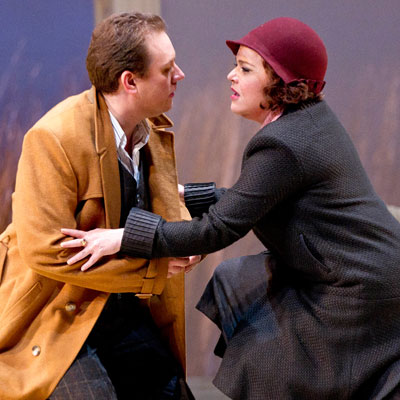 The other week (May 25th, to be exact), I went to the Washington National Opera to see Jules Massenet’s Werther. Having only recently read the Goethe novel upon which it was based, I was a bit excited.
Massenet is not among my favorite composers, by any means, but I enjoy the works of those great French composers who followed him and built upon his work, like Debussy and Saint-Saens.
Overall, the two leads (Werther and Charlotte) were strong singers, but the opera itself, frankly, lacked.
In terms of the production, the 1920s style costume and design, were present, but not used to add anything to the opera, so I’m not quite sure what the point was.
But mainly, when I say the opera lacked, I mean the music and libretto. And mainly, I mean the first half.
The opera ends strongly, with the two singers pouring their hearts out in some truly moving duets. But the first two acts are rambling and have a lot of loose ends. For example, there are two friends, drinking buddies of Charlotte’s father, but heck if I know what their dramatic purpose was. I can’t even remember if they appeared in the second half and if they did, they certainly didn’t have much to do. So why were they there, except to fill up space and time?
Massenet is accounted to be famous for his ability to match music to the conversational pace and cadences of natural conversation, so that the singing comes across as unforced and natural. Which it did. But Werther is about all-consuming, tragic, deeply romantic love and not about the rhythms of life in an idyllic French countryside. So push the musical envelope a bit, eh? Like those two disappearing characters, I don’t really know what the point was to a lot of the early music.
So, some excellent singing, but in a flawed opera.
You can read the Washington Post‘s review here.

 I’m a big fan of minor league baseball.
Right now, I don’t go, because I live within walking distance of the stadium of a major league team, the Washington Nationals.
But in principle, I like minor league and when I have lived near minor league teams, I have gone to see games more frequently than I go now to see the Nats.
This article backed me up on my appreciation for minor league ball.
While working on campaigns in Iowa and Mississippi (legislative and a governor’s race, respectively), I went frequently to see the Des Moines’ triple A Iowa Cubs and Jackson’s single A Braves. The I-Cubs play in a great stadium, on the edge of downtown and right by Iowa’s state capitol. It’s a beautiful park with great views and some quality ball is player there. I have less positive things to say about the Jackson Braves, but paying a few bucks to see some ball means that going to see a game feels like less of an effort. No planning, no worries. Just head out there and see the game if you feel like.
And I grew up Florida, the land of spring training. My hometown of Dunedin has a stadium for the Blue Jays (for both major league spring training and minor league in the regular season). You could walk to it. That’s freaking awesome.
The neighboring town of Clearwater has a much nicer stadium, but it’s in a more suburban environment and feels less like an organic part of the city, but it’s still pretty darn gorgeous and pleasant.
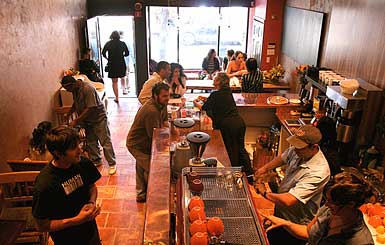 While overall engaged in the classic Washington activity of waiting for a phone call telling us our table at Sticky Rice (featuring the most hipsterific wait staff in the DMV) was ready, we walked down H Street towards the Atlas Theater. On the other side of the street, I saw Sova Espresso & Wine, which served, I had read, some of the best coffee in DC.
Sova is actually two places. One is wine bar (which I have not yet been inside) and the other a small, but classic coffeehouse.
The coffeehouse (or should I call it an ‘espresso bar?’) has only a few seats, but is appropriately cluttered with weeklies and flyers and pamphlets for protest marches and yoga classes. A single man behind the counter carefully assembled each order (which waiting in a for longer than one might normally expect, considering how few people were ahead of me).
I ordered an espresso.
Ordering an espresso is an exercise in unfounded faith. Because, let’s be honest, 99.9% of all espresso are terrible. The harsh flavor of burnt, bitter coffee completely drowns all the possible flavors of the coffee bean.
But this was different.
It was the best espresso ever.
It didn’t taste burnt or bitter. The aromatic oils of the coffee were present and the overall flavor had the notes of full bodied red wine.
I told the barista, “That was the best espresso I have ever had.”
 The other night, I attended a fundraiser for the Center for American Progress, a progressive think tank and strategy clearinghouse at the Corcoran Gallery of Art.
Mostly, it was a crowded room filled with progressive semi-luminaries (Andy Stern, Ruy Texeira, etc), your usual political/policy hacks (no disrespect intended).
But some of the galleries on the first floor were open, containing a beautiful collection of about half American and half European art, mostly from the late eighteenth through the late nineteenth centuries. And that was why I came. In a city filled with free museums, I am resistant to paying for one and the Corcoran is not free, so I naturally finagled myself a couple of tickets so we could go and see what was open to see. We had done the same thing when we went to an inaugural party there in January 2010, though far fewer galleries were open.
My date and I were cornered by two strange men. One man named Bill described his tangential participation in that nastiness in Beirut in 1982 and the other, named Jean-Pierre described how he had begun “treating his glaucoma” at age twelve (I’ll leave you to read between the lines as to his true meaning).
The final reading of the Folger Shakespeare Library‘s 2011-2012 poetry series was Gary Snyder, the great, west coast poet of deep ecology. It took place last night.
He was an engaging reader and speaker when by himself on stage. Not powerfully so, but still significantly so. He has obviously led an interesting life (studying Zen Buddhism in Japan, serving on tramp steamers, reaching the summit of Mount Saint Helen the day that the atomic bomb was dropped on Hiroshima, and his relationship with various poets of the San Francisco Renaissance and the Beat writers).
In the past, I have described him as a Beat, though he was never part of the original group in New York, but only met them when they came out to San Francisco. Now, I would be more likely to relate his poetry with the man who introduced him to the Beats, Kenneth Rexroth, than with the Beats themselves. Like Rexroth, his poetry is more influenced by the restrained aspects of spiritualism, rather than the ecstatic ones.
As befits a poet associated with the deep ecology movement, his writing is very much grounded in the physical and the concrete. The realities of the natural world and the realities of living in the world.
One thing he said struck me. While living in Japan and studying meditation and Buddhism, he often used to visit an English language bookstore and buy books on ecology to read. Then, he pointed out, ecology was about the relationship of things to the natural world – which mainly meant how things ate each other. Only later, did it acquire the quasi-political/spiritual/activist meanings now associated with it. When one speaks of ecology now, one is generally making a statement about politics and society. Then, it was simply a branch of science.
During the Q&A, Snyder was very short with a young man who stood up and asked him to speak about Jack Kerouac’s novel, The Dharma Bums. The main character is generally considered to be based on Snyder and some of the events in the book based on some trips taken together by Snyder and Kerouac.
Snyder dismissed the whole line of thought, basically saying that Kerouac wrote fiction and Dharma Bums is novel. Not even one of Kerouac’s best novels (and Snyder’s tone implied he thought it not a very good novel). Then he said that someone always asks him about this and he’s tired of answering so that’s all he’s going to say. And that was how the Q&A ended.
The novel was clearly a touchstone for the young man – a way to keep a connection to the wilderness and the west coast while living her in DC – and I felt bad for him and for what was almost a public shaming by Snyder.
And let me say that I’m just glad that young men still read Kerouac. Whatever I may think of him as a writer, I think it will be sad day when young people stop indulging in old rebellions and stop reading Salinger, Kerouac, Ginsberg, Burroughs, and others when they are in their teens and twenties.
Whoever that young man was, kudos to him for finding meaning and solace in the turning to books.
There was a sort of reunion of members of the Dark Room Collective on Monday night, put on by the Folger Shakespeare Library but actually held at the church across the street (which has considerably more seating – and the place was still pretty full).
The Dark Room Collective (and I had not been familiar with them before attending this reading) was a sort of group house for African-American artist-activists in Cambridge that (when the house was sold off) evolved into a sort all purpose artistic clearinghouse for writers, painters, sculptors, dancers, and musicians. But always, it appears, poets, poetry, and poetry readings held a central place in its history and the role it saw for itself.
Present this particular were eight poets of, admittedly, varying quality and charisma (none were poor, but several would be considered among the country’s leading poets, so naturally stood out). The poets present were: Tisa Bryant,Thomas Sayers Ellis, Major Jackson, John Keene, Tracy K. Smith, Sharan Strange, Natasha Trethewey, and Kevin Young. Among that group, you might have picked out the names of Smith (who just won the Pulitzer Prize for her collection, Life on Mars), Trethewey (who won a Pulitzer in 2007 for Native Guard), and Young (who wrote The Gray Album, a book which is very du jour right now).
I enjoyed listening to about two thirds of the poetry read, but loved all the descriptions of the early days of the Collective and was intensely jealous of their participation in that history.
I bought one book, of course – Smith’s Life on Mars – and got it signed.

 the coffee philosopher