Poetic Likeness: Modern American Poets


Charles Olson 1910–1970
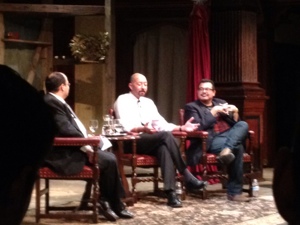
R. B. Kitaj (1932–2007), Color screenprint, 1969

The National Potrait Gallery has a new exhibit – Poetic Likeness: Modern American Poets.

The show’s title is, I hope, self-explanatory. If it is not, I suspect you are just on this blog in the hopes of finding dirty pictures (there aren’t any, so quit looking; the entire rest of the internet exists solely to store pornography, so you’ll live if you encounter a single freaking page without any nudity).

But a nice way to honor great American poets while providing a different way to look them and (hopefully) an opportunity to encounter their work.

Indie Thursday


Apparently (at least, according to someone I don’t know on twitter), it’s Indie Thursday, when we’re all supposed to go shopping at local, independently owned bookstores. I don’t actually have time today, but here are some recommendations of where to go in various locales:

Montgomery, Alabama

Tampa Bay

Los Angeles

Washington, DC & Northern, Virginia

Jackson, Mississippi

Don Giovanni At The Washington National Opera


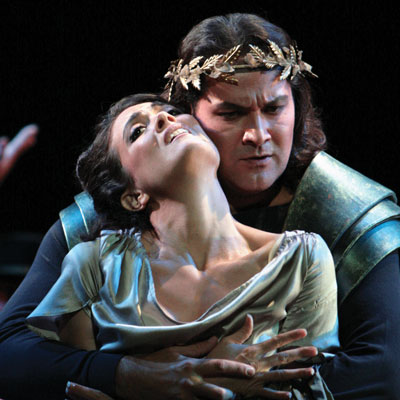
First of all, Ildar Abdrazakov, a bass from Russia, is amazing as Don Giovanni. Not only is his voice very, very strong, his acting was very good and he captured the swaggering, violent charisma of Giovanni, as well as the oddly principled nature of his existence (which allows the character’s final choice to seem organic). He really understood the intersection of the frequently light, almost breezily comic, music with the darker themes thudding just below surface. Don Giovanni is frequently described as the greatest opera ever written and, without diving into that debate, Abdrazakov was great platform for someone looking to make that argument.

Meagan Miller, who sang Donna Ana, had a throat infection, but the only affect was that her voice was always penetrating and was a little reedy during an emotional scene with Don Ottavio early in the first act.

It was a big production, as befits the season’s centerpiece, and a very physical one.

Swordfights and brawls were acted out with the kind of vigor more common to productions of Shakespeare than Mozart and Giovanni was aggressively physical with his libidinous targets; I don’t think I’ve very seen so many breasts so openly manhandled in an opera before.

But it didn’t all work. Donna Elvira was given a corset-style top and often wore pants and always wore a sort of light, flowing coat. It was anything but demure and while it did express her sexuality, it also made her seem too much the sartorial equivalent of Giovanni’s equal. Her bold steps across the stage were too aggressive for the character, at least too much for my taste. I could see that the director was trying for something, but I don’t think it quite came off.

Andrew Foster-Williams as Leporello deserves credit for his acting and for standing toe to toe with Giovanni in so many scenes. I can imagine it being a tough role; it’s not the lead, but shares a lot of physical and vocal space with one of the most powerful roles in opera and he hit the right balance in his portrayal of Don Giovanni’s (mostly) faithful servant.

This Is What A City Should Look Like


Or so says Kaid Benfield…

But I rather agree, but I am also biased.

Definitely read the piece, though. The picture at the top is of the George Mason monument. You are unlikely to find it unless you happened to take the long route around from the Rev. Dr. King memorial to the Jefferson memorial. If I recall, those two books by Mason’s side say “Locke” and “Rousseau.”

The Franciscan monastery pictured has some gorgeous gardens and is one of the best places to sit, stroll, and relax, regardless of one’s sectarian stance. And the monks, being mostly older brothers, retired from having watched over sites in the Holy Land, are pretty laid back (having gone to confession there several times, I appreciate the presence of laid back monks when listing my faults).

Cokie, I’m Afraid I Have To Disagree With You


I was tuned into NPR (WAMU) on the commute this morning, listening to Cokie Roberts talk about what may or may not happen during the lame duck session.

Part of her point was that not just the results of the election, but the narrative, will have a great effect on how the lame duck session (which will be one of the most critical in recent memory) will play out.

If, she argued, Romney loses but the narrative is that Romney just ran a poor campaign and that he was just a fatally flawed candidate and if other things happen (GOP’ers hold the House and take the Senate, for example), nothing will change and the Republicans in Congress will simply continue to obstruct and be of as little use as they possibly can (and they can be of remarkably little use, as we have seen).

However, she continued, if that doesn’t happen, then the Republicans will have to reevaluate their positions and may work more closely with the President to actually accomplish something verging on the proactive in the lame duck.

Cokie, I must respectfully disagree.

The Republicans will continue to do what they’ve been doing (which is basically to sabotage the country and our economy). The only way it will play out differently is if Obama loses, in which case, they will only pass things that will expire a week after Romney is sworn in so that their new Gordon Gekko can start signing extreme right wing legislation with a clean slate, as it were.

And let’s not pretend that the narrative has not been preset. The GOP establishment is already setting the narrative to do just what Roberts described as being something that might happen. There’s no question about it – if Romney loses, the narrative is already in place to make sure that the results are defined as not being a repudiation of real Republican principles (which Romney will be defined as somehow not espousing), but rather as a failure to either hold or articulate those principles, i.e., that those principles would naturally have won out if Romney had really been a believer or if he hadn’t been so bad about explaining them.

Yes, if Romney loses, the narrative that he was a flawed candidate who, mainly because of the flaws, ran a flawed campaign, will actually be more or less true.

But what that will miss is that Romney’s flaws have so far led him into the trap of having to run a campaign of two visions.

The whole point was the Romney wanted to run as a bland, safe, generic ‘not that guy’ against Obama. He did not want to have to articulate anything. It is because this race is being framed as a choice between Democratic and Republican principles that Romney is losing; because this race has become a real choice between that ‘real’ Republican vision and the one being promulgated by President Obama.


P.S. – This post is dedicated to my Aunt Anna, who kindly asked me to write a little less about poetry and a little more about politics. I hope she enjoyed this post and the post immediately preceding it.
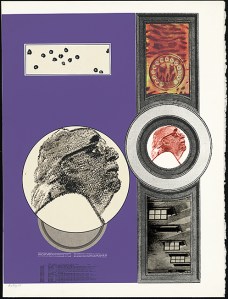
Poets Francisco Aragon, Carl Phillips & Eduardo Corral At The Folger Shakespeare Library


20120919-141913.jpg

Folger Poetry Series Kicks Off


Carl Phillips and Eduardo C. Corral kicked off the 2012-2013 O.B. Hardison Poetry Series at the Folger Shakespeare Library on Monday night. Phillips was the judge for the last Yale Series of Younger Poets and Corral was his chosen winner.

Corral was introduced, both by Phillips and by the program with some beautiful, haunting, and challenging lines from a poem in his debut collection. And it was all down hill from there. His poetry never hit those heights again, which is why I purchased a book by Phillips (I limit myself to buying just one book at these things, no matter how much I want to splurge; discipline, discipline).

Can I admit to being a bit hierachical? I found Corral to insufficiently respectful beside Phillips. Or maybe I found his efforts to portray himself as Phillips’ equal too forced and overdone. Corral may become a great poet. But he just published his first book and the man beside you has been there and done that, as it were.

During the question and answer portion, the last question came from a local poet, Sandra Beasley (well, sort of local; I suspect she doesn’t live in SE). She asked about how first books and publishing had changed.

I rather felt her question was more about the contest culture of getting first publication and perhaps the greater difficulties of the process now (but what the hell do I know? I’m inserting myself into the mind of a stranger; but she spoke like she’d memorized the question and seemed to orate as much as interrogate, which leads me to believe that there was some point in there that I don’t think was addressed). The answer given was actually about ‘project books,’ as both men called them – things like books about just one thing (fleas were mentioned – though Virgil wrote a poem of that title and Phillips did say he liked Virgil; also collections of just sonnets).

Many of Phillips’ poems spoke lovingly and elegically of sexual love and desire, frequently tinged with memories of when sex and love between men was more verboten than it is now. His known for the influence of Greek and Roman literature on his work (though he dismissed that being overemphasized; he also said that, excepting The Iliad, he didn’t much like classical poetry, but preferred to read the great orators, like Cicero and Quintulian) and of the two books available (the other being Double Shadow), I made my selection because Speak Low featured more poems the explicitly referenced the classics.

When I asked Phillips to sign my book, he was extremely personable and reached out to me (I tend to be a pretty basic, ‘here’s my book’ kind of guy when it comes to getting autographs) and spoke for a bit. Certainly, I can see him as very generous teacher in many respects (he does teach university).

Meet Your New Dungeon Master


Well, not yours exactly. Not unless you want me to be. And even then, I’d have to run it by my lady friend and I can’t see her agreeing to it.
But I’m someone’s dungeon master! But not my lady friend’s because, well anyway, what I mean is, that I’m trying to run my own Dungeons & Dragons campaign.

One hundred percent from the ground up. I’m kind of proud. I’ve only done it once and that was semi-successful, but we’re up again next weekend, in our secret space (actually a large meeting room above a bar in Alexandria, just outside of DC). And my three companions have been patient with my learning curve (which has been relatively steep). And they have graciously consented to let me continue on.

I’ve never written fan fiction, but part of me relates the process to what I suspect the process of composing fan fiction to be like. The characters were created by someone else (in my case, by the people you play the game with) and the plotting is driven by many nearly oulipian level restrictions that make for what can be a satisfying game (or fan fiction story), but which is rarely of publication worthy quality – but which can still be (I hope) useful in learning how to plot (especially because one’s fellow gamers and, I suspect, the fan fiction community, can be tough critics of one’s failures).

Maybe later I’ll tell you what it’s all about. But not for a few more sessions…

The King And I


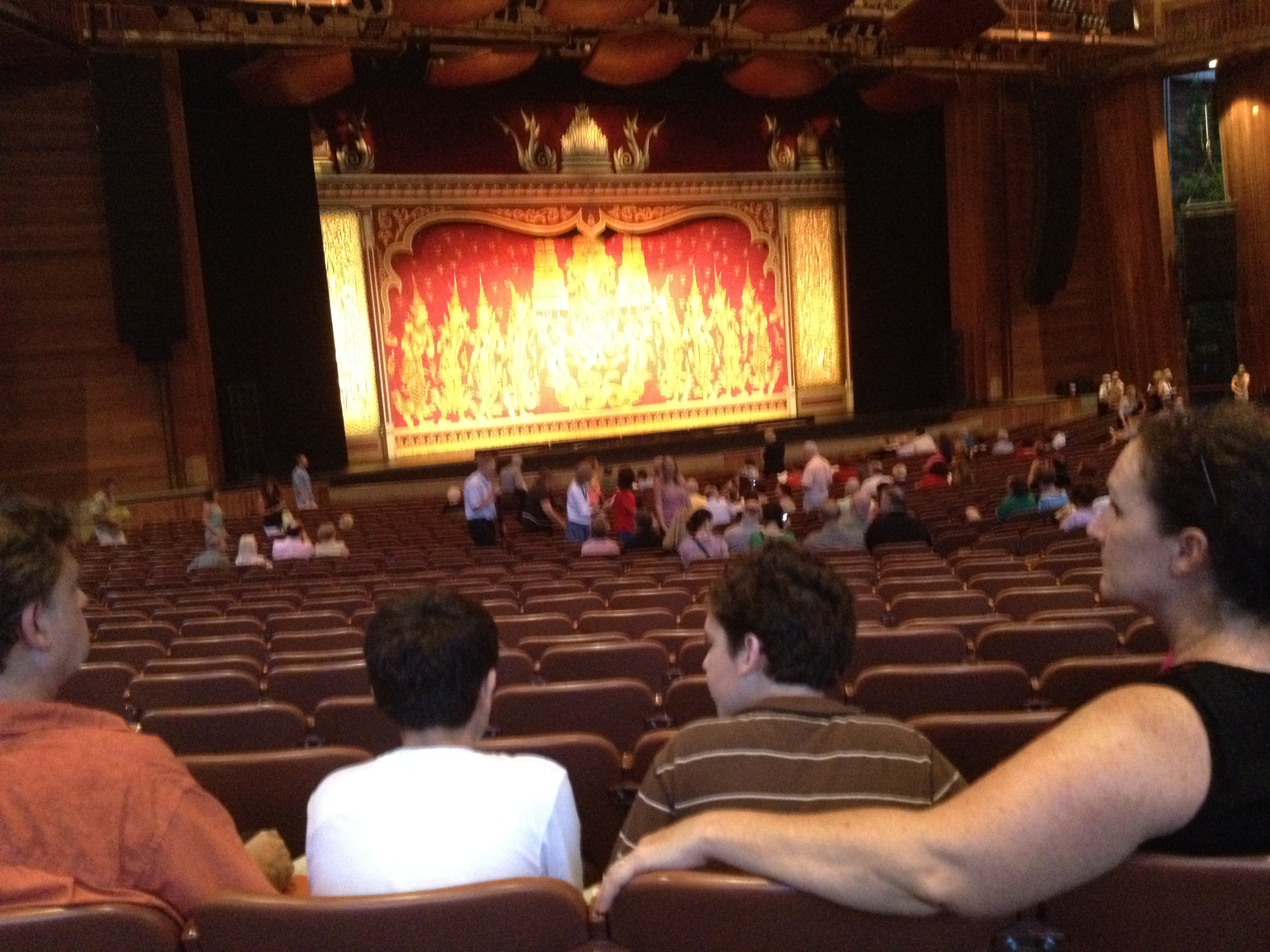
So, we saw The King and I at Wolf Trap on Sunday.

As you may know, I am not a huge fan of musicals (there are a few I like; none of them are Phantom or Les Mis) but live theater is always something worthwhile.

The King had a fine voice and did well with a character that will always risk tipping over into a racist caricature. Unfortunately, Anna did tip for me, with her faux (I assume) British accent being a little grating.

The story was better than I would have suspected. Or rather, the story was more difficult (in a good way) than I would have suspected. The story of the doomed lovers remains, well… doomed. Pat, happy endings are avoided in favor of something triggering more ambivalent emotions. I like that.

What I Hope For Tomorrow Night


Tomorrow night is an important World Cup qualifier against Jamaica, to be played in Kingston, Jamaica. It’s an important game because a win or at least a draw puts us in good shape to not exactly cruise through the rest of this part of qualifying, but at least to have the freedom to try out young players and new strategies in hard fought games and not just meaningless friendlies.

So, I hope for a win.

I also hope to find a good place to watch the damn game in DC because it’s not going to be readily available on television. Any recommendations for which bar to go to? And not the Lucky Bar. That place is too crowded for me.

Mostly, I hope to see Jose Torres justify the coach’s faith in him.

The US Men’s National Team (USMNT) is fast and physical, but sometimes, it’s nice to actually keep possession of the ball for stretches of time. Michael Bradley can do that, sort of, but he’s more of a driving force than someone who can tweak the tempo of a game.

Torres is supposed to be that guy. The problem is, his role isn’t immediately obvious. He’s not a defensive midfielder – he’s not particularly strong in the tackle and doesn’t have that sixth sense for putting himself into opposition passing lanes. He also isn’t a trequartista, that final, killer pass or ghosting into the box to score the odd goal or providing a shooting threat from medium distance.

But even Klinsmann, who is more forward thinking that either of his two USMNT coaching predecessors, keeps trying to shoehorn him into the wrong role.

He’s been played on the wing, where he lacks the speed to be effective or the eye for the cross. Most recently, he was played at the top of a 4-4-2 diamond (or as the ‘1’ in a 4-3-1-2, whichever nomenclature you prefer), which isn’t his spot either because he likes to drop deeper, which leaves the forwards isolated.

The closest thing to Torres is Luka Modric (or at least the Luka Modric of the last several seasons at Spurs) and Xavi (the Xavi of Barcelona; the role he plays on the Spanish national team is a little higher up the field, closer to the forward) – which is not to say he’s remotely close to their quality. They don’t score many goals (not usually anyway; Xavi actually racked up some good scoring numbers last year) and they don’t even get many direct assists. What they do it keep possession and keep things carefully ticking.

Modric’s play especially is illuminating, playing next to a more purely defensive central midfielder, giving him freedom to sit near the center circle and play smart balls out to the wingers. Torres can do that.

On another note, I’d also like to see Freddy Adu given more chances. He is actually better for the roles that Klinsmann keeps shoehorning Torres into. He can keep possession (though he doesn’t set the tempo so well) in either a trequartista or winger role – playing the winger as more of a playmaking winger (think Sebastian Larsson or David Beckham a dozen years ago) who doesn’t burn you with speed, but with calmness and vision and a sense of when to play the ball into the strikers and when to keep it for an extra two seconds.